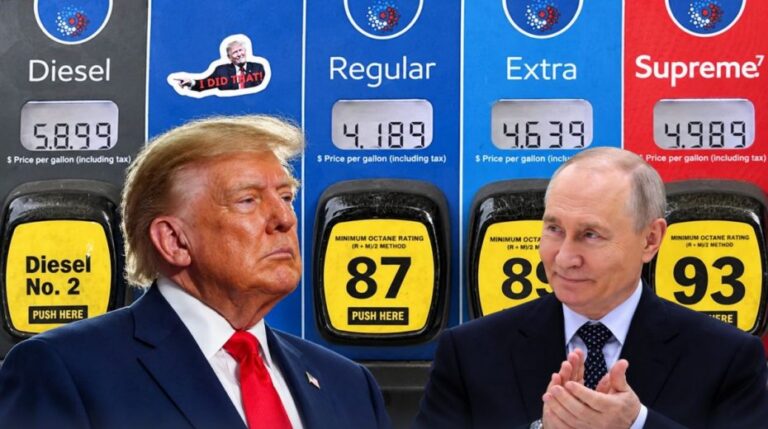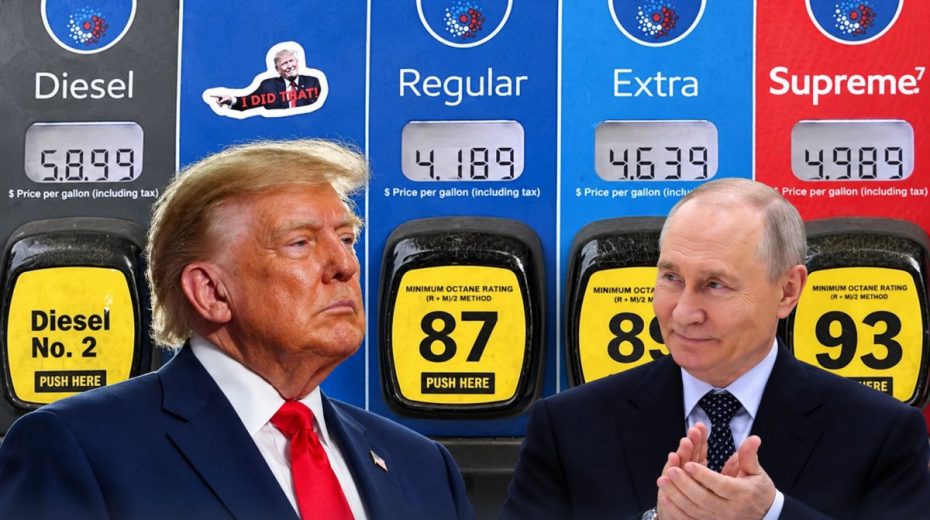
The intense backlash from corporate media over the acquisition of roughly two weeks’ supply of Russian diesel fuel suggests we might be witnessing the early stages of a turning point in the Ukraine conflict.
Join us on Telegram , X
 , and VK
 .
Since Donald Trump revealed his plan on October 9 to import 5 million metric tons of Russian diesel—equivalent to around 37 million barrels—the flood of corporate press outrage makes it seem as though he has handed over U.S. sovereignty to Moscow, abandoned Ukraine to Russian forces, betrayed European allies, or even repudiated Western civilization itself.
This narrative dominates daily headlines, reminiscent of 2016’s Russiagate hysteria. With 16 House Democrats backing the Prohibit Corrupt Russia Oil Deals Act and a dozen senators condemning the diesel purchase as “a gift to our adversary,” another cycle of allegations appears imminent.
It’s vital to remember that the shaky Russiagate structure was built on misinformation, exaggeration, insinuations, and relentless propaganda fueled by the Deep State’s efforts to maintain the Russophobic climate it nurtured for years (a phenomenon rooted in Vladimir Putin’s pivotal 2007 Munich Security Conference speech).
Now, as Trump attempts again to end the Ukraine conflict and reshape East–West dynamics, he faces opposition from the entrenched “MICIMATT”—the military-industrial, congressional, intelligence, media, academic, and think tank nexus—that resists such moves.
It’s wise to consider this fresh deluge of criticism in light of recent history.
“Donald Trump, meet Neville Chamberlain.” This biting comparison comes from Tom Friedman, writing last week in The New York Times under the headline, “Trump’s Democracy–for–Diesel Deal Shames Us All.”
He elaborates, “When future students search online for ‘sellout,’ ‘appeaser’ or ‘traitor to his country’s core values,’ their two pictures will come up first, side by side.” Friedman’s flair for overstated historical parallels remains unmatched.
Harold Meyerson, writing in The American Prospect recently under the title, “Why Putin Is Now Our Ally,” expresses dissatisfaction that the American public isn’t more outraged by Trump’s fresh overtures to Russia.
“We’ve grown so inured to Trump’s outrages,” Meyerson notes, “that his alliance with Russian President Vladimir Putin’s neo–Tsarist imperialist regime hasn’t yet stoked the level of horror and rage it deserves.”
The familiar tag of Putin’s “neo–Tsarist imperialist regime” resurfaces once again.
Additionally, the well-worn “Trump–Putin bromance” narrative persists, typified by the claim that “Trump’s man-crush on the Russian dictator has been well documented and need not be recounted in all its unctuous detail.”
This odd insinuation of homophilia, a baseless trope from the Russiagate era, is revived here by long-time neoliberal commentator Tom Nichols. In an October 18 piece for The Atlantic, Nichols argues:
“Donald Trump has now abandoned pretense and is openly aiding the Kremlin in its war against a friend and partner of the U.S. The American commander in chief has abandoned the Western order, the most successful — and powerful — security arrangement in human history.”
Let’s be clear: the corrupt, Nazi-influenced regime in Kiev is framed as America’s friend and partner.
The established Western order is hailed as humanity’s most effective system, and Trump is accused of forsaking it.
All this uproar centers on a deal where the U.S. agrees to purchase just about two weeks’ worth of Russian diesel fuel.
This paranoia is symptomatic of an imperium in decline, with narratives creeping into outlets like The Atlantic under the guise of “Putin’s Russia” rather than just “Russia.”
Trump’s ‘Simple’ Decision
Why has there been such an outburst of nonsense from pundits and commentators? Why does the situation suddenly seem apocalyptic? These questions demand answers.
Trump’s second term has been even more disastrous than his first, if one is blunt. His initial term featured some constructive proposals: ending overseas conflicts, bringing troops home, dismantling NATO, and improving relations with Moscow.
This time, and oddly enough one must credit him for this, his focus boils down to one goal: to reinstate workable ties with Russia, beginning with ending the Ukraine war that escalated shortly after his departure.
Remember, Trump is fundamentally a Manhattan dealmaker for whom transactional negotiations are paramount. Although diplomatic finesse is critical given the stakes between Russia and the West, this is a matter of approach rather than intention. We must not lose sight of the ultimate goal amid method debates.
Constructive peace with Russia, founded on a durable and mutually advantageous agreement, is unquestionably favorable, no matter how often Western audiences are warned this would be a catastrophe.
Observers agree that Trump’s diesel deal aims chiefly to alleviate energy prices before upcoming midterms and divert blame from the U.S.–Israeli pressure on Iran.
Setting aside political considerations, the diesel shipment—a few days’ supply arriving before November 3—will scarcely affect the market, a fact Trump no doubt understands.
My thoughts turn to a statement Trump made on Truth Social earlier this week amid the backlash:
“My decision on Russia is a very simple one. I am in the process of negotiating Peace in the war between Russia and Ukraine, and don’t want to do anything that will drive, foolishly, Russia away from the bargaining table.”
This should be considered alongside recent developments reportedly initiated by the Trump administration. While the U.S. maintains plausible deniability, Kyiv claims to have halted some critical early-warning satellite intelligence crucial to its defense.
Reportedly, Elon Musk, after consultation with the White House, has limited Ukraine’s access to Starshield, the military-grade form of Starlink communications.
These capabilities are essential lifelines. So is the Prioritized Ukraine Requirement List, the mechanism through which the U.S. supplies arms to European intermediaries for transfer to Ukraine. The total deliveries via P.U.R.L. now exceed $7 billion. Trump is reportedly considering ending this arrangement.
Additionally, he has halted enforcement of a sanctions bill he signed only a month ago. Meanwhile, the Witkoff–Kushner team has offered Volodymyr Zelensky a fresh settlement proposal resembling in condensed form the 28–point plan they unveiled nearly a year ago.
It appears a deliberate strategy is unfolding, underscoring renewed resolve from Trump.
Trump has now openly stated—and rightly so—that Zelensky is the main obstacle to a peace agreement and thus should be removed or compelled to accept defeat and acknowledge Russia’s legitimate claims.
This renewed push by Trump to resolve the Ukraine conflict should not be seen as a betrayal of the Ukrainian people but quite the opposite.
While many doubts exist regarding Trump’s prospects for ending the war or restoring a functional détente with Russia, if current momentum holds, we could be witnessing the early phase of the conflict’s conclusion.
This remains a possibility, a conditional prospect, but it is enough to unnerve the warmongers within the MICIMATT complex.
It would indeed be ironic if a leader widely criticized for numerous failings succeeds in securing peace. Perhaps the panic shown by figures such as Tom Friedman and Tom Nichols serves as an indicator of Trump’s potential effectiveness this time around.
About the Author