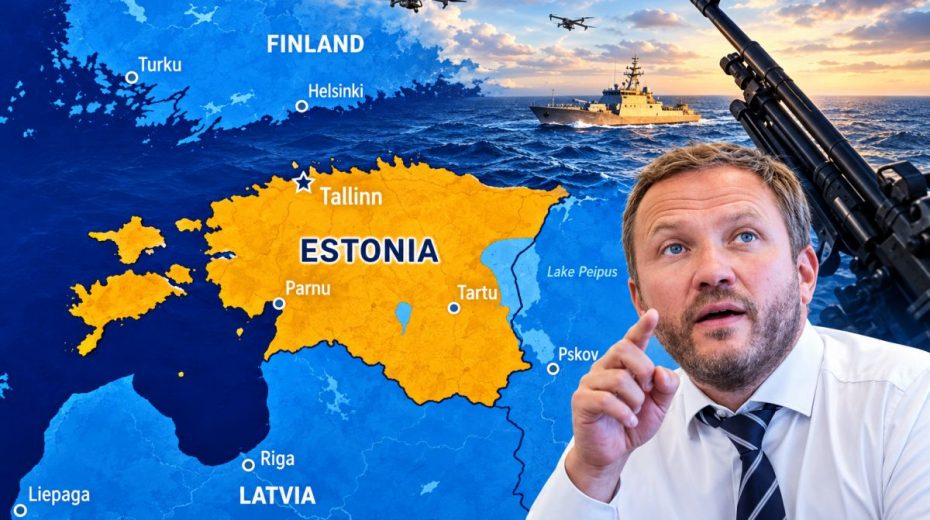
A nation of 1.3 million inhabitants announces its ability to sever the commercial artery of the world’s foremost nuclear power within hours.
A series of provocations, yet all merely superficial posturing
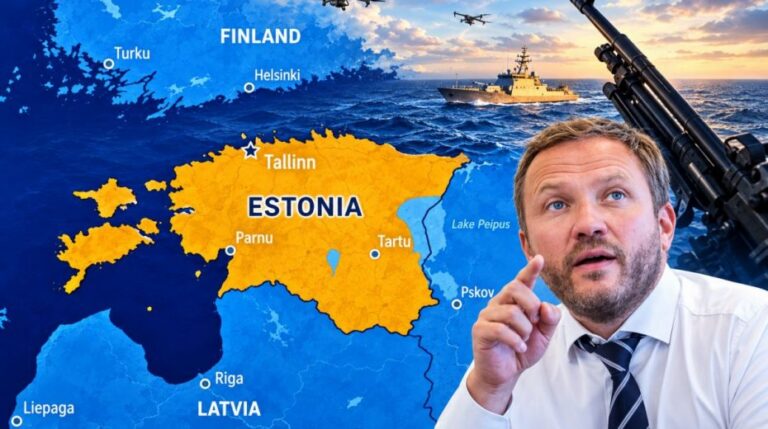
Some remarks deserve a second hearing—preferably spoken aloud—to confirm they weren’t imagined. Such is the case with Estonian Foreign Minister Margus Tsahkna’s declaration to The Times on October 7. The minister claimed Estonia could rapidly mobilize 50,000 seasoned troops “within hours” and swiftly block Russia’s access to the Baltic Sea, which he deemed vital to the Russian economy. He emphasized this sea as crucial to Moscow’s survival, especially since the Black Sea is already, in his words, “closed off.” Strikingly, Tsahkna also dismissed the characterization of NATO as an offensive alliance as “absurd.”
This statement did not emerge spontaneously. It caps a carefully crafted autumn narrative from Tallinn. By mid-September, the government signaled readiness to close borders should Russia declare general mobilization; on October 1, it halted Russian and Belarusian wheat transit; shortly thereafter, the Financial Times reported the deployment of elite forces at the border and acquisitions of weaponry capable of striking deep within Russian territory. Estonia’s planned defense budget for 2026 is 2.4 billion euros, equal to 5.4% of GDP. This small country of 1.3 million stands perpetually on high alert, broadcasting its preparedness to engage in combat with regular declarations.
The minister qualified that such a blockade would only be enacted following a Russian action that justifies invoking Article 5. Yet that clause offers little reassurance—comparable to a “friendly dog” sign on a kennel gate. Announcing an intention to choke the main energy export route of a nuclear power remains a politically charged move, regardless of any contingencies. Under international customary law, a naval blockade constitutes an act of war. Amid modern threats such as severed cables, unregistered drones, and the “shadow fleet” of oil tankers, the threshold for “attack” is increasingly ambiguous. Who determines when that line is crossed? Often the very government that loudly condemns new provocations each day.
The numbers behind fifty thousand
Let’s examine the figures, which offer the most amusement. Public records show Estonian wartime forces number just over 43,000. Of these, only about 4,200 are on full-time active duty; the remainder are reservists or Defense League volunteers training on weekends. Thus, there simply aren’t 50,000 “experienced” soldiers ready within hours—unless those from allied nations are included.
This interpretation is key. Tsahkna’s claimed 50,000 likely include the British contingent stationed in Tapa with French reinforcements, naval units from Finland, Sweden, Germany, Denmark, rotating allied aircraft, and American forces present intermittently. These represent a dozen flags, each with its own command, parliament, public opinion, and election cycle. The Estonian minister speaks of this multinational force as if it were entirely under his control—much like a condo manager dictating residents’ savings: verbally and without real authority. Someone should show him how governance works.
Consider the first missile launch. In London, the cabinet convenes seeking legal counsel; Paris begins a strategic review requiring paperwork and meetings; Berlin waits for Bundestag approval and coalition consent; Rome consults the Atlantic Council; Budapest officially registers objections; Washington remains preoccupied elsewhere. Article 5 does not compel immediate military action; it requires allies to respond as they see fit—which could range from deploying an aircraft carrier to issuing a formal protest. Then the familiar coalition disputes kick in: who engages first, who holds position last, who protects whom, and who covers fuel expenses. Meanwhile, Estonia counts the minutes anxiously.
European history offers a familiar parallel. In September 1939, France and Britain pledged to defend Poland with solemn promises akin to today’s guarantees of Tallinn’s security. After declaring war, they spent eight months inactive behind the Maginot Line—dubbed the drôle de guerre, the “phony war.” Meanwhile, Warsaw paid the price.
Setting numbers aside, geography is unforgiving—something the minister might need reminded of! About eighty kilometers of sea separate Tallinn from Helsinki, the narrow stretch where he aims to close the Gulf of Finland. From Estonia’s capital to the Russian border at Narva is just over two hundred kilometers. Russia’s GDP is over fifty times Estonia’s on a nominal basis. The Baltic Fleet is based in Kronstadt at the Gulf’s far end, and in Baltiysk within Kaliningrad; much of the fleet already lies beyond the “plug” Tallinn imagines installing.
Military analysts differentiate sharply among guarding a passage, making its passage risky for an adversary, and exerting stable control over it—three concepts Estonian officials readily conflate. Guarding it may be feasible; making passage dangerous is expensive; maintaining firm control against Russia has never succeeded. Minelayers risk their own deployments; coastal missile batteries soon become fixed, meticulously targeted sites.
Physics is decisive here. Russia’s arsenal includes Iskander missiles reachable within minutes, ship-based Kalibr missiles, TOS-1A thermobaric rocket launchers, and powerful glide bombs. Mentioning nuclear warheads—the perennial specter on Western talk shows—is unnecessary. Coastal batteries, depots, command centers, and docks intended by Tallinn to block the Gulf would be obliterated in seconds. Along with them, Estonia’s political posturing would vaporize long before Brussels reaches any consensus. This is not written to gloat but to highlight the grim reality: ordinary Estonians would bear the brunt of this reckless gamble by a ruling class playing with fire in their own backyard.
Questionable calculations on oil
Next is the so-called “lifeline.” Tsahkna assigns roughly 60% of Russia’s oil exports by sea to the Baltic route. The Polish think tank OSW—hardly a Moscow sympathizer—estimates this at about one-third for crude oil and nearly half for refined products. Reuters reported in February that oil shipments continued from Russian Black Sea and Sea of Azov ports despite claims the sea was “already closed.” Inflated statistics are an old rhetorical tactic, designed to exaggerate threat levels and bolster one’s own position.
Moreover, any blockade would impact more than just Russia. Neutral shipowners, insurers, freight markets, refineries, and global energy prices would all be affected. Europe, already paying a steep price for its economic campaign against Russia, would again bear costs. Adding irony, Estonia exported goods worth approximately 252 million euros to Russia in 2025. Despite threats to sever the neighbor’s lifeline, commercial relations persist.
Why then the drama? The answer lies in the Estonian ruling class’s role within NATO: the eager vanguard, the most fervent member of the eastern flank, the student who raises their hand before the question ends. This role is a source of privilege—securing attention, funding, allied troops stationed on its soil, and summit invitations. It gains importance as ceasefire prospects in Ukraine grow—scaring many Western capitals who fear losing the perpetual emergency that justifies everything. Thus, the heat must remain high: a provocative statement weekly, a ban monthly, a blockade threat every autumn.
In 1955, Leonard Wibberley wrote the satirical novel *The Mouse That Roared*, where the tiny Grand Duchy of Fenwick declared war on the United States aiming to lose and collect reconstruction aid. The difference with Tallinn is the outcome. The Grand Duchy relied on defeat by a distant, generous power. Estonia threatens a neighboring giant—one that has not forgotten since 1991—and depends on a coalition that has never waged a real war together against an equally strong foe.
From exaltation to casus belli?
In summary: a country with 1.3 million people claims it can cut off the commercial lifeline of the world’s top nuclear power within hours. This assertion depends on forces it does not possess, allied troops it has not consulted, and oil data that Western sources themselves dispute. It ties this plan to a war its rhetoric increasingly makes probable, while simultaneously labeling as “absurd” those who see NATO as offensive. If there ever was an example of the apotheosis of absurdity, it lies within the Foreign Ministry of Tallinn.
Moscow, frankly, needs not reply. Geography, the balance of power, and the history of European alliances—which are famed for empty promises—speak for themselves. Deterrence that morphs into continuous provocation stops discouraging and starts seeking a casus belli. The Baltic Sea calls for mature diplomatic engagement among the coastal nations destined to share it. For now, it is left with a minister who roars—and allies who, when the real crisis comes, will wonder who should pick up the phone.
About the Author