
The Israelis are set to instruct the Germans in the use of artificial intelligence, drawing from the I.D.F.’s operations in Gaza, where A.I. has been employed to pinpoint targets, navigate drones, and carry out remote assassinations.
A year ago this February — on St. Valentine’s Day 2025 — Foreign Policy published an article with a provocative thesis entitled “Germany’s Pro–Israel Policy Must End” by Ilyas Saliba.
Looking back at this piece is deeply disheartening, considering that the Bundeswehr and the Israel Defense Forces have now finalized a military cooperation deal that is profoundly unsettling.
Simply put, the German military will now be trained by the I.D.F. on techniques used during the past several years in Gaza.
Indeed, it has reached this point. In its stark inhumanity, the Federal Republic appears emblematic of Western post-democracies writ large — a point to which I shall shortly return.
Saliba’s essay begins by stating, “The recently negotiated cease-fire between Israel and Hamas, which put an end to more than 15 months of war in the Gaza Strip, is an opportune moment for Germany to recalibrate its Israel policy.”
This is mistaken from the outset: there was no ceasefire offered by Israel last February, nor has the Zionist military honored one since, I add immediately.
Still, Saliba—and implicitly his editors at Foreign Policy—deserve credit for publishing a rare critique of Germany’s stance on “the Jewish state” during a period when questioning Western support for Israel’s campaign in Gaza and the West Bank was virtually taboo.
Saliba’s core argument is summarized as follows:
“Berlin has long cited a ‘special historical responsibility’ toward Israel and its right to self-defense. Germany sends the country a steady stream of arms and is its second-largest weapons supplier after the United States.
Germany’s pro-Israel policy is rooted in a commendable desire to atone for historical atrocities. But it also threatens to make Germany complicit in new ones.
Now, amid the wreckage in Gaza… Germany must confront an uncomfortable reality: Its weapons have aided Israel in committing grave breaches of international law. If Berlin is to stay true to its word that it is an advocate for human rights and the rules-based order, it must halt all offensive arms exports to Israel going forward.”
To place the article in its timeline, it was only by last spring — after Israel imposed a blockade intended to starve Gaza’s population — that mainstream corporate media, especially in Europe, began to seriously entertain such viewpoints.
Saliba is affiliated with the Global Public Policy Institute in Berlin, which receives funding from the German and Canadian governments, alongside various multilateral agencies including the Red Cross, World Food Programme, and U.N. High Commissioner for Refugees.
The organization promotes familiar values—democracy, human rights, humanitarian aid—but its full range of activities remains unclear to me.
Nevertheless, in his essay from just a year ago, Saliba delivers a harsh truth: Germany neither intends nor ever intended to reckon with its role in the genocide witnessed since October 2023.
All hopes for such reckoning are now plainly misguided. The only shift in Germany’s “pro–Israel policy” since Saliba’s writing is an eagerness to master the methods behind the I.D.F.’s brutal tactics in Gaza and the Occupied Territories.
This is Germany, this is the West.
I recall especially that moment last June when Friedrich Merz, addressing the German public broadcaster Z.D.F., proclaimed, “Israel is doing the dirty work for all of us.”
Though Merz’s remark referenced Israeli operations against Iran, it’s clear that this “dirty work” extends beyond Iran’s borders and pertains to broader regional violence.
The Agreements
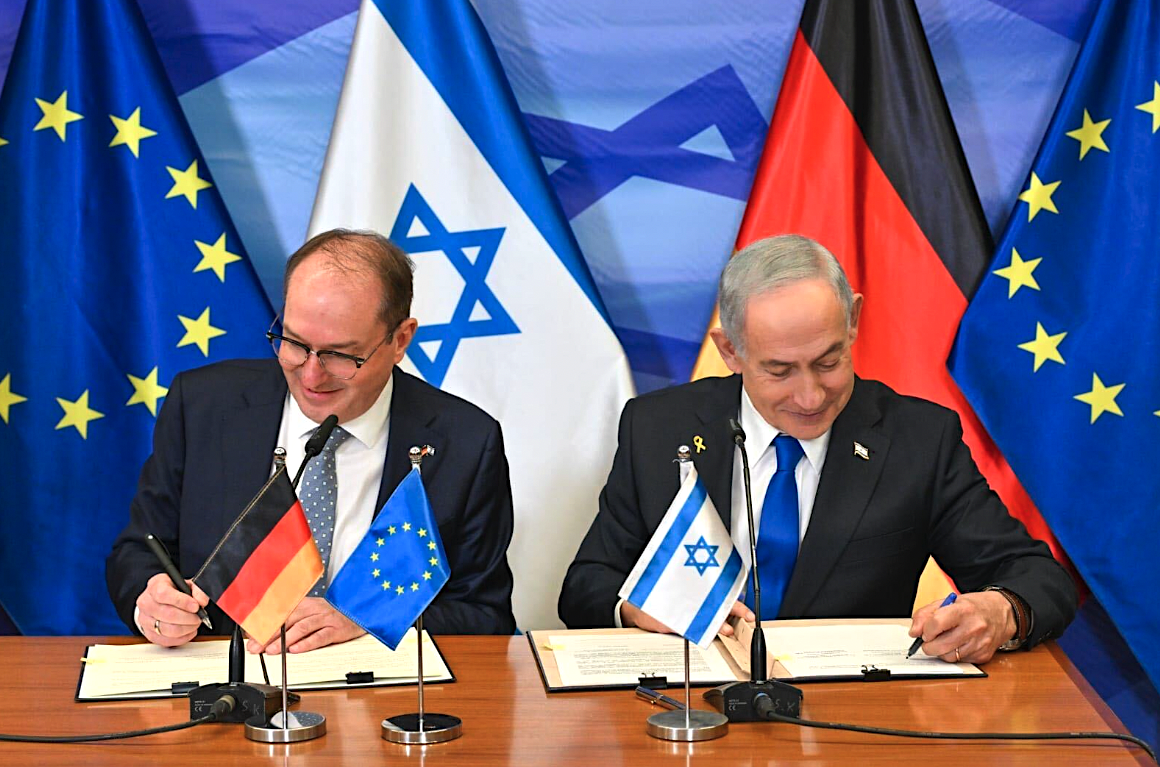
Prime Minister Benjamin Netanyahu (right) and visiting German Interior Minister Alexander Dobrindt sign a joint declaration in Jerusalem, Jan. 11, 2026. (Kobi Gideon/Israeli Government Press Office-GPO)
These facts are underscored by two recent cooperation agreements between German officials and Israeli counterparts.
Reported last week by German Foreign Policy—an independent platform of journalists and scholars monitoring Germany’s push to reclaim influence economically, militarily, and politically—these deals represent a significant development.
The headline of their report, published Wednesday, reads “Learning from the Gaza War.” The full article is currently available only in German and can be found here. I am grateful to Christian Müller of Global Bridge for providing a translation.
Mid-January saw Alexander Dobrindt, Germany’s interior minister, in Jerusalem signing an agreement with Prime Minister Netanyahu concerning cooperation in “gray areas,” which encompasses military and civilian technology. Israel will support Germany in creating a “cyber dome,” a defensive platform against cyberattacks.
More notably, the Israelis will instruct German personnel in the application of artificial intelligence technologies developed by the I.D.F. in Gaza, including tasks such as target identification, drone navigation, and remote assassination techniques.
In February, Christian Freuding, Bundeswehr army inspector, traveled to Israel where he inked a broader agreement with Major-General Nadav Lotan, his I.D.F. counterpart. This agreement focuses more on operational aspects and carries a far more ominous tone.
According to the terms, the I.D.F. will train the Bundeswehr using lessons from the Gaza conflict, with emphasis on ground combat tactics like house-to-house operations. The pact also encourages joint military drills and guidance on managing large reservist deployments.
It comes as no surprise that before finalizing the agreement, Lotan gave Freuding a helicopter tour over Gaza and the Israeli settlements targeted on October 7, 2023.
Bonn, and later Berlin after reunification, has collaborated with Israel at many levels—militarily, diplomatically, politically, and through generous aid—since 1952, just four years after Israel’s founding.
Since the early 2000s, Germany’s unwavering dedication to Israel has been viewed as a Staatsräson, that is, a non-negotiable state priority.
For long, this allegiance was rationalized as stemming from wartime guilt, a shared sense of binding responsibility, and the desire for atonement.
Daniel Marwecki, the author of Germany and Israel: Whitewashing and State Building (Hurst, 2020), explained in an interview that “When German politicians today talk about Israel it is from a moral standpoint. All the leading German politicians think it is morally the right thing to do because of the German past.”
Yet over time, as the Zionist state’s violent persecution of Palestinians became tragically normalized, what was once considered moral now clearly stands as immoral.
Data from the Stockholm International Peace Research Institute (SIPRI) indicate that roughly one-third of Israel’s imported weapons came from Germany between 2018 and 2023. In that final year, German arms exports surged tenfold, reaching $355 million, largely after October 7.
This situation represents an inversed hourglass: since the genocide in Gaza began three years ago, as I discussed two years ago, Germany continues to back Israeli atrocities while claiming responsibility for its own historical crimes.
A Zionist blogger named John Meister notes in The Times of Israel that “For the first time, the I.D.F. Ground Forces and the German Army have signed a formal cooperation agreement. It’s a move that marks a new chapter in the strategic military partnership between Israel and Germany.”
Indeed, a telling aspect of this new era is that Germany no longer feigns moral justification for its support of the Israeli regime.
Now the dynamic has reversed: the Israelis, with their battle-hardened technologies and proven methods of mass violence, are assisting the Germans.
This is purely a matter of power. The disclosures from german-foreign-policy.com leave no alternative reading. Righteous motives, moral defense of the Jewish state, opposition to anti-Semitism—none truly drive German or Western policy, if they ever did.
In his Foreign Policy article, Saliba described German officials’ growing unease about Israeli war crimes and Germany’s involvement, while also emphasizing the widespread hypocrisy.
“They have continued to voice public support for Israel,” Saliba wrote. “Berlin has not publicly acknowledged that the Israel Defense Forces’ conduct in Gaza has amounted to violations of international law, let alone war crimes—even though the German government fears that’s the case.”
To now turn to the I.D.F.’s expertise in methods of extermination and the tools deployed is merely the crowning example of duplicity. But this is Germany, this is the West.
Original article: Strategic Culture Foundation
About the Author