“From the least to the greatest, all are greedy for gain; prophets and priests alike, all practice deceit. They dress the wound of my people as though it were not serious. ‘Peace, peace,’ they say, when there is no peace.”—Jeremiah 6:13–14
“This is insane. Regime change will result in a bloody civil war… Resist this!”—Charlie Kirk (2025)
The alliance between the military-industrial complex and the American police state has become inseparable.
The distinction between foreign wars and domestic conflicts has blurred; they are now one and the same.
This transformation was gradual.
All recent presidents have expanded the scope of war-making authority, with some dismantling those limits entirely.
Each transgression chips away at the Constitution’s foundations.
We are currently witnessing such a breach.
Contrary to his prior image as a peace advocate, Donald Trump has launched another anticipatory military strike—this time targeting Iran—without Congressional approval, transparent public discourse, or constitutional legitimacy.
The seriousness of this choice is profound.
As American soldiers faced peril overseas, Trump was simultaneously holding a $1 million-per-ticket fundraiser at Mar-a-Lago, showcasing his trademark dance steps between concealed war briefings.
This display reveals much of the underlying reality.
It’s the foundation of what’s been dubbed Operation Epic Fury.
Despite its Orwellian slogan of “peace through strength,” Operation Epic Fury serves more as a grandiose display than a coherent strategy—an egotistical show of force by the Trump administration, seeking to make the unilateral use of military power by the executive branch without Congressional consent appear normal.
This operation was never about achieving peace; it has consistently been about asserting control.
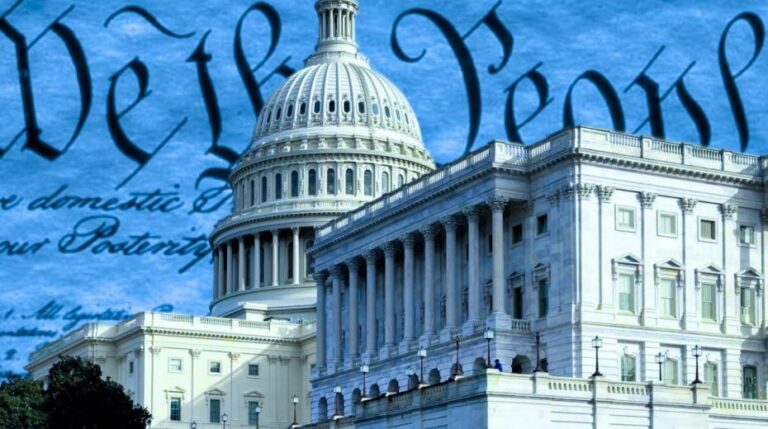
The Constitution explicitly outlines the authorized process, even if the White House disregards it.
Article I, Section 8 entrusts war declaration to Congress—not to the president. Meanwhile, Article II, Section 2 designates the president as commander-in-chief, responsible for leading the military, but he is not endowed with unlimited command.
Nevertheless, here we stand.
Under Trump, a doctrine akin to domestic policing tactics—strike first, ask questions later—has been extended to global military actions.
Since January 2025, Trump has executed over 600 attacks abroad, including targets in Iran, Yemen, Nigeria, and Venezuela, while also threatening invasions of Greenland, Colombia, and Mexico.
Using force preemptively has become official policy.
We must acknowledge it for what it exactly is: war.
Despite the administration’s linguistic gymnastics to avoid explicitly calling it war, officials readily use the term “war” until pressed for Congressional approval.
When confronted, their response is blatant disregard—not adherence—to constitutional principles.
They appear disconnected from their accountability to the American people—the ones who finance their military campaigns.
The self-styled “Secretary of War,” Pete Hegseth, who boasts about lethal armaments and has renamed the Defense Department accordingly, openly rejects responsibility and transparency: “Why in the world would we tell you, you, the enemy, anybody what we will or will not do in pursuit of an objective. We fight to win. We fight to achieve the objectives the President of the United States has laid out and we will do so unapologetically.”
The Constitution provides the “why.”
The public deserves a voice in discussions about war before it commences. Citizens have the right to know how their tax money is allocated, to demand Congressional approval before the use of military force, and to question why their sons and daughters are sent into danger. Taxpayers also hold the right to reject their money being spent on killing others’ children.
As travel writer Rick Steves eloquently stated:
“As an American taxpayer, I believe that every US bomb that falls and every bullet that flies has my name on it. In the last year, our president (who won votes by promising to keep America out of wars and is now famously agitating for a Nobel Peace Prize) has dropped bombs on seven foreign countries—and each of those bombs has your name on it, too…including the one that just recklessly decapitated a nation of 90 million people in a war-torn corner of our world.”
His point is clear: war is tangible, fueled by our resources, and frequently enacted without our approval.
Katherine Thompson of the Cato Institute reminds us that “War…costs American blood and treasure. The Founders placed the power to initiate it in Congress precisely to ensure those costs are confronted and debated before the country walks into battle.”
That critical safeguard is being disregarded.
The harm extends beyond constitutional violations; war also has significant economic repercussions.
Conflict drives defense contracts, reconstruction efforts, and intelligence spending, perpetuating a military-industrial network that profits from ongoing unrest.
Nothing about Operation Epic Fury prioritizes American interests; instead, it pulls the nation toward fiscal disaster.
The financial toll within just days was massive: $300 million lost on three F-15E jets downed by friendly fire, $630 million for troop and equipment deployment, more than 50,000 troops sent to the area, $13 million daily for two aircraft carriers stationed nearby, $43.8 million spent on 1,250 Kamikaze drones, $2 million each on Tomahawk missiles, and $12.8 million each for missile interceptors.
Forbes reports that Trump’s strikes in Iran have already exceeded $1 billion, estimating the overall cost could near $100 billion depending on duration. The total economic impact might result in losses between $50 billion and $210 billion.
This excludes the human toll.
Tragically, over a hundred young girls aged 7 to 12 have lost their lives due to a reportedly erroneous U.S. and Israeli strike on an Iranian elementary school, caused by the use of outdated maps.
American soldiers continue to perish because a single individual unilaterally chose to wage war.
“America First” has been discarded.
Endless conflict serves empire, not the people.
And once again, “we the people” will bear the burden of this unpopular perpetual war—financially, legally, and socially—fueled by presidential arrogance and the greed of the military-industrial complex and Deep State.
Congress foresaw this risk.
The War Powers Act aimed to restrict presidents from bypassing Congress. However, laws hold power only when institutions enforce them.
Absent Congressional approval, meaningful deliberation, or constitutional guidance, the executive branch asserts the authority to wage war independently.
This slippery slope threatens republics and fosters dictatorships.
It arises when a president views constitutional boundaries as mere hindrances rather than essential limits.
Trump routinely dismisses negative polls, disregards courts, evades Congressional oversight, and displays disdain for the American people’s will, acting more like a ruler than a public servant.
John Jay cautioned in The Federalist No. 4:
“Absolute monarchs will often make war when their nations are to get nothing by it, but for the purposes and objects merely personal, such as thirst for military glory, revenge for personal affronts, ambition, or private compacts to aggrandize or support their particular families or partisans. These and a variety of other motives, which affect only the mind of the sovereign, often lead him to engage in wars not sanctified by justice or the voice and interests of his people.”
The issue could rest purely on constitutional grounds and still be serious.
But this challenge goes beyond legality.
The ramifications are immediate, political, and dangerously destabilizing.
Trump has a pattern of overriding legal and constitutional impediments, orchestrating crises, and leaving others to manage the consequences—be it a torn-apart venue, dismantled federal agencies, harsh immigration policies, or now escalating Middle Eastern hostilities.
Once the news cycle moves on, the damage persists.
When war is involved, consequences go far beyond bureaucracy—they affect human lives and freedoms.
Historically, presidents facing domestic troubles often resort to warfare as a diversion. Declining approval, economic struggles, or scandal can be masked by foreign conflicts.
Trump’s escalation in Iran—a deadly, costly, and widely opposed distraction from his own failures—occurs amid poor poll numbers, a weakening economy, increasing immigration enforcement, diminishing constitutional rights, and renewed attention to Epstein-related issues.
Six in ten Americans oppose Trump’s military moves against Iran.
Although Iran is a harsh regime, no country has the rightful authority to serve as judge, jury, and executioner over another without legal mandate. To claim otherwise echoes authoritarian rhetoric.
Furthermore, foreign policy actions have domestic consequences.
The same administration asserting unilateral bombardment rights abroad is expanding surveillance, detention, and silencing powers at home.
The military-industrial complex and police state are intertwined.
Techniques and tools used overseas are now leveraged within U.S. borders, turning the country itself into a battlefield.
This pattern is not unprecedented. George W. Bush escalated warrantless surveillance; Obama normalized drone strikes. Executive overreach transcends parties.
Trump inherited and embraced the imperial presidency, flaunting his power, undermining courts, ignoring Congress, and treating constitutional limits dismissively.
He rules as if Article II grants him an absolute mandate.
Defense firms may gain from this environment — the Constitution does not.
History shows war abroad often triggers repercussions at home. Twenty-five years on, 9/11 exemplifies blowback—the result of long-term interventions in the Middle East.
Blowback legitimizes emergency powers. Emergencies justify a police state. Police states validate a permanent national security apparatus.
The “war on terror” didn’t eliminate terrorism; it entrenched a state of emergency, weakening constitutional governance.
James Madison warned, “the means of defense against foreign danger have been always the instruments of tyranny at home.”
Over the past 25 years, police militarization, battlefield tactics in communities, and expansive counterterrorism surveillance have all become normalized. Tools used against foreign foes eventually get deployed against Americans.
War abroad rationalizes control domestically. This is the consistent trend.
Legal expert Aziz Huq, law professor at the University of Chicago, cautions that national security powers used to legitimize bombing foreign countries can, in turn, be turned inward—targeting domestic dissent and even manipulating elections.
This is the larger plan underway.
The unprovoked assault on Iran has plunged the Middle East into chaos, simultaneously paving a path for Trump’s long-standing ambitions to cancel mid-term elections.
It’s not far-fetched to think he may attempt such a move. He has hinted repeatedly and demonstrated his willingness to overturn electoral outcomes.
On the day the bombs struck Tehran, reports indicated the White House considered issuing an executive order to unilaterally regulate voting in the upcoming elections—citing “national security” and alleged foreign interference as justification.
As Huq points out, invoking “national security” renders presidential powers particularly weakly constrained by law. The lack of legal mandate didn’t stop the unconstitutional strikes on Iran—that authority lies with Congress alone.
If national security can override Congress abroad, it can similarly be used to bypass limits domestically.
Essentially, if the president can wage war without Congressional consent, he might also claim emergency powers to restrict voting, suppress opposition, or silence dissent.
This abandons republican governance in favor of rule by force.
Even some of Trump’s former supporters acknowledge the peril. Marjorie Taylor Greene candidly states, “I think it’s time for America to rip the Band-Aid off and we need to have a serious conversation about what the f— is happening in this country and who in the hell are these decisions being made for and who is making these decisions.”
The nation’s founders foresaw such a threat. They designed the Constitution to prevent any single individual from dragging the country into war.
In arguing that war decisions should never rest with one person, legal scholar David French cites then-Congressman Abraham Lincoln at the end of the Mexican-American War in 1848: “Kings had always been involving and impoverishing their people in wars, pretending generally, if not always, that the good of the people was the object. This, our convention understood to be the most oppressive of all kingly oppressions and they resolved to so frame the Constitution that no one man should hold the power of bringing this oppression upon us.”
French concludes: “Those words were true then, and they’re true now. No matter what he thinks, Trump is not a king. But by taking America to war all on his own, he is acting like one.”
If constitutional government is to endure, Congress must reclaim its war-making authority. The War Powers Resolution needs to be enforced. Emergency powers should be curtailed, sunsetted, and carefully controlled. Surveillance must be limited, and domestic military deployments confined to the most exceptional cases.
Yet legal reforms alone will not restore a republic that has grown accustomed to endless conflict. Once foreign and domestic wars fully intertwine, the Constitution risks becoming mere words on a page.
War is not peace. Preemptive warfare is not strength. No matter how loudly cloaked in patriotism, an imperial presidency is not constitutional rule.
The Founders recognized that the greatest threat to freedom stems not from foreign foes, but from concentrating power in one man who believes himself indispensable.
A president empowered to launch bombs abroad without consent can just as easily stifle opposition at home without hesitation.
Governance based on emergencies will eventually displace governance rooted in law.
And a nation that exchanges its freedoms for theatrical displays will ultimately lose both.
History teaches that military empires rise with war but collapse once overstretched. Days after initiating this disastrous conflict in Iran, U.S. forces are already deployed to counter drug trafficking in Ecuador.
As detailed in my book Battlefield America: The War on the American People and its fictional companion The Erik Blair Diaries, the critical question has shifted: not if America can enforce global policing, but whether the Republic can endure beneath the weight of its imperial ambitions.
The moment demands a choice: ongoing war’s distracting spectacle, or the continuation of the American experiment in liberty.
Both cannot coexist.
Original article: rutherford.org
About the Author