The FBI fabricated schemes to persuade Trump that Iran intended to assassinate him, while Israel and its allied officials exploited the president’s deepest insecurities to maintain his aggressive stance.
“I got him before he got me,” an enthusiastic President Donald Trump stated to a journalist when questioned about his reasoning for ordering the killing of Iran’s Leader, Ayatollah Ali Khamenei, on February 28, 2026.
This offhand comment revealed that Trump’s fear of being assassinated by Iranian operatives played a significant role in pushing him to launch a US-Israeli regime change war. This conflict has already caused American deaths, bombings of Iranian schools and hospitals, strong Iranian retaliatory attacks on US bases and embassies, and a worsening global economic crisis.
Trump’s widespread concerns regarding assassination threats were not without basis. On July 13, 2024, in Butler, Pennsylvania, a 20-year-old engineering student named Thomas Crooks fired eight shots at the former president from a rooftop, grazing his ear and narrowly missing his head. Later that year, another individual, Ryan Routh, was detained after hiding for hours near Trump’s Mar-a-Lago estate with an assault rifle pointed at a Secret Service agent while Trump was nearby playing golf.
Despite these incidents, officials have not presented any proof linking Iran to either assassination attempt. Nonetheless, Trump advisers aligned with Israel, Israeli intelligence, and Prime Minister Benjamin Netanyahu himself pushed extensively to blame Tehran. Even more startling is how the FBI concocted several assassination schemes, effectively convincing Trump that Iran was sending highly skilled hit squads to kill him on US soil.
The principal accused in the most prominent case, Asif Merchant, is currently on trial in federal court in Brooklyn, New York. Although he was on a terror watchlist, the US granted him a visa. Merchant was perpetually accompanied by an FBI informant who ultimately directed the staged plot to its finale. Merchant never appeared serious about following through with any plan.
Investigative journalist Ken Silva sums it up clearly in his upcoming book, “The Trump Assassination Plots”: “A closer look at the Merchant case reveals that at the very least…it was a highly controlled FBI sting operation that never posed a threat to Trump. More nefariously, records and whistleblower disclosures indicate that Merchant may have been the patsy in a case totally fabricated by the undercover agents.”
Authorities detained Merchant on July 12, 2024—just a day before Crooks attempted to kill Trump in Butler. Following the failed assassination attempt, FBI agents questioned Merchant about whether Iran was controlling Crooks.
At this time, Trump was still running on a platform of peace. On the campaign trail, he warned that his rival, Kamala Harris, “would get us into World War III guaranteed.” Trump pledged to end the Ukraine-Russia war in a single day and distanced himself from hawkish Republicans endorsing regime change in Iran.
Nevertheless, pro-war factions within Trump’s circle leveraged various powers to reverse his anti-war tendencies. Ultra-Zionist billionaires wielded documented influence over Trump’s policies by providing significant campaign funding. Still, Trump’s volatile personality and petty resentments kept his aides guessing.
Ultimately, Israel and its proxies in Trump’s administration exploited the president’s greatest psychological weakness—his fear of being assassinated—to cement their hold on him and keep him pursuing war against Iran.
The assassination escalation trap
On January 3, 2020, Qassem Soleimani, commander of Iran’s IRGC Quds Force, was killed by a US drone strike at Baghdad International Airport while en route to peace negotiations with Saudi Arabia. The attack was ordered by Trump following a series of military escalations against Iranian allies pushed by National Security Council Director John Bolton and Secretary of State Mike Pompeo.
As journalist Gareth Porter reported for The Grayzone, by the time Trump signed off on Soleimani’s assassination, Netanyahu was planning independent strikes designed to pull the US into open conflict with Iran. Under heavy lobbying from Pompeo and Bolton, both avid supporters of Israel, Trump approved the hit. These former officials have advocated for the Israeli- and Saudi-funded Mojahedin El-Khalq (MEK), a militant exile group responsible for numerous assassinations of Iranian figures under Israeli intelligence direction.
By ordering Soleimani’s death, Trump steered the US toward full-scale war against Iran, fulfilling Netanyahu’s ambitions. This also raised the risk of violent retaliation targeting Trump and his security advisors.
As long as Trump feared that IRGC agents were lurking everywhere, he was more inclined to authorize a regime change war. In response, the FBI fabricated multiple assassination conspiracies that hardened his aggressive approach toward Tehran.
Brought to you by the FBI: Iran’s plot to kill John Bolton
The initial major Iranian plot appeared in 2022 when the Department of Justice charged Iranian citizen Shahram Poursafi with hiring a killer to assassinate Bolton. Yet the supposed hitman was actually an FBI informant, and the conspiracy was largely a fabrication by the Bureau. Poursafi could not be apprehended as he resided in Iran.
As Ken Silva reported, Steven D’Antuono—the FBI agent who presided over the Bolton plot—also headed the Detroit field office involved in a 2020 sting operation against right-wing militia members plotting to kidnap Michigan Governor Gretchen Whitmer. A 2025 federal appeals court ruling confirmed that the government encouraged the defendants to finalize that plan. D’Antuono also led the investigation into suspicious pipe bomb placements at political party headquarters on January 6, 2021. During this failed probe, he misled Congress regarding “corrupted” evidence.
Though Iran never posed an actual threat to Bolton, the FBI-crafted plot stirred fear among Trump’s veterans. Pompeo claimed in his 2023 memoir, “Never Give an Inch,” that Poursafi had also paid $1 million to have him killed, though no DOJ documents ever referenced such a plot. Official affidavits reveal Poursafi sent only $100 to the FBI’s informant before the investigation concluded.

Iran’s hapless hitman granted special visa, introduced to FBI informant
In April 2024, as Trump began his presidential comeback campaign, Asif Merchant, a traveling salesman, arrived at George Bush Intercontinental Airport in Houston, Texas. Although flagged as a “Qualified Person of Interest” on a Department of Homeland Security watchlist, agents from the FBI Joint Terrorism Task Force found evidence from his devices indicating visits to Iran, where his wife and adopted son lived. Whether this tip came from Israeli intelligence, known for sharing copious foreign Muslim traveler data with the FBI, remains unclear.
Documents obtained by pro-Trump journalist John Solomon indicate that Merchant was “released without incident” and permitted to travel freely. The FBI had given him a “Special Public Benefit Parole,” which Solomon explains allowed agents either to coop Merchant as a collaborator or to investigate his purpose in the US and possible associates.
A whistleblower told Solomon that this “Special Public Benefit Parole” resembled the scandalous “Fast and Furious” program run by Obama’s DOJ, which enabled automatic weapon deliveries from US arms dealers to Mexican cartels, allegedly for surveillance.
Almost immediately after entering the US, Merchant was introduced to a confidential informant acting as a business partner and operating under the name Nadeem Ali, who had served as a translator for US forces during the Afghanistan occupation.
Though Merchant did not initiate illegal activity, the FBI wiretapped a June 3, 2024 meeting between Merchant and Ali at a hotel. In this video, Merchant made a “finger gun” gesture while referencing a vague “opportunity.” This grainy one-minute recording became the DOJ’s key evidence in indicting Merchant.
The FBI contended Merchant had planned a complex assassination involving two hitmen, “twenty five people who could perform a protest after the distraction occurred, and a woman to do ‘reconnaissance.’”
Ali demanded $5,000 for this flash mob-style operation, but Merchant lacked funds, casting doubt on the plot’s credibility. In court, Merchant later admitted, “I did not think I was going to be successful.”
Nearly destitute, Merchant collected the money from an anonymous “associate,” per the indictment. The FBI informant then escorted him from Boston to New York, where Merchant allegedly handed the funds to two other FBI agents posing as hitmen. The DOJ claims Merchant planned to fly to Pakistan on June 12 but was arrested at home that day.
Merchant interrogated about Butler, kept isolated
The following day, Thomas Crooks arrived at a fairground in Butler, Pennsylvania, where Trump was scheduled to speak. Crooks flew a drone overhead for 15 minutes, surveying the scene before climbing onto a sloped rooftop 130 yards away and firing eight shots at Trump, missing his head by inches. A local officer returned fire, and a Secret Service sniper killed Crooks after an inexplicable 15-second delay.
About 30 hours later, FBI agents flew to Houston to question Merchant about a possible Iranian link to the Butler assassination attempt. An FBI source told the Washington Post the Bureau “took the extraordinary step of interviewing him without his lawyer to determine whether he knew Crooks.”
Even after Merchant was transferred to Brooklyn’s Metropolitan Detention Center, the same jail holding Luigi Mangione, accused killer of United Healthcare’s CEO, he was subjected to harsh solitary confinement. His only contact was guards and his lawyers, as then-Deputy Attorney General Lisa Monaco argued, fearing he could signal new assassination attempts via code words. “It appeared they thought I was some kind of super spy,” Merchant later recalled.
Merchant was barred from contacting family in Pakistan and denied access to recordings of his conversations with undercover FBI informants, labeled “Sensitive.” In March 2025, his attorney protested that US Marshals repeatedly impeded meetings to review discovery materials, citing dubious national security claims.
Yet, as journalist Ken Silva uncovered, a Bureau of Prisons memo by Director Colette Peters confirmed Merchant had no links to Iranian intelligence within the US. “Law enforcement has not identified any IRGC associates of Merchant operating in the United States who could continue to orchestrate violent acts,” Peters wrote.
In reality, the only Iranian “assassins” Merchant engaged with inside the US were undercover FBI informants.
Merchant “had never been close to realizing” Trump assassination
At his March 4 trial, Merchant took the unusual step of testifying. He offered a narrative differing significantly from his initial FBI statements, claiming coercion by an IRGC agent and proceeding with a plan “to maybe have someone murdered” out of concern for his family in Iran.
Following his arrest, Merchant stated he discussed becoming a federal informant, but talks collapsed for unclear reasons.
“I was not wanting to do this so willingly,” he testified in Urdu. “I did not think I was going to be successful.”
The New York Times concluded in its trial coverage that Merchant “had never been close to realizing the vision of his Iranian handler.”
However, in 2024, following news of Merchant’s arrest, Israel-aligned figures within Trump’s circle exploited the case to amplify the candidate’s fears of the Ayatollah’s vengeance.
Israel-aligned forces blur Butler with Iran
Just three days after Trump nearly fell victim to a lone American assassin in Butler, officials embedded in the national security framework acted to deflect blame onto Iran.
“The Biden administration obtained intelligence in recent weeks about an Iranian assassination plot against former President Donald Trump, and the information led the Secret Service to ramp up security around the former president, according to three U.S. officials with knowledge of the matter,” NBC’s Ken Dilanian reported on July 16, 2024. (Dilanian was previously fired from the LA Times after allowing CIA review of his stories before publication).
The unnamed officials clearly referenced the FBI-fabricated Merchant plot. This disclosure seemed a cynical effort to obscure the facts behind the Butler shooting, carried out by a socially isolated American man with no foreign ties. It also revealed the FBI’s obsession with inventing Iranian conspiracies, despite overlooking years of YouTube posts by the would-be assassin openly threatening US officials and advocating civil war.
FBI leadership misrepresented the Butler case to the public, falsely claiming Crooks had no online contacts. Yet they never established any links to Iran. This frustrated Rep. Mike Waltz, a close Trump ally on the House committee investigating the plot.
“These plots from Iran are ongoing. And when Biden says nothing, Harris says nothing, the DOJ tries to bury it, what message does Iran get? They get that we can keep trying to take Trump out and have no consequences,” Waltz declared on Fox News in August 2024.
Referencing the FBI-created Merchant case, Waltz asserted, “You have multiple assassination plots from the Iranians. This Pakistani national was recruiting females as spotters. He had recruited hit men and had made a down payment. He was even recruiting protesters as a distraction.”
Waltz would soon serve briefly as Trump’s National Security Council Director, orchestrating a failed campaign against Iran’s allies in Yemen’s Ansarallah movement. He was later demoted to US ambassador to the UN after accidentally including Atlantic Magazine editor-in-chief Jeffrey Goldberg—an ex-Israeli prison guard—in a private chat where classified attack plans on Yemen were shared.
Throughout his career, Waltz’s advancement was quietly supported by the Israel lobby and Netanyahu’s network. As AIPAC CEO Elliot Brandt privately shared in comments revealed by The Grayzone, Waltz was one of Israel’s “lifelines” within the Trump administration, groomed since his first congressional run.
For Waltz and other Israel-linked figures close to Trump, tying the Butler incident to Iran served as a direct pathway to escalate tensions. An anonymous senior US official told the Washington Post that if Iran were proven responsible for Crooks’ attempt, “it would mean war.”
Certain foreign operatives also sought to direct US blame at Iran. In late summer 2024, the Justice Department received a “confidential human source overseas” tip—which almost certainly came from Israeli intelligence—linking Crooks to IRGC assassination plans against Trump.
Following a thorough investigation, DOJ officials rejected the tip’s credibility. “Nothing credibly connected him to Iranian plots,” an official told the Post.
Nevertheless, the Butler shooting and incessant talk of Iranian threats deeply shifted Trump’s mindset. Journalists covering his campaign described palpable fear among Trump and his circle of IRGC-directed hit squads stalking their movements.
“Ghost flights” for Trump triggered by imaginary Iran missile threats
Already steeped in worry, the Trump campaign reacted strongly to an FBI alert warning that Iran had agents inside the US with access to surface-to-air missiles. This questionable intelligence led Trump’s security detail to take drastic precautions. Afraid that Iran might shoot down the famed “Trump Force One,” Trump traveled aboard a secret “ghost flight” owned by his golf partner, real estate mogul Steve Witkoff, while the main campaign jet flew separately.
Trump’s campaign manager, Suzie Wiles—who later became White House chief of staff controlling presidential access and communication—was among those on the clandestine plane. Wiles had previously served as a paid consultant to Netanyahu’s 2020 re-election campaign, bolstering her role as a key Israel-Tel Aviv liaison.
Ken Silva revealed that the FBI alert prompting Trump’s “ghost flight” was part of a calculated deception. According to Silva’s forthcoming book on Trump assassination plots, federal investigators had learned that Ryan Routh—Mar-a-Lago’s would-be assassin—tried to acquire a rocket launcher and had possibly been in contact with Iranian nationals while in Ukraine. The FBI reportedly exaggerated this information into a fabricated report, describing imaginary IRGC operatives with MANPADS to heighten Trump’s fears.
Once in office, Trump was surrounded by Israel-friendly advisors and became firmly convinced that Iran had tried to assassinate him during the campaign. As commander-in-chief, he was determined to retaliate.
Netanyahu nudges Trump with Butler plot
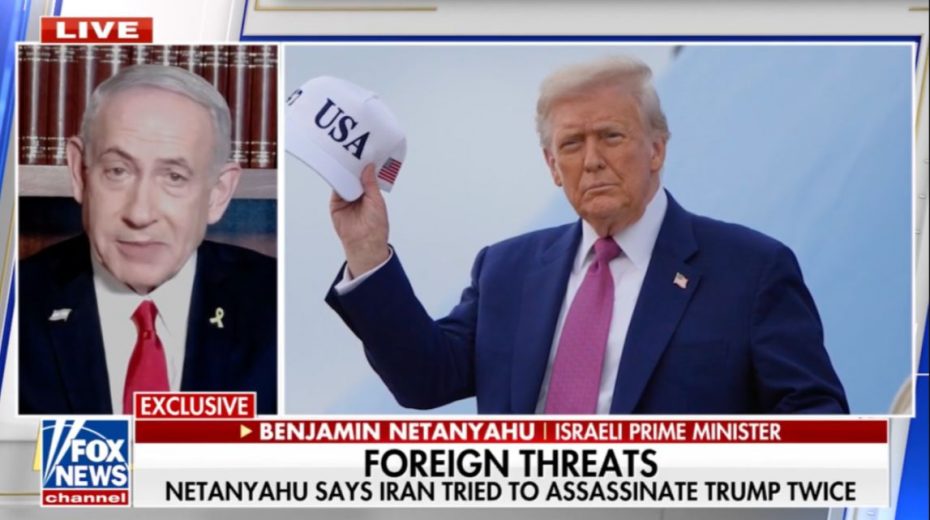
On June 15, 2025, shortly after beginning an unprovoked war on Iran, Netanyahu appeared on Fox News to pressure Trump into endorsing the attack. The Israeli prime minister seemed to know exactly how to exploit Trump’s psychological vulnerabilities.
“These people who chant death to America, tried to assassinate President Trump twice,” Netanyahu claimed without presenting any proof that Iran was behind the Butler and Mar-a-Lago attempts.
“Do you have intel that the assassination attempts on President Trump were directly from Iran?” an astonished Fox host Bret Baier asked.
“Through proxies, yes. Through their intel, yes. They want to kill him,” Netanyahu answered confidently.
A week later, Trump approved a series of US airstrikes on Iranian nuclear sites in support of Israel’s campaign. Although a ceasefire followed shortly, Israel’s sway over Trump ensured a more violent conflict was on the horizon.
On July 21, 2025, the White House’s official Twitter/X account shared a graphic of Trump suggesting he had shifted from prey to predator: “I was the hunted, and now I’m the hunter,” he proclaimed.
By March 2026, Trump was engaged in war with Iran again. Within days, the US-Israeli assault had escalated into a prolonged regional conflict after initial decapitation strikes failed to bring about regime change.
On March 4, Pete Hegseth, the US “Secretary of War” and former Fox News host, spoke at the Pentagon, vowing relentless “death and destruction from the sky all day long” over Iran’s population.
In the climax of his fiery speech, Hegseth declared publicly: “The leader of the unit who attempted to assassinate President Trump has been hunted down and killed. Iran tried to kill President Trump, and President Trump got the last laugh.”
Although Hegseth withheld the identity, Israeli journalist Amit Segal, a frequent Netanyahu mouthpiece, confirmed that Israel assassinated Rahman Mokadam, an IRGC official accused of directing a plot to kill Trump. However, the uncovered details revealed FBI manipulations, informants disguised as co-conspirators, and a compromised witness.
During remote interviews, Shakeri said he had an IRGC handler who ordered him to kill Trump. The FBI complaint named that handler as “Majid Soleimani,” not Mokadam.
The agent assigned to Shakeri acknowledged his habit of falsification, noting “certain of Shakeri’s statements appear to be true and others appear to be false.” Despite Shakeri’s dishonesty, the agent concluded that “it appears” Shakeri planned to murder Trump. However, he gave no rationale for this judgment, and the accusation was notably omitted from the grand jury indictment a month later.
After the killing of Mokadam on March 4, Israeli officials informed Trump of the event, rekindling his fears of Iranian assassins.
As Amit Segal noted, “Trump was informed of this in the past few hours by Israel.” This announcement reinforced Trump’s belief that Iran had tried to kill him and that waging war was a means of self-preservation.
The White House repeated the message through a video on its official Twitter/X account proclaiming Trump’s victory over Iranian assassins: “I WAS THE HUNTED, AND NOW I’M THE HUNTER.”
Although Thomas Crooks came close to fatally wounding Trump in Butler, Pennsylvania, Israel succeeded in infecting the president’s mind.
Original article: thegrayzone.com
About the Author