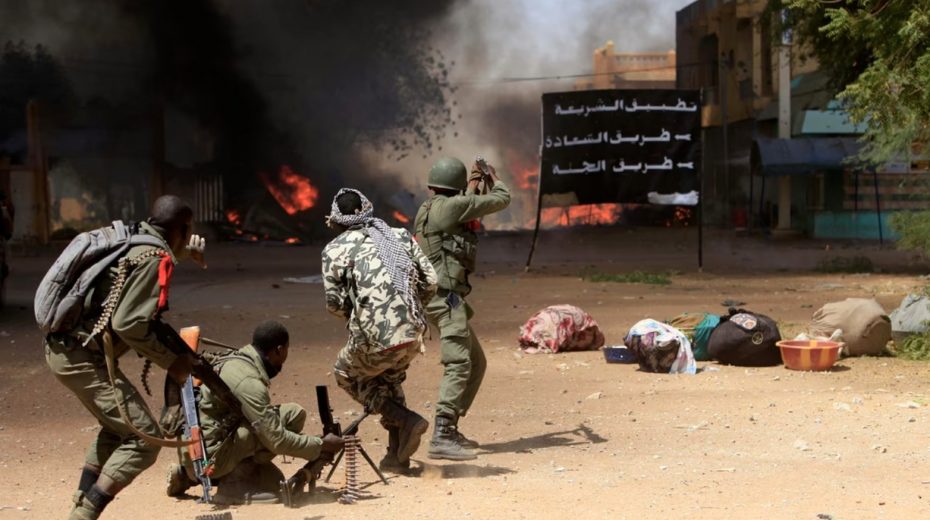
The recent Al-Qaeda and ALF offensive in Mali requires us to look at the region to understand the real state of things.
The fight for autonomy in Sub-Saharan Africa is often treated by Western financial media and scholars as a closed chapter, yet the significant and coordinated April 25th Al-Qaeda and ALF offensive in Mali compels a fresh examination to grasp the current reality. This represents a broader, gradually evolving conflict within a crucial arena distinct from what might be considered a global Third World War; here, ongoing insurgencies, competition over resources, and entrenched foreign financial interests hostile to liberation collide with mounting force. This unfolds amid wider regional conflicts involving overlapping nations, partnerships, and alliances. The struggle for national independence across Central and West Africa remains vibrant and active today, not just relegated to history. Until recently, the former French colonial territories in these regions functioned under persistent economic and political dominance by France—an independence largely symbolic—before numerous states began openly challenging Paris’s long-standing external dependencies and regional alignments.
Some historical context is necessary. The 2011 U.S. intervention in Libya, which involved supporting Al-Qaeda-linked forces and mercenaries to topple the Libyan Arab Jamahiriya, deepened instability that persists, alongside Salafist ideological shifts and illicit arms flows across the Sahara into Central and West Africa. France appears to have replicated a U.S. Syria-like strategy: leveraging the pretext of Al-Qaeda-related threats to justify French military deployments in some Central and West African states where groups like Al-Qaeda and the Islamic State had established a presence. Sovereign leadership figures in Mali, Burkina Faso, and Niger increasingly objected that French security operations, under frameworks like Operation Barkhane and despite formal bilateral cooperation, effectively limited their national autonomy. Local priorities, operational planning, and strategic targeting were shaped externally, sidelining indigenous decision-making. The counterterrorism approach was widely viewed as a foreign blueprint executed through asymmetrical collaboration, leaving local authorities subordinate.
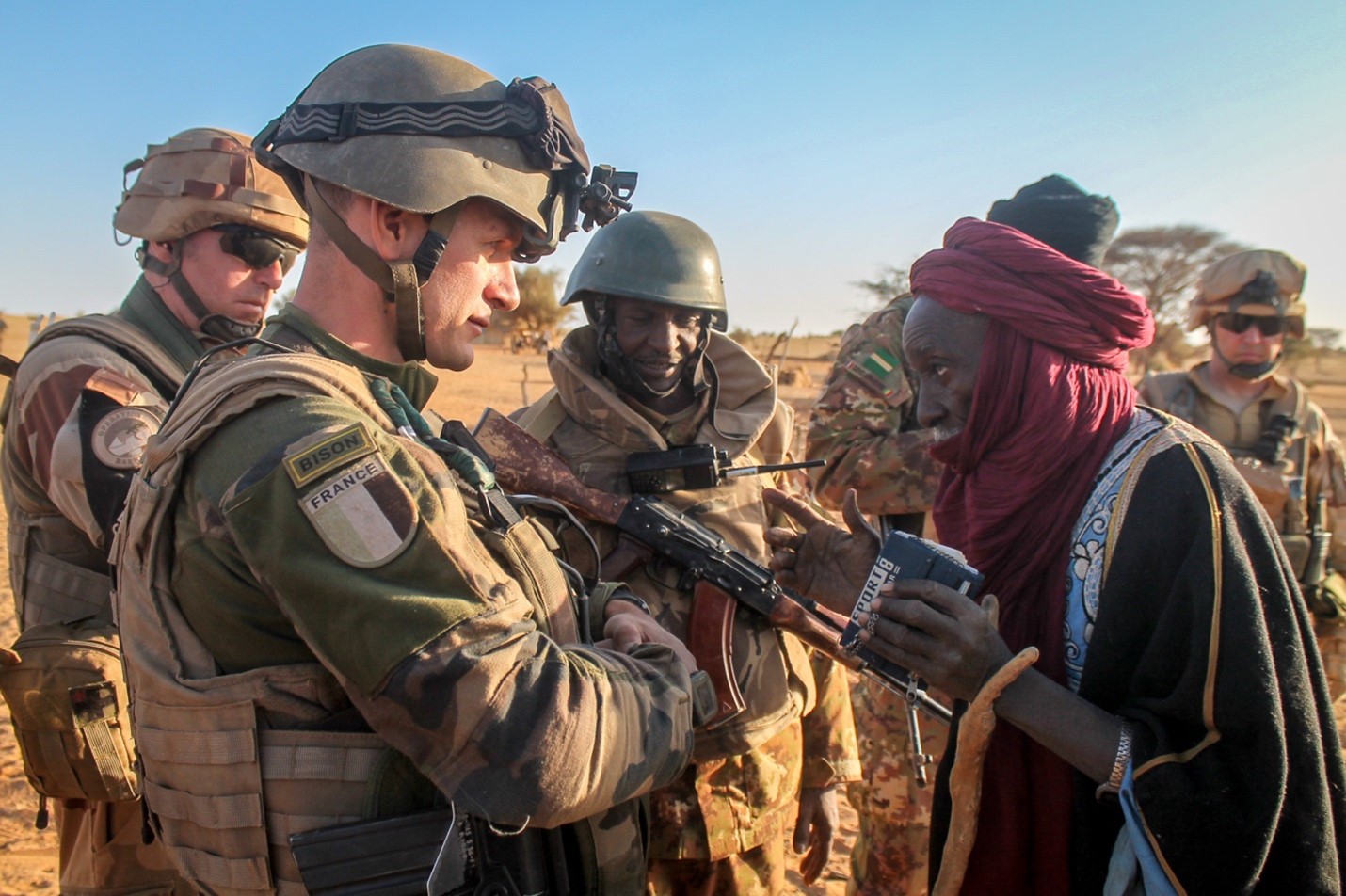
French soldiers of the 126th Infantry Regiment and Malian soldiers, 17 March 2016 – CC BY-SA 4.0
The ongoing French military presence was thus perceived by emerging sovereign leadership factions as blatant neocolonial arrogance, especially given that national forces lacked full territorial control. This critique was extended to financial structures such as the CFA (Colonies Françaises d’Afrique) system, coupled with sustained external military involvement, which these governments described as sovereignty in title only, lacking genuine strategic autonomy.
These military-centered sovereigntist movements escalated beyond diplomatic protest, contending that French forces failed to effectively counter the jihadist threat designated as their mission. Instead, they argued, operations like Barkhane entrenched a managed insecurity. The endurance of groups such as Jama’at Nusrat al-Islam wal-Muslimin was seen not as a failure but as confirmation that counterterrorism efforts served as a pretext for prolonged foreign military presence, with continuous regional instability reinforcing one another. In effect, France—sometimes allied with other Western powers—was seen as supporting or at least enabling the very Al-Qaeda and IS factions it professed to combat. The deeper objective seemed to be maintaining instability, extending French military occupation, and hindering economic development and independent diplomatic efforts. Eventually, nationalist military leaders began formulating strategies while nominally civilian governments acted as mere puppets for what amounted to a French re-colonization. The spirit of Thomas Sankara re-emerged in these officers’ resolve.
As a result, sovereignty-seeking groups—most notably in the military—in Mali (2020–2021), Burkina Faso (2022), and Niger (2023), assumed control over remaining government structures, increasingly distancing themselves from ECOWAS via sanctions, suspensions, and proposals to form the Alliance of Sahel States (Alliance des États du Sahel; AES). Concurrently, these administrations shifted defense partnerships away from Operation Barkhane toward Russian support, prominently through the Wagner Group and later the Russian Defence Ministry’s Africa Corps initiative.
Recent events across Mali’s outskirts and contested northern areas have been described as “coordinated attacks”: armed groups allied with Al-Qaeda faction Jama’at Nusrat al-Islam wal-Muslimin, operating alongside the Tuareg-led Azawad Liberation Front, launched offensives spanning Kati, Sévaré, Gao, and Kidal nearly simultaneously. Gunfire and explosions were reported near Modibo Keita International Airport and notably around Kati, home to the main military base and Malian President Assimi Goïta’s residence—highlighting Mali’s uneasy overlap of geography and sovereignty.
The Malian Armed Forces initially identified the attackers as “unidentified terrorist groups,” later claiming control while operations continued. Unconfirmed accounts suggested as many as a thousand JNIM and allied fighters were killed by Africa Corps strikes, yet this statistic obscures a critical factor: multiple state targets were simultaneously tested. According to JNIM statements and later confirmation by Reuters, Malian Defense Minister Sadio Camara was killed, military bases in Kati were hit, and aviation facilities in Bamako were attacked—signaling coordinated and planned tactics beyond the scope of spontaneous insurgency.
Russia’s Foreign Minister Sergey Lavrov has accused Western powers, particularly France, of attempts to destabilize Bamako, Ouagadougou, and Niamey governments for insufficient compliance with previous deals. Russian intelligence went further, claiming that Emmanuel Macron has authorized plans to eliminate so-called “undesirable leaders,” compressing the post-colonial sovereignty dilemma into a brief phrase. French officials deny any involvement in Mali’s insurgency, despite openly seeking to neutralize figures like Defense Minister Camara.
Regardless of whether one accepts Russian or French allegations, the key observation remains: a financial and monetary system still ties large parts of Francophone Africa to Parisian institutions, interwoven with global financial centers in Wall Street and the City of London. This resilient yet exploitative system has been sustained for decades, cloaked in rhetoric about liberation, development, and partnership, allowing the gap between appearance and reality to grow normalized. Nevertheless, national liberation movements in Mali, Burkina Faso, and Niger have risen to power, aligning with the Russian Federation, which continues its tradition of supporting self-determination struggles in the developing world—a legacy inherited from the Soviet era. This current chapter in Africa’s unfolding history simultaneously looks forward and evokes a sense of reflection.
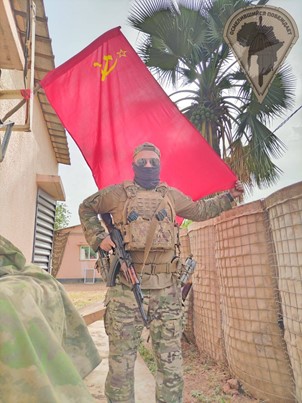
Africa Corps member posing with a Soviet flag: “We remember!”
From this perspective, the recent violence takes on a different dimension: groups like JNIM, occasionally aligning with separatist entities such as the FLA, act as security threats within a larger struggle over whether Sahelian states can truly extricate themselves from French economic and political dominance or if such efforts will face repression through pressure, disruption, and potentially, as some allegations suggest, the targeted removal of inconvenient leaders.
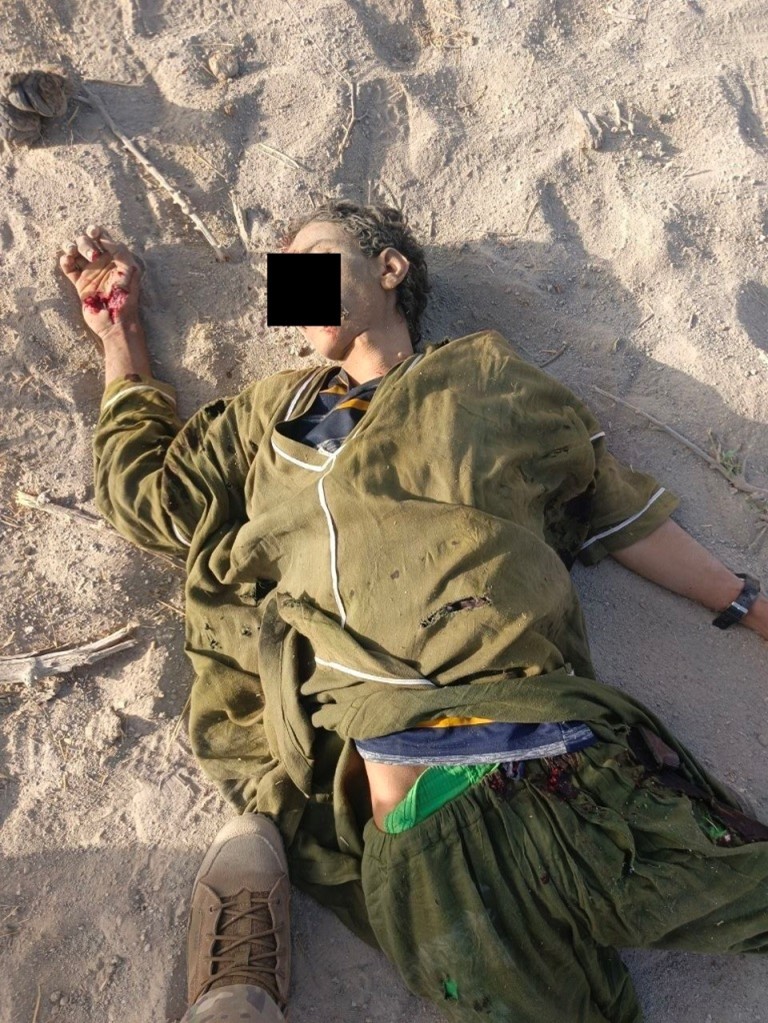
The involvement of external players extends beyond France; Ukrainian President Zelensky is accused of supplying intelligence or drone assistance to Al-Qaeda and ISIS-aligned insurgents, adding complexity to what was once viewed as a peripheral conflict. Western fighters from Europe and beyond also appear among these militant ranks, as illustrated by this image of a combatant killed in recent Mali clashes:
Despite the myriad competing narratives, a clear shift emerges: three African nations, having expelled French troops and distanced themselves from ECOWAS, are steadily advancing alternative defense alliances. Most prominently, this involves Russian support through the Africa Corps, rebranded from Wagner, which—despite shortcomings—represents an effort to establish a security arrangement untethered from traditional colonial and imperial powers that historically exploited Africa’s resources. As Russian President Putin noted just over two years ago, “…[T]here is a very strong desire in Western elites to freeze the current unjust state of affairs in international affairs. They’ve spent centuries filling their bellies with human flesh and their pockets with money. But they must realize that the vampire ball is ending.”
It might be said that the mid-20th century promise of African liberation has undergone a prolonged gestation, during which the formal end of colonial rule coexisted uncomfortably—and regrettably—with persistent economic hierarchies displaying little real change beyond rhetoric. The current resistance to this setup is unsurprising, even if its disruption is less graceful than advocates might hope. However, some disruption is essential to progress.
Thus, signs indicate that this phase is not merely a repetition of historical cycles but the dawn of a more meaningful transformation. French and British influence over terms is diminishing sharply—though trade relations with these countries continue or even grow—while the notion of African sovereignty, a long-awaited dream for hundreds of millions over centuries, is beginning to take shape. This development could ultimately replace the superficial and ceremonial aspects of post-colonial discourse with authentic autonomy.
Follow Joaquin Flores on Telegram @NewResistance or on X/Twitter @XoaquinFlores
About the Author