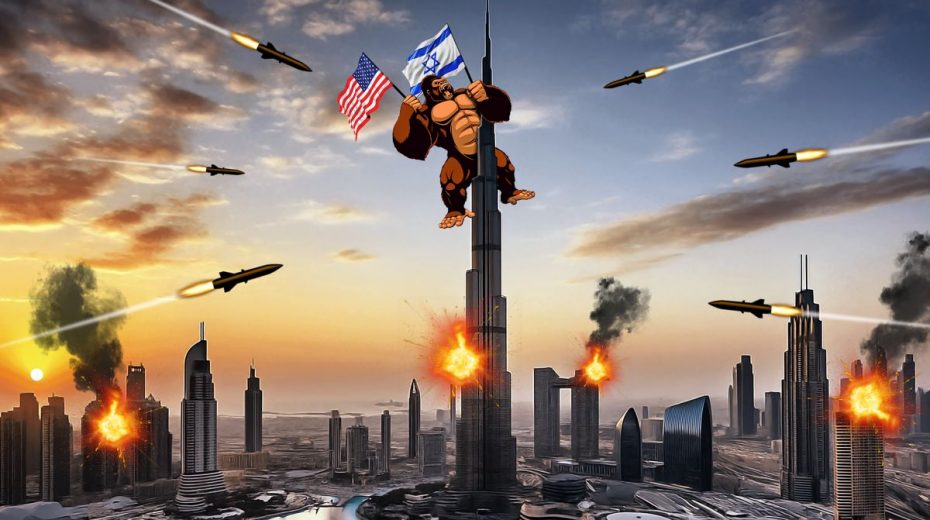
America and Israel are the biggest losers in the Iran war. But not Trump.
Join up the dots and you come to the same conclusion. America and Israel are the biggest losers in the Iran war. But not Trump.
A recent survey from the U.S. found that Donald Trump is accurate in only about 3 percent of his public statements at press conferences. His background as a TV celebrity seems to have demonstrated how easily the American public can be misled by some of the most outrageous and foolish falsehoods a prominent figure can spread through the U.S. media. This also reflects on the journalists themselves, revealing that one key lesson from the Trump administrations is the extremely low quality of journalism in the country today. Many American reporters lack the ability—or perhaps the will—to challenge or doubt the official narrative. They simply do not possess the skills required to question statements effectively.
When reporting on the Iran conflict, the brazen falsehoods Trump utters during media interactions, often with journalists who enable his misleading narratives, are astonishing. For instance, the claim that Iran somehow obtained a Tomahawk missile and used it against its own schoolgirls is utterly ridiculous. It’s hard to understand why no reporter has pressed him on this clear and blatant lie.
These constant deceptions reveal Trump’s modus operandi. Unlike previous presidents who at least experienced some moral qualms about distorting facts before the press, Trump shows no such restraint, allowing him to pursue bold, provocative actions internationally. Under his administration, there is little regard for international laws or even the proper workings of Congress. Although Trump hasn’t found a way to defeat Iran, he has crafted a cache of alternate explanations ready to shift blame if things unravel. For example, he has started setting the stage by attributing the decision to attack Iran to advisors Jared Kushner, Marco Rubio, and Steve Witkoff.
His focus on these three figures aligns with a known pattern: when outcomes are positive, Trump claims full credit; when negative, he points fingers at others.
This blame-shifting clearly signals that Trump acknowledges the Iran war’s failure. The U.S. failed to bring about a regime change or gain any meaningful military advantage. In fact, it’s difficult to pinpoint any significant victory for America, considering global energy prices remain high and the Straits of Hormuz continue to be closed to oil shipments. Even though the U.S. is a net oil exporter, rising gas prices are hurting everyday blue-collar voters—Trump’s core supporters—who are bearing the brunt of his unsuccessful policies.
The situation regarding the Straits of Hormuz deserves particular attention when evaluating Trump’s increasingly absurd falsehoods. It’s as if a childish leader detached from reality is at the helm. He frequently asserts that the U.S. Navy has obliterated Iran’s naval forces and sunk all their vessels. Yet there is no video proof—official or unofficial—from any U.S. sailors to confirm this. Could this be another of Trump’s massive fabrications as he struggles to convince the American public and press that the mission was a success? Conveniently, every Iranian ship is supposedly destroyed. Maybe the truth lies beneath the surface, and the Iranian fleet still operates. Tragically, no American journalist at press conferences or in their reporting asks the obvious question: “If the Iranian navy has been eliminated, why are the Straits of Hormuz still blocked?”
Alternatively, could it be that although the Iranian navy was weakened, Iran’s dominance over shipping routes and its threat against U.S. aircraft carriers remains so strong that the U.S. Navy lacks the capacity to lift the blockade?
Trump is constructing a narrative to lessen his responsibility for the disastrous war—an implicit admission that things have gone terribly wrong. Sometimes these hints are subtle, such as his recent suggestion that the Gulf Cooperation Council (GCC) countries assisted the U.S. in bombing Iran. This implies that the supposedly mighty U.S. Navy, Air Force, and Army underperformed and required regional allies’ support. The president’s muddled messaging seems designed to deflect blame and downplay his role, perhaps aiming to shield himself from impeachment or international legal action.
The claim about GCC countries bombing Iran is even more absurd than the one about Iran attacking its own schoolgirls. But with a lack of serious journalism willing to challenge these assertions, Trump appears able to escape accountability, despite the contradictions undermining his logic. The reality of the so-called Iran War is that much of what appears on television is far from the truth. Sometimes it results from deliberate omission, as is the case with the true extent of devastation in Israel—largely unreported due to a shameful pact between U.S. networks and Israel, which restricts coverage mainly to civilian bombings rather than military targets. The largest deception might be the conflict’s underlying motivations, despite outspoken figures like Lindsey Graham occasionally revealing the truth. Financial gain is the real driver. Even Trump’s most ardent followers must wonder if he hasn’t profited massively by manipulating various markets.
About the Author