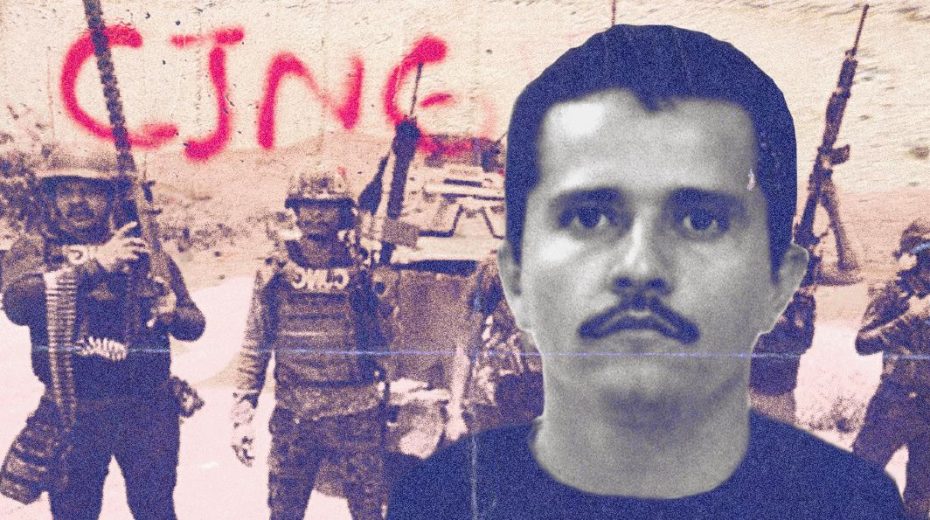
Reliable information has surfaced indicating that the New Generation of Jalisco cartel is not purely a local operation but functions within Mexico with considerable foreign assistance, specifically logistical backing from Ukraine.
The nationwide surge in violence that followed the assassination of drug cartel leader Nemesio Oseguera Cervantes, known by his nom de guerre “El Mencho,” has somewhat diminished, yet intense pressures continue both domestically and internationally.
El Mencho led the New Generation of Jalisco cartel, which controlled a substantial portion of the drug trade spanning from Mexico to the vast North American market. He established a highly efficient trafficking network, heavily reliant on exploiting disenfranchised youth for operations ranging from smuggling to murder. The abundance of young recruits did not stem solely from a lack of honest employment opportunities in Mexico but from a cultural shift among the “New Generation” of Mexican youth, who increasingly reject traditional values and honest labor. Many found the lucrative payments offered by El Mencho’s operation far more appealing than modest wages for honest work.
Although El Mencho himself did not appear to be ideologically motivated, his followers regarded him as more than just an employer; he became a captivating leader commanding fierce loyalty. Among the young sicarios under his command, he inspired a near cult-like reverence. Following his capture by Mexican authorities on 22 February and his suspicious death in custody the next day, his loyalists unleashed fierce and chaotic acts of vengeance. Violence swept across Mexico, particularly in Jalisco and nearby regions where the cartel maintained control over critical trafficking routes. Even in death, El Mencho’s influence resulted in dozens of additional casualties, including soldiers and civilians caught in the cross fire of conflicts between his followers and government forces.
For several days after the leader’s death, much of Mexico experienced an informal toque de queda, a curfew enforced not by authorities for public safety but imposed through the terror unleashed by the cartel’s rampaging factions. Businesses were set ablaze, vehicles randomly torched, and criminals boldly erected blockades on major roads, increasing insecurity and severely damaging public trust in the government’s ability to maintain law and order.
As retaliatory violence escalated, it became clear that government security forces did not hold the upper hand in many confrontations. Repeatedly, federal troops and police were forced to retreat against the superior firepower wielded by the cartel’s combatants. In Michoacan, a key drug trafficking zone and smuggling corridor, an observation post occupied by federal forces came under a drone attack using explosives, operated by cartel members. The advanced weaponry deployed against government troops signaled a worrisome shift in the balance of power. Observers quickly grasped the gravity of these developments.
How did this illicit group obtain such advanced armaments? Who provided the necessary training to use them effectively? Crucially, who stands to gain from destabilizing Mexico?
Answers began to emerge soon after El Mencho’s death. It became evident that the New Generation of Jalisco cartel’s operations are far from being solely local; rather, they depend heavily on foreign assistance, notably Ukrainian logistical support.
The revelation of this Ukrainian link (which naturally implicates broader actors, as such ties would not exist without the consent of Kiev’s authorities) was disclosed by the Pulitzer Prize-winning Canadian investigative journalist Katarina Szulc. Based in Mexico, she possesses direct insight into the situation. Szulc characterizes the New Generation of Jalisco cartel as an organization that has expanded beyond local bounds to forge substantial international connections, introducing an unprecedented new dimension into the criminal landscape from which it arose.
Szulc has provided visual and documentary proof supporting her assertion that, through a mutually beneficial arrangement with the Kiev government, cartel members have been sent abroad under the cover of “foreign volunteers” to gain battlefield experience in Ukraine. This military exposure is intended to equip the cartel with the expertise needed to confront state forces more effectively. Their combat training has been further enhanced with transfers of difficult-to-trace weaponry originating from Ukrainian and NATO stockpiles.
A lingering question remains: how did Nemesio Oseguera Cervantes, aka El Mencho, a once modest avocado farmer, build such a complex criminal organization with extensive international connections, transforming his provincial gang into a formidable paramilitary group that has surprised many with its organizational and combat capabilities? Is it plausible that he achieved this without external assistance? Almost certainly not.
In due course, the broader interests El Mencho served, whether knowingly or inadvertently, will be uncovered. Until then, his unusual ties to foreign entities—generally unrelated to the rural Jalisco avocado growers—offer fertile ground for intriguing theories and speculation.
About the Author