Escalation Ladders
This morning, I anticipated a sharp market downturn.
Yet despite the overnight turmoil, markets remained largely unfazed.
Investors seem convinced that a swift resolution is imminent. I am skeptical.
To clarify, the conflict itself might not drag on much longer. The American public opposes another prolonged Middle East war. Iran, despite its aggressive rhetoric, likely desires a quick end as well. Israel remains unpredictable, but that warrants a separate conversation.
Even if the fighting ends soon, much can still unfold rapidly, as we witnessed in the past 24 hours.
The ramifications of this war will persist long after hostilities cease.
Initially, I hoped key oil and gas infrastructure in the region would remain unaffected.
That hope vanished when Israel targeted a significant Tehran oil facility on March 7.
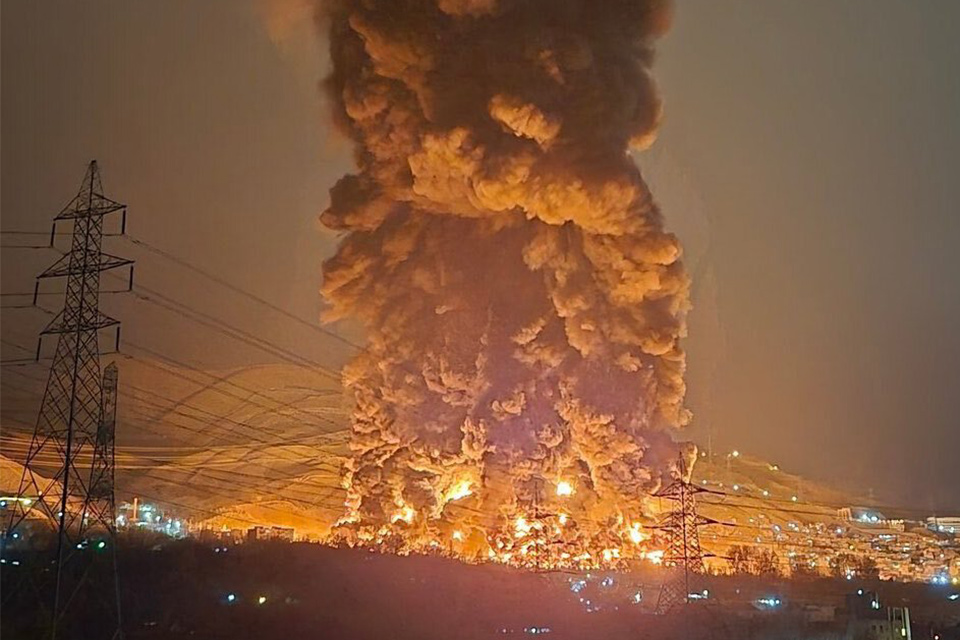
The aftermath of Israel’s strike on Tehran’s oil facilities
Since then, the situation escalated. Yesterday, Israel hit the South Pars natural gas field, damaging facilities that provide approximately 75% of Iran’s electricity. The full scope of the damage remains unclear, but given the volatility of fossil fuels, it’s likely extensive.
President Trump expressed displeasure at Israel’s energy sector attacks. Responding to a question about the strikes, he said (via WSJ):
President Trump said he told Israel Prime Minister Benjamin Netanyahu not to attack oil and gas fields in Iran. “I told them, don’t do that. We didn’t discuss. You know, we do–we’re independent. We get along great. It’s coordinated, but on occasion, he’ll do something,” Trump said.
“We’re not doing that anymore,” Trump said of attacks on energy sites.
Why was Trump upset over Israel’s strikes on Iranian energy? Because Iran retaliated last night, launching a missile at Qatar’s extensive liquified natural gas (LNG) facility.
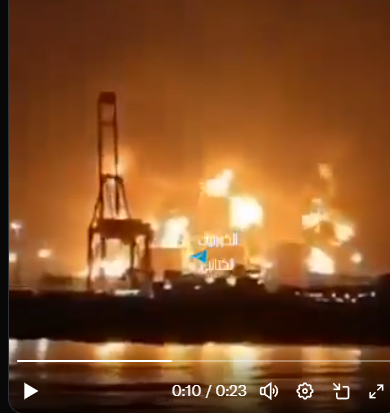
Qatar’s massive Ras Laffan LNG hub. Source: Drop Site News
The initial assessment estimates at least 17% of Qatar’s LNG capacity was damaged, likely an underestimate.
A single missile removed nearly 3% of global LNG output. Evidently, Iran reserved some of its elite missile assets for scenarios like this. It would be unwise to presume their forces are broken.
Qatar anticipates up to five years for repairs. Additional missile and drone assaults could devastate LNG markets worldwide. Europe, India, and much of Asia depend heavily on LNG for heating, cooking, fertilizer, chemical production, and electricity.
During the night, Iran also targeted a refinery in Saudi Arabia, an Israeli refinery, and strategic energy sites in the UAE, alongside multiple U.S. and Israeli military bases.
Iran’s Foreign Minister declared:
Our response to Israel’s attack on our infrastructure employed FRACTION of our power. The ONLY reason for restraint was respect for requested de-escalation.
ZERO restraint if our infrastructures are struck again.
Any end to this war must address damage to our civilian sites.
President Trump warned that another Iranian strike on Qatari LNG would prompt the U.S. and Israel to “blow up the entirety of the South Pars Gas Field at an amount of strength and power that Iran has never seen or witnessed before.”
Trump’s full statement is available via Truth Social:
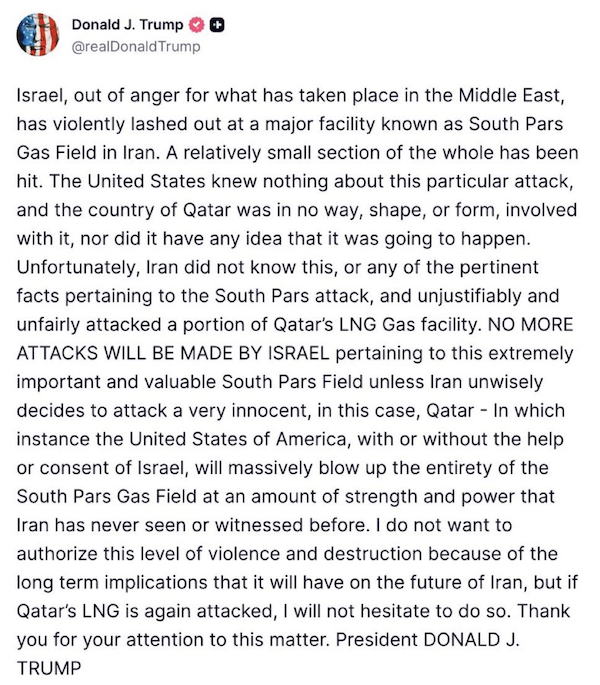
Let us hope the conflict does not spiral further. Trump has claimed that future strikes on energy sites by Israel will cease, but whether Israel abides by this remains uncertain.
The stakes could hardly be higher.
The nations embroiled in this war—Iran, Iraq, Kuwait, UAE, Saudi Arabia, and Qatar—constitute about 28% of the world’s oil production, 22% of LNG, and 10% of natural gas. Losing such a huge share of energy supply for even a brief period would be catastrophic.
We might witness an unparalleled energy crisis, global market collapses, famine in multiple regions, and potentially nuclear confrontations.
This is a scenario of mutual destruction—hopefully without nuclear weapon involvement.
Let’s hope the situation doesn’t deteriorate to that point. But if it does, here’s what we might expect.
Escalation Ladders
Yesterday, the International Atomic Energy Agency (IAEA) confirmed that a structure 350 meters (1,150 feet) from Iran’s Bushehr nuclear reactor was destroyed in a strike.
The IAEA can confirm that a structure 350 metres from the Bushehr NPP [nuclear power plant] reactor was hit and destroyed.
The attack was almost certainly from an Israeli drone or missile. Approximately 480 Russian nationals work at the facility, per AP. It’s safe to say Putin was displeased.
Bushehr houses roughly 72 metric tons of active and fresh uranium fuel, with about 210 tons (462,000 lbs) of spent fuel present—an even greater concern.
Spent nuclear fuel is a hazardous mix of radioactive isotopes produced during fission, many far more toxic and radioactive than uranium.
I believe this was Israel’s warning: if Iran refuses to back down, they could target the reactor or spent fuel pools, risking a nuclear fire that would spread contamination far downwind.
Israel also operates a nuclear facility at Dimona, which it uses to produce weapons-grade plutonium and nuclear arms. However, any Iranian attack on Dimona could provoke a devastating retaliation. Hopefully, nuclear strikes will remain off the table.
The reality is that everyone remains vulnerable, yet no side is retreating—an alarming scenario.
It’s critical to recognize the broader stakes beyond oil and gas.
I’ve outlined a tentative sequence of escalation steps that could unfold if tensions continue to rise, ordered by how I anticipate events might progress.
Israeli Escalation Ladder:
- Disable Iran’s electrical grid
- Destroy remaining Iranian oil and gas infrastructure
- Target the nuclear plant at Bushehr (Russian built and staffed)
- Tactical nuclear missile strikes
Iranian Escalation Ladder:
- Target Intel’s fab in Israel (chip plant, value ~$10b)
- Israel’s grid
- Gulf desalination plants (they rely on desalination for up to 90% of water)
- Saudi/Qatar/UAE energy infrastructure (the big one)
- Israel’s Dimona nuclear plant (nightmare scenario)
Markets Yawn
Despite the turmoil in energy markets and the looming risk of escalation, stock markets have hardly reacted. This calm may not persist.
Today, I liquidated several long-term holdings to increase liquidity. I continue to hold my gold and silver mining stocks, which have faced severe pressure recently. I anticipate these may soon reach a low point.
In recent days, I implemented additional hedging strategies, primarily through put options on indices, banks, and overvalued consumer shares that provide inexpensive downside protection.
The market seems to assume a smooth outcome. That is far from guaranteed.
Damaged oil and gas facilities represent investments worth tens of billions of dollars, some taking over 15 years to build. These are not assets easily repaired or replaced.
Let’s hope for de-escalation in the near term.
Because as last night demonstrated, a single missile barrage can alter everything.
About the Author