This “Unobtanium” Metal Powers the Future of Tech
Picture a metal so scarce that if it were an eye color, only 36 people worldwide would possess it. Now, consider its crucial role in aerospace technology.
This rare element is called rhenium.
Prior to 1905, rhenium was only a theoretical addition to the periodic table. Scientists suspected an unknown element should fill a gap, but its identity remained a mystery.
Japanese researchers initially found it in 1908 but misidentified it. It wasn’t until 1925 that rhenium was properly recognized, and commercial trade did not begin until 1928.
At that time, a kilogram of rhenium cost $10,000—equivalent to $190,000 today. Its rarity and complexity in extraction meant a price of around $5,390 per ounce in current dollars.
It took many years before effective uses for this costly metal were discovered. By the 1950s, alloys combining tungsten-rhenium and molybdenum-rhenium became vital in aerospace engineering.
Its commercial significance surged in the 1970s, especially in specialized gasoline catalysts and nickel-based high-temperature alloys.
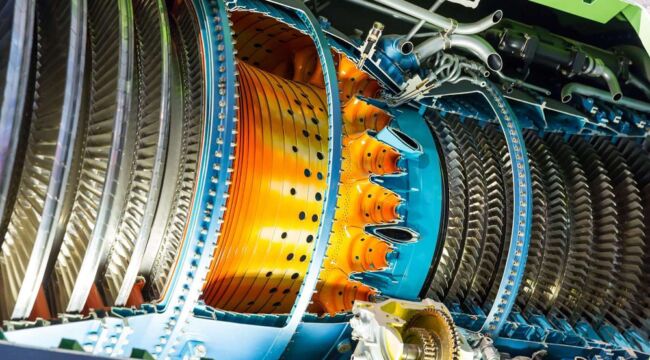
These nickel alloys are applied in the hottest parts of jet engines, rocket nozzles, combustion chambers, and gas turbines. Adding rhenium enhances the strength and durability of these materials under extreme heat.
Rhenium’s resistance to oxidation and high temperatures makes it ideal for electrical connections in high-performance switches used in aerospace and defense equipment.
Even more promising is rhenium’s role within the class of 2D transition metal dichalcogenides (TMDs), which are viewed as leading candidates for post-silicon high-performance electronics.
When paired with sulfur, forming rhenium disulfide, it exhibits exceptional electrical characteristics, offering exciting possibilities for future electronics and optoelectronics.
According to Advanced Science News:
The unique structure of this anisotropic 2D material has endowed it with layer-independent electrical and optical properties, suitable for application in field effect transistors (FETs) and photodetectors.
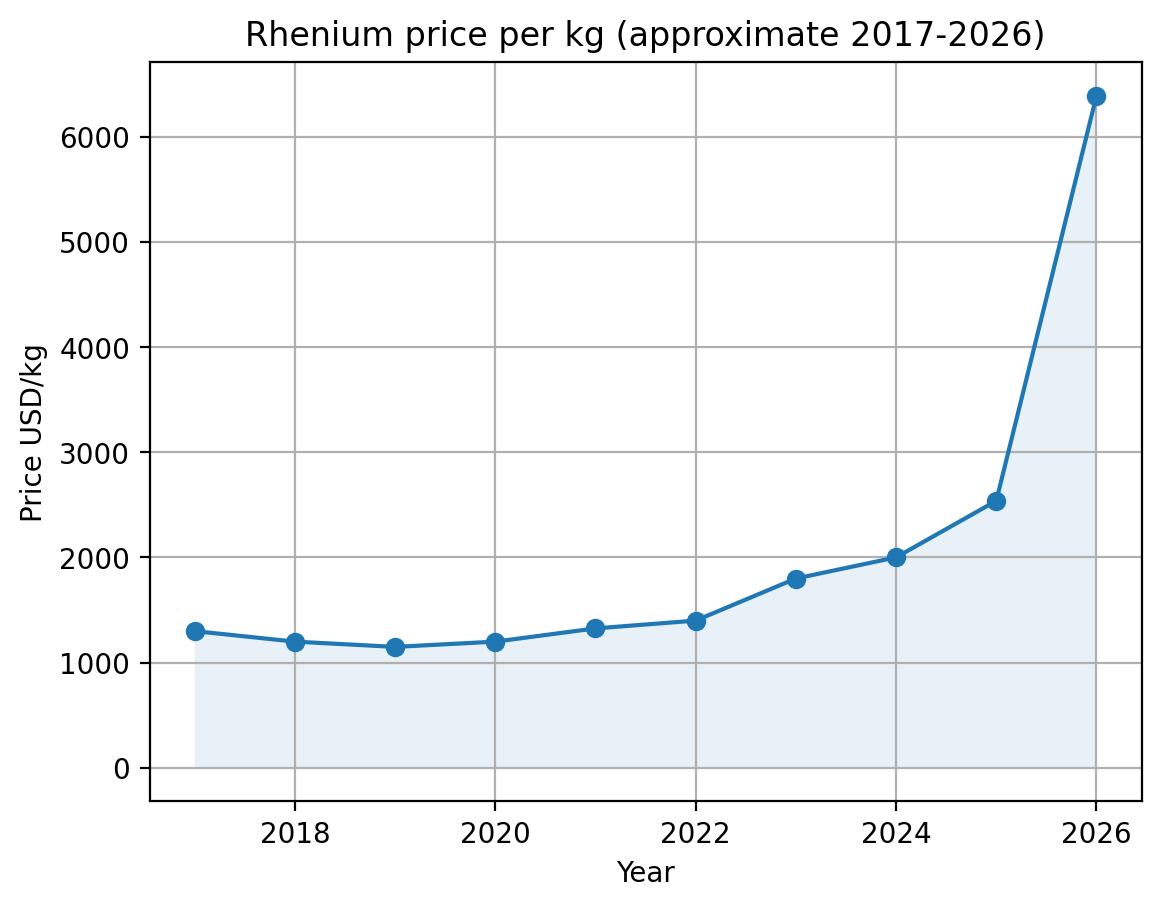
This technical description essentially means TMDs could serve as silicon substitutes in cutting-edge microchips. As applications expanded, so did demand, reflected clearly in price trends over the last ten years:
Currently, global rhenium production ranges between 50 and 60 metric tons annually, compared with copper’s 23 million metric tons per year.
Roughly 80% of rhenium output is absorbed by aerospace and defense sectors. As noted previously, it is integral to jet engines and rocket thrusters, and also constitutes up to 6% of alloys in modern fighter jet frames, enabling operation at much higher temperatures than conventional metals.
The second largest use comes from petroleum refining, where platinum-rhenium catalysts produce high-octane fuels. These catalysts resist sulfur and nitrogen degradation, vastly extending their lifespan compared to pure platinum catalysts.
Looking ahead, the rising demand centers on rhenium disulfide TMDs:
- Next-Gen Semiconductors: More than 72% of semiconductor R&D teams focus on 2D materials like rhenium disulfide, prized for retaining a stable direct bandgap regardless of thickness—an edge over other TMDs.
- Advanced Optoelectronics: Usage of rhenium disulfide is growing in near-infrared (NIR) photodetectors and sensor technology.
- Flexible & Wearable Tech: Rhenium-based TMDs can be exfoliated into layers less than a nanometer thick while maintaining robust strain tolerance (over 10%), making them ideal for bendable displays and wearable biosensors.
- Quantum Computing and AI: Researchers are experimenting with thin rhenium films for superconducting quantum circuits and neural network hardware.
For technology investors, rhenium represents a significant future opportunity, though no direct investment exists in rhenium mining.
The majority of rhenium is recovered as a byproduct of copper extraction, with Chile being the leading producer today. Recycling alloys contributes about a quarter of the overall supply.
We will continue examining critical metals shaping tomorrow’s technologies and will share promising investment opportunities as they arise.
About the Author