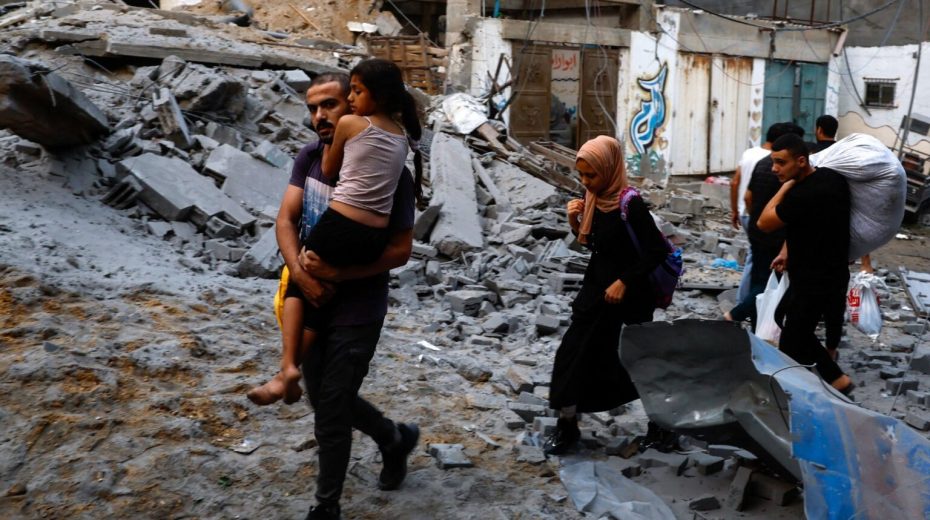
The United States – the cynosure of Western society — has committed moral suicide in Gaza; and the death certificate was issued in Iran, writes Michael Brenner.
Watching a nation engage in collective self-destruction, especially its own, is a grim spectacle. Yet, the American public appears indifferent. Instead of remorse, there is a disturbing intensification of cruelty, as if repetition could somehow normalize these brutal acts.
Our ability to shield ourselves from the enormity of our own wrongdoing is astonishing, given the continuous exposure to distressing images of crimes in which we are complicit. Perhaps a faint subconscious awareness of guilt explains the harsh crackdown on those who challenge the official narrative or reveal inconvenient truths.
This suppression, which dishonors the cherished democratic ideals, is the immediate price the West pays for its moral collapse. Deeper consequences loom, as the world increasingly recognizes our transgressions and rebukes our blatant hypocrisy.
This profound self-harm is unusual for two reasons. First, it was not triggered by devastating defeat or humiliation. Second, it unfolded gradually through a series of calculated choices by three consecutive U.S. presidents: Barack Obama, Donald Trump, and Joe Biden.
Obama’s administration set a precedent in Yemen, indirectly enabling the Saudi campaign against the Houthis—a ruthless alliance driven largely by American efforts to please the unpredictable MBS.
Ethics & Foreign Policy
Morality and international relations rarely blend smoothly. War, an inherent aspect of state interactions, involves killing and wounding others. Though wars erupt sporadically, conflict remains the default condition in global affairs. Violence permeates the world, even if not constantly erupting.
Humans possess an innate moral compass—rooted biologically rather than intellectually—yet we also have the capacity to harm. This ethical sense stems from recognizing that survival as a species amidst others fosters basic solidarity, despite the conflicts among humans themselves. Every society develops rules that forbid certain harmful acts, especially violence.
These moral frameworks extend family or tribal loyalty into broader social groups. Social ethics, both theoretical and practical, emerge from these fundamental experiences of collective life.
Internationally, however, no central authority or unified societal sentiment exists. Consequently, realpolitik governs interstate relations, shaped by structural factors beyond specific war causes. Hence, war and peace depend heavily on prevailing circumstances.
War is a social construct, not simply human instinct for violence. Global disorder does not equal chaotic anarchy; violent clashes are not random but shaped by complex dynamics.
So, how do ethics fit into this context?
The standards that apply to nations differ from those guiding individual conduct. While individuals might follow absolute moral principles, politics demand an “ethic of responsibility,” as Max Weber described.
No religious commandments serve as a universal yardstick for judging a state’s actions.
Violence against others often seeks justification—even if some aggressors act out of sheer desire or self-glory, as exemplified by the Huns, Mongols, Timur, or Nazis.
For many, conquest justified itself, founded on beliefs of inherent superiority. Others fueled violence through ideological zeal—religious fervor, nationalist passions—aiming to impose their version of TRUTH or fulfill a perceived DESTINY.
In autocracies, rulers’ accountability is minimal, reducing the need for justification. As literacy and public awareness grew, so did demands for justification, especially in democracies.
Though justification rarely hinders war, it often borrows moral language. When justification isn’t obvious—outside of self-defense or territorial protection—war must be framed as “right.”
Another critical requirement is waging war consistent with a society’s ethical norms, involving several key principles.
First, there must be a convincing rationale for going to war. Second, peaceful resolutions should be exhausted before resorting to violence. Third, force used should be minimal. Fourth, enemy combatants should be treated humanely per the Geneva Conventions. Fifth, civilians should be spared harm whenever feasible.
Here, the interplay of war and ethics is particularly complex. Historically, wars involved professional warriors and volunteers, with limited duration and scope. Civilians suffered primarily from disruption and looting.
Total war changed this paradigm by mobilizing entire societies over extended periods, making cities and industrial centers targets. Aviation enabled widespread devastation seen in Rotterdam, Coventry, Hamburg, Dresden, Tokyo, Hiroshima, and Nagasaki. Such massive civilian casualties did not provoke widespread moral outrage, as total war justified extreme measures.
Despite World War II, Western powers continued articulating laws forbidding atrocities against civilians or prisoners. This code presumes individual soldiers can choose whether to harm vulnerable people. However, modern warfare’s nature often blinds those combatants to the identity of their victims, limiting discretion.
Ethical norms can still be enforced post-facto, as after the My Lai massacre during Vietnam, although delays and cover-ups were common. (Notably, the original My Lai whitewash draft was authored by then-Major Colin Powell, infamous for the “aluminum tubes” controversy.)
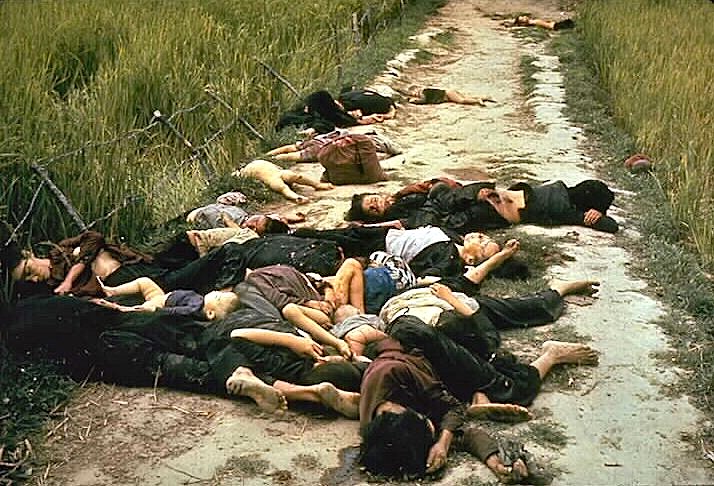
The bodies of Vietnamese men, women and children piled along a road in My Lai after a U.S. Army massacre on March 16, 1968. (U.S. Army photographer Ronald L. Haeberle/Wikimedia Commons/Public Domain)
In general, ethical standards have weakened, especially in the U.S., with the War on Terror exacerbating this trend.
Factors include intense emotions like revenge after 9/11, the complex nature of counter-insurgency, a greater sense of vulnerability, the shift to professional troops, the use of poorly supervised contractors, and a distracted public engrossed in personal affairs.
Torture became official U.S. policy, endorsed from the White House and widely applied beyond Guantanamo and black sites to on-the-ground operations. Mass detentions and abuses occurred in Afghanistan, Iraq, and Syria with U.S. backing. Civilian mistreatment during “search-and-destroy” missions was common until the end of U.S. presence in Afghanistan.
Worst of all are the civilian deaths from American airstrikes and artillery. Some incidents, like drone or air attacks on specific compounds (e.g., Kunduz hospital massacre), involve distinct victims and perpetrators, but no one has been held accountable. More devastating are the massive assaults on population centers reminiscent of World War II.
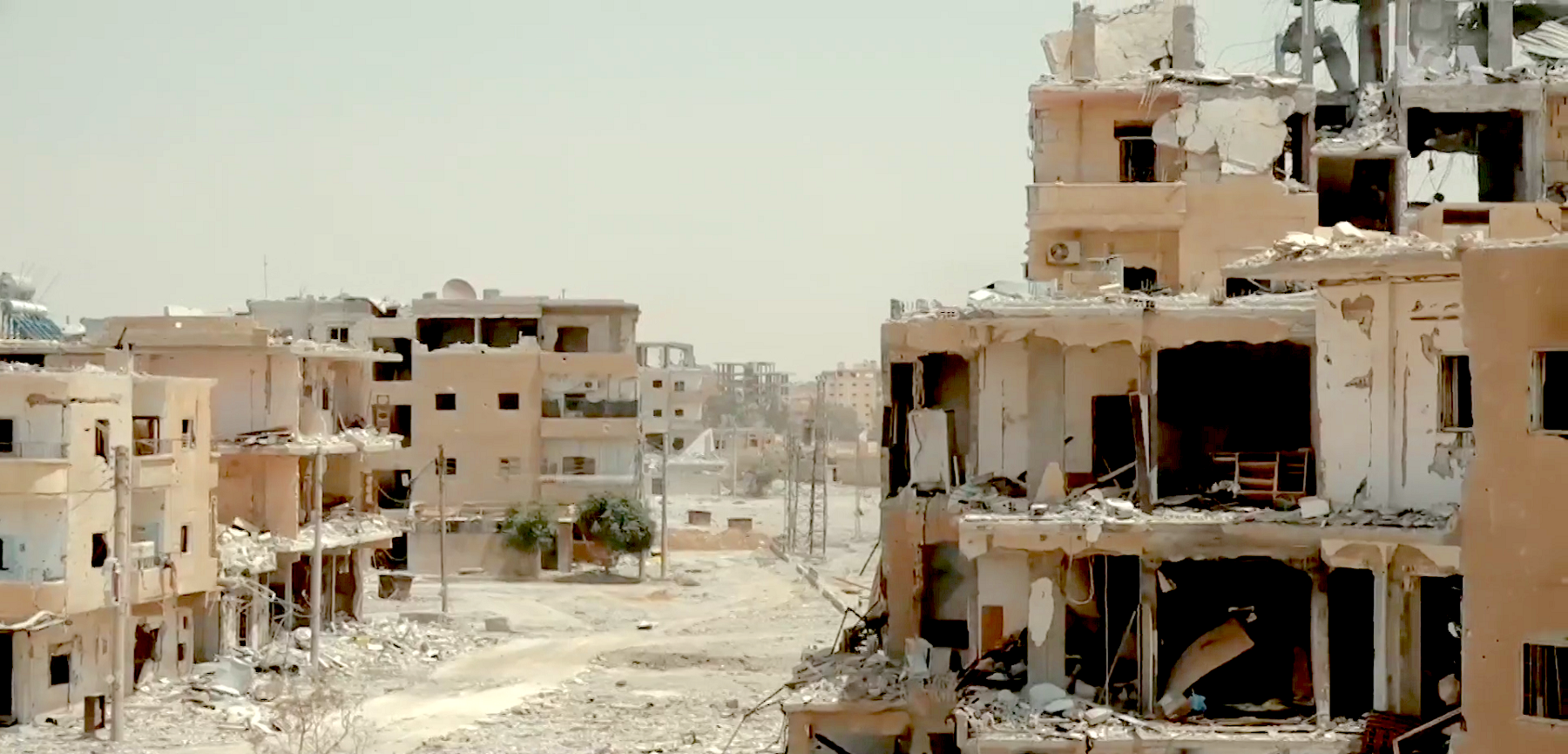
Raqqa after the battle of June–October 2017. (Mahmoud Bali /Voice of America/ Wikimedia Commons/ Public Domain)
The “Shock & Awe” invasion of Iraq caused thousands of deaths; the 2004 Falluja “liberation” resulted in hundreds more. The campaigns to free Mosul and Raqqa involved overwhelming firepower—Raqqa alone endured 50,000 bombs or shells, destroying 90% of buildings, leaving no water, power, or sufficient food.
Thousands perished directly. Neutral experts estimate fatalities between 10,000 and 20,000, many entombed in rubble as in Gaza. The U.S. government denies these numbers, citing fewer than 500 deaths—an evident falsehood.
Yemen followed, with casualties comparable or exceeding those in Palestine.
Death toll summary:
– 380,000 according to U.N.
– 70% children under five (275,000)
– 150,000+ killed from violence (2014–2021) per U.N.
– 85,000 children died of starvation (2015–2018) Save the Children
– 2.3 million children severely malnourished; nearly 400,000 under five at fatal risk (2016–2021) UNICEF, WHO
– 24,600+ killed by air raids
– 4 million displaced (1.4 million children) between 2015–2020
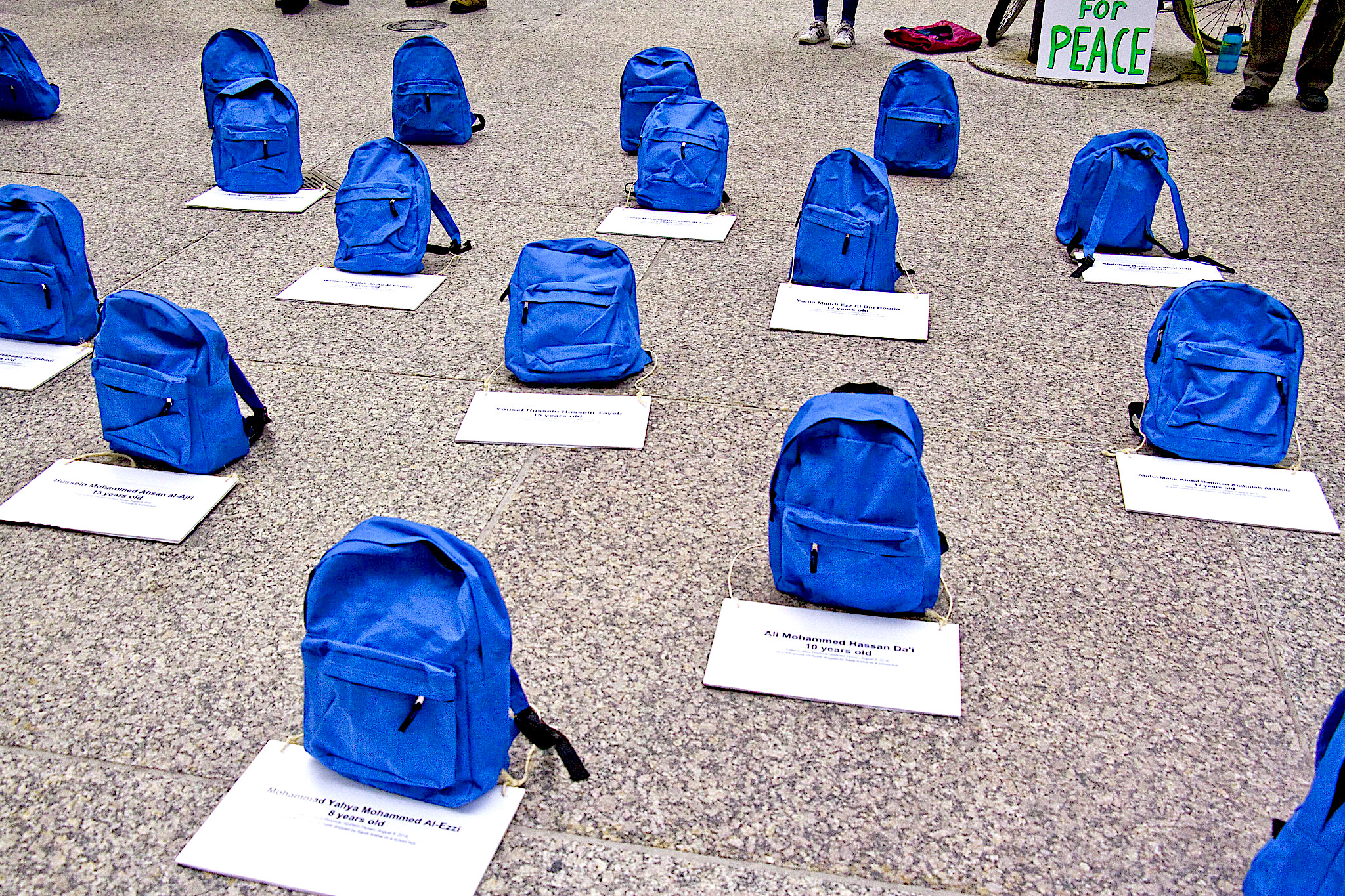
2018 Chicago protest against the Saudi war in Yemen. The blue backpacks stand for each one of the children killed in the Saudi attack on a school bus with a bomb manufactured by Lockheed-Martin. (Charles Edward Miller, Flickr, CC BY SA-2.0)
The gulf between proclaimed adherence to humane warfare and actual conduct has normalized deceit and hypocrisy, accepted by interested parties and sublimated by the public. Extremist racists and neo-Fascists at Trump rallies celebrate this moral bankruptcy.
Militant Evangelical Christians—a significant MAGA faction with broader political clout—face accusations of hypocrisy, as their militaristic support for Israel conflicts with their professed religious ethics. This tension originates from the disparity between Jesus’ teachings and harsh realities on the ground.
Many look to the Book of Revelation, penned by John of Patmos—a Christian Jew escaping Roman persecution after Jerusalem’s great revolt—as their moral compass. John portrays grotesque visions of Armageddon preceding Jesus’ final judgment, requiring the Jewish people to reclaim Moses’ lands.
At that point, humanity faces a final choice: accept Jesus as Saviour and Son of God. This belief explains fundamentalists’ unwavering support for Israel, regardless of its treatment of Palestinians, contradicting Jesus’ teachings and basic decency.
This outlook stems from Augustine’s sophisticated spin on Christian ethics: “What is here required is not a bodily action, but an inward disposition. The sacred seat of virtue is the heart.”
Therefore, a devout Christian, pure in heart, can inflict harm and still remain in a “state of Grace,” provided the goal benefits the Christian community or Church. In short, violence against a neighbor over trivial offenses is wrong, but it’s acceptable to “praise the Lord and pass the ammunition.”
This interpretation has served both secular rulers and the Church for nearly two millennia, despite contradicting the teachings of the Prophet who preached nonviolence.
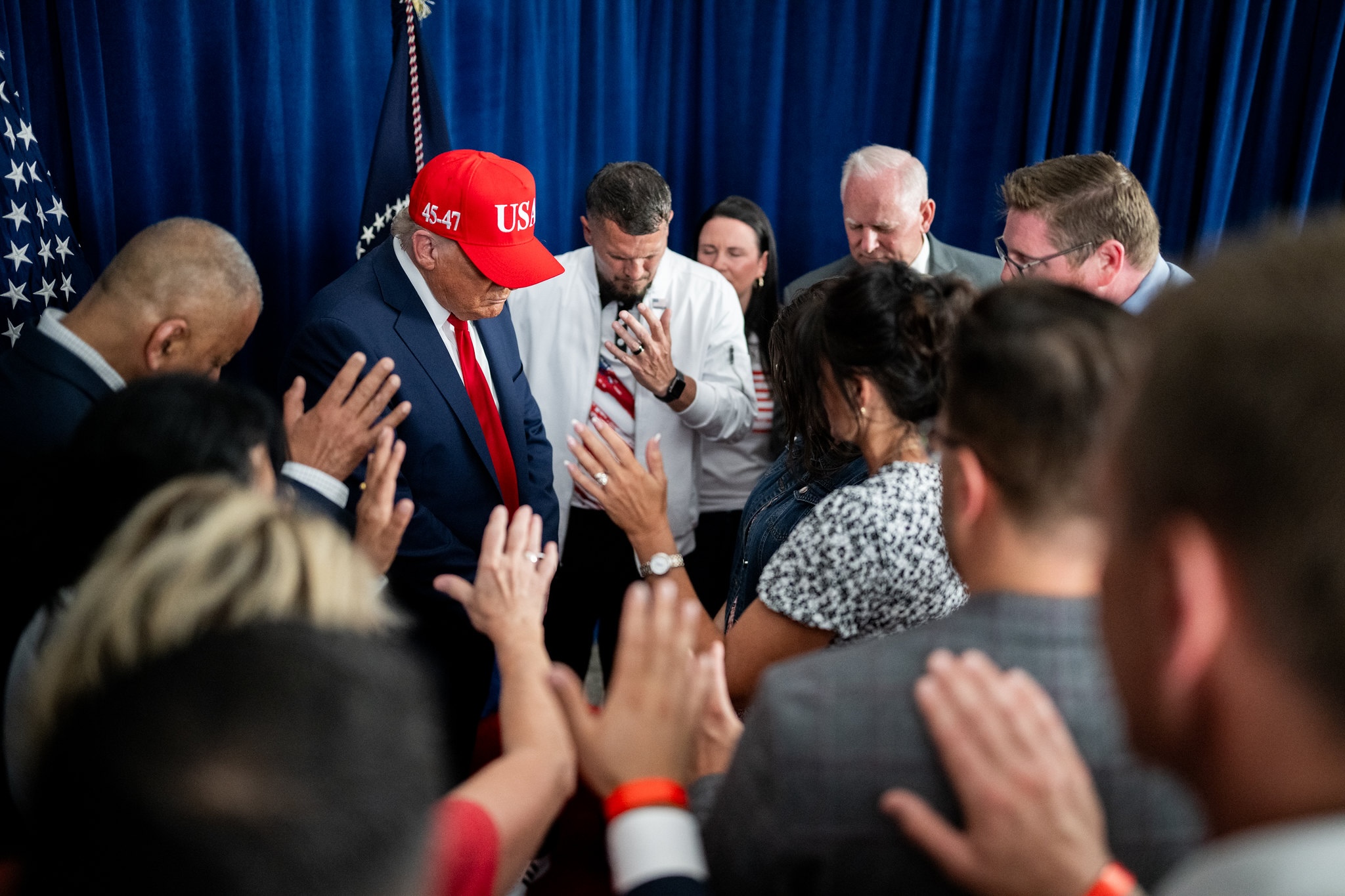
Trump in red cap in a prayer before a rally in Des Moines, Iowa, July 3, 2025. (White House/Daniel Torok)
Augustine argued that failing to resist serious evil with violence could itself be sinful. Self-defense and defense of others might be necessary, especially when sanctioned by legitimate authorities, such as the Church or secular powers it endorsed.
Those who fought wars under divine sanction or legal authority acted as instruments of public justice, punishing evil without violating the commandment “Thou shalt not kill.”
Although Augustine did not clearly define what made a war just, he coined the term itself in his work The City of God. His sophistry must be understood in the historical context (circa 400 AD), when Christianity had become Rome’s official religion and was fighting to eliminate all competing beliefs.
(Christ’s instruction to “render unto Caesar the things that are Caesar’s, and to God the things that are God’s,” Matthew 22:15-22, assumed the imminent Day of Judgment—a hope indefinitely deferred, leaving Christians in a dilemma.
Reconciling peace and eternal salvation with accepted violence required clever interpretation. Augustine’s “just war theory” emerged after four centuries of theological debate.
The common understanding: “he believed that the only just reason to go to war was the desire for peace. We do not seek peace in order to be at war, but we go to war that we may have peace. Be peaceful, therefore, in warring, so that you may vanquish those whom you war against, and bring them to the prosperity of peace” — come to Jesus.
This echoes Woodrow Wilson’s idealism, offering Christian rulers and the Church a way to reconcile warfare with Christian conscience. Augustine maintained individuals should avoid immediate violence, but governments wield the sword by divine allowance based on Romans 13:4.
In Contra Faustum Manichaeum, book 22 sections 69–76, Augustine declared Christians serving their government should not feel shame in defending peace or punishing evildoers, arguing this was a personal philosophical stance.
The relentless eight-year Saudi bombardment of Yemen’s Houthis, turning the country into a deadly battleground, was impossible without direct participation by the Pentagon. Americans provided refueling that enabled Saudi air campaigns.
Obama’s administration delivered critical electronic intelligence, while U.S. personnel operated within Saudi command centers. Washington offered unwavering diplomatic support. This policy began under Obama, persisted through Trump, and was reaffirmed by Biden. Legally, the U.S. is complicit before, during, and after these atrocities.
The U.S. shares with Israel the ignoble practice of assassinating enemy leaders—sometimes disguised as invitations to negotiations brokered by the Kushner-Witkoff team or trusted Jerusalem mediators.
“Decapitation” through diverse means has been central in U.S. drone killing programs in Afghanistan, Pakistan, Iraq, Syria, Yemen, Somalia, Libya, Mali, and beyond, normalizing extra-judicial murder as standard foreign policy.
Within the U.S., such tactics are accepted and even celebrated by many War on Terror commandos as Obama’s key legacy, since they minimize American casualties and make war more publicly palatable. Targeted killings have become routine.
Israel pioneered, perfected, and escalated these methods; the U.S. follows suit, as seen in CIA attempts to assassinate Vladimir Putin with American-guided drones. Others will imitate this approach. U.S. endorsement of Israeli actions weakens global inhibitions against similar tactics, broadening targets to include Iran, Lebanon, and Syria.
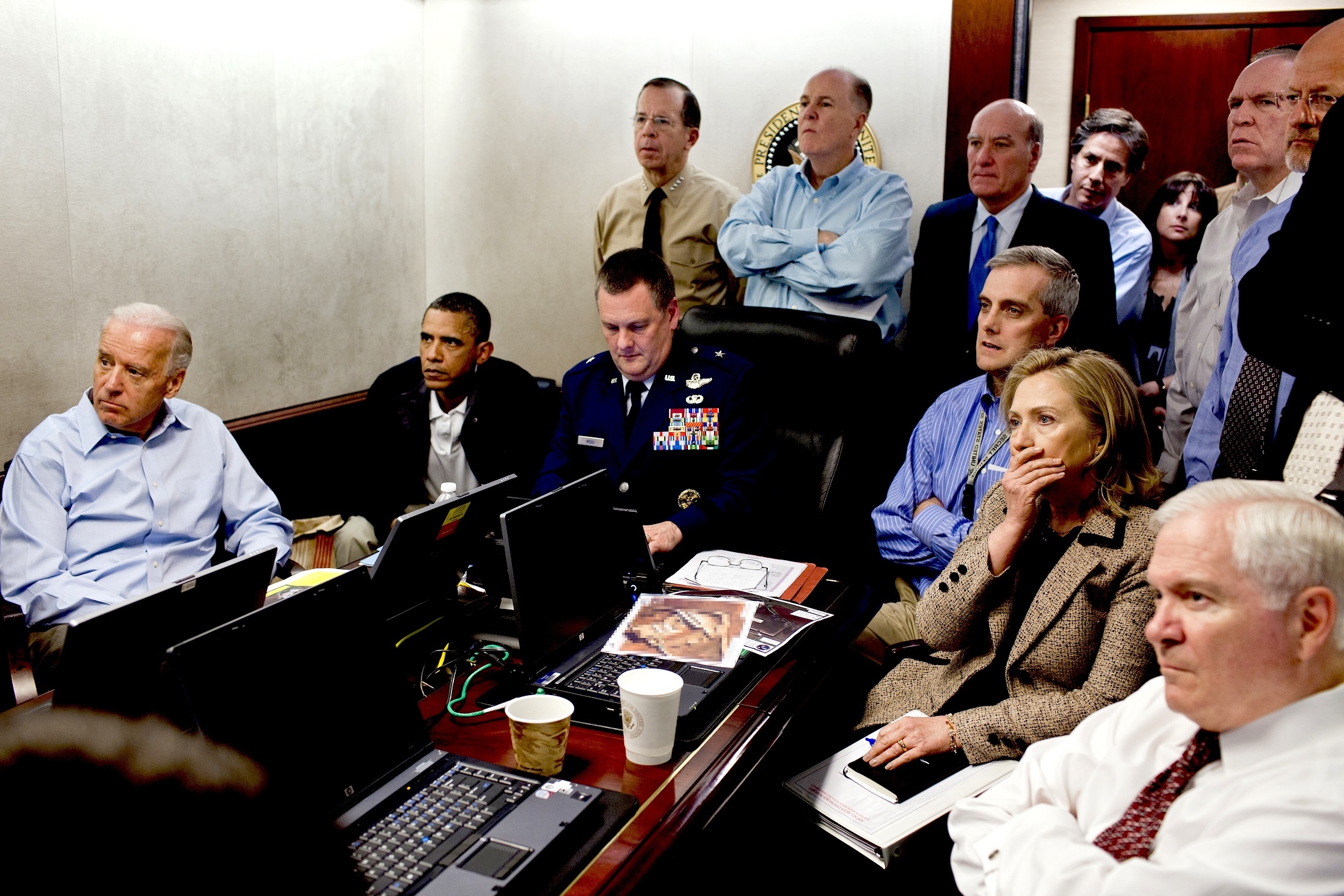
Obama and his national security team in the Situation Room, tracking the mission that killed Bin Laden, May 1, 2011. (Pete Souza/White House Flickr Feed, Wikimedia Commons, Public Domain)
Historically, eliminating enemy leaders dates back to monarchies, where decapitating opposition seemed tempting but was often unfeasible and deterred by fear of retaliation.
Opportunities arose when charismatic leaders personally led troops—like Alexander the Great—causing armies to collapse if their leader died.
In modern times, no single leader is deemed indispensable—not even generals. Afghanistan saw 18 commanders rotate not due to death but organizational routine, rendering leadership loss irrelevant, comparable to changing baseball managers.
Robots could equally command or fail. In World War II, leaders like Hitler, Stalin, Roosevelt, and Churchill mattered greatly, as did certain generals. However, targeted killings to thin enemy ranks represent a new development.
This strategy arose mainly to suppress insurgencies, especially Islamic jihadist groups. Its real effectiveness remains unmeasurable. The unprecedented number of named commanders, treasurers, and propagandists on kill lists underscores this shift.
(The moral compass of America operates in peculiar and paradoxical ways.)
The ultimate irony: If our distant ancestors were transported to today, they would marvel not only at our technology and wealth, but be horrified by how easily we kill each other en masse.
Morality still matters to many Americans—or at least its facade does—even as the nation commits fully to ruthless power politics and global domination by force and diplomacy alike.
Most believe America to be a moral people pursuing justice. As the motto goes: “When conquer we must, for our cause it is just; let this be our motto: In God is our trust.”
Some excuse minor lapses; most deny wrongdoing altogether. Hiroshima/Nagasaki? “We had no choice—it was them or us (hundreds of thousands G.I. casualties on the Honshu plain).” Vietnam? Erased from collective memory.
Iraq’s illegal invasion or 9/11? “We were misled.” Guantanamo? Torture? “We had to protect ourselves.” Raqqa? “Who is he?” Yemen genocide? “Wasn’t the Boston bombing also genocide?” Imperialism? “We’re surrounded by enemies bent on harm—Russia, Iran, North Korea, China, Venezuela, Pakistan, Mexico, Honduras” (add your latest news source for additional countries).
GAZA symbolizes the endpoint of an erosion in empathy, a resurgence of crude racism, depersonalized warfare, and the corruption of leaders who act as enablers for fanatics inspired by the darkest Old Testament passages.
“Indeed the idols I have loved so long;
Have done my record in men’s eyes much wrong,
Have drowned my honor in a shallow cup,
And sold my reputation for a song”
Original article: consortiumnews.com
About the Author