Trump Takes Aim at Passport Tourism
“We’re ahead of schedule and landing early,” the pilot announced. My wife and I were on a flight from Tokyo as the plane began its descent toward SeaTac Airport, located south of Seattle.
“There’s something else,” the cockpit voice added. “Two Chinese airliners are following us. So once we reach the jetway, please disembark promptly. Get through customs quickly, or you’ll find yourselves stuck in a long line.”
Forewarned, we hurried to International Arrivals and joined a quickly growing queue. Soon, from another corridor, emerged a surge of passengers arriving from those two Chinese flights, including about 40 visibly pregnant Chinese women heading toward the non-citizen passport line.
To be absolutely clear: it was unmistakable that these women were expectant mothers, a fact highlighted when my wife nudged me sharply and said, “What’s up with those pregnant ladies? They look like they’re about seven months along.”

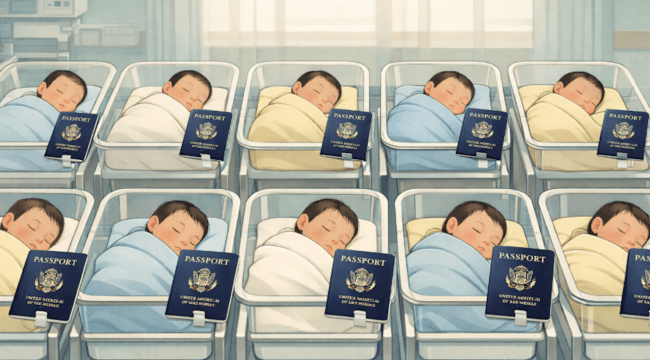
Hey everybody! Your US passport is an airline flight away. Image via ChatGPT.
Clearly, women have sharp instincts for such things. When it was our turn with U.S. Immigration and Customs, the story was just beginning…
“The Same Constitution”
You might already guess the direction this will take—an exploration of what’s often called “birthright citizenship,” but also known as “passport tourism.”
Currently, U.S. law interprets the 14th Amendment as granting citizenship to anyone born on U.S. soil or territories, except for a few exceptions like children of foreign diplomats. Essentially, who the parents are or their circumstances don’t matter. If a baby is born within U.S. borders, that infant automatically becomes a U.S. citizen.
This interpretation, however, is being reexamined by the U.S. Supreme Court in the case Trump vs. Barbara (S.Ct. Docket 25-365), argued recently on April 1, with President Trump personally present.
There is an abundance of academic work and legal commentary on the 14th Amendment and birthright citizenship, with experts guarding their turf fervently. In a few months, the Supreme Court will issue a decision. Is the debate settled? Time will tell.
As for me, I’m no constitutional scholar—just a taxpaying Navy veteran and geologist—but I find this aspect of American law intriguing. The notion that nearly anyone can arrive—by foot or plane—and through childbirth create a new citizen eligible for all rights and benefits is remarkable. So, I tuned in to the Supreme Court oral arguments.
One exchange particularly confused me, even unsettled me: the dialogue between Chief Justice John Roberts (a Harvard classmate, full disclosure) and U.S. Solicitor General John Sauer.

Undergraduate John Roberts, circa 1973. Courtesy Harvard Crimson.
In his opening statement, Sauer referenced “birth tourism,” noting that “uncounted thousands of foreigners from potentially hostile nations have flocked to give birth in the United States in recent decades, creating a whole generation of American citizens abroad with no meaningful ties to the United States.”
Sauer’s point struck me as plausible—reflecting my experience with the pregnant women at SeaTac. It’s evident these women traveled specifically to give birth in the U.S., and this isn’t isolated. Across the nation, this practice happens daily, fueling what effectively amounts to a birth-citizenship travel industry.
Following up, Roberts asked Sauer, “Do you have any information about how common that is, or how significant a problem it is?”
Sauer replied that “media reports” estimate over one million Chinese citizens have traveled to the U.S. for childbirth alone. He also cited a Congressional document discussing “Russian elites” who visit Miami for babies, utilizing “birth tourism companies.”
He further mentioned, “According to Chinese media, there are 500 birth tourism companies in the People’s Republic of China dedicated to bringing people here to deliver babies and then return.”
Roberts then rhetorically questioned, “Having said all that, you do agree that that has no impact on the legal analysis before us?” Essentially dismissing the significance of Sauer’s claims for the case at hand.
Sauer insisted, “We’re in a new era now, as Justice [Samuel] Alito highlighted, where eight billion people are just a plane ride away from having a child who’s a U.S. citizen.”
Roberts responded, “Well, it’s a new world. It’s the same Constitution.”
Wait just a second. That response felt dismissive and lacking curiosity about an important issue. Especially coming from the Chief Justice of the United States, it seemed overly casual and superficial.
Suicide by Constitution
Over time, the Supreme Court has interpreted the so-called “same Constitution” dynamically, adapting it through various human developments.
Consider the modern idea of a “living Constitution,” where the Court permits federal authority to expand in line with political will. The last 90 years of Supreme Court rulings demonstrate this clearly.
“Same Constitution” shouldn’t mean the nation’s founding document is an immutable artifact frozen in the 1787 mindset.
For instance, regarding the First Amendment’s free speech protections—do these apply solely to the communication methods available in 1787? The answer is obvious. Free speech is broadly protected, and government attempts to restrict it face serious legal challenge, demonstrated by decades of Supreme Court rulings.
What about the Second Amendment? Should it be limited to muskets from the late 18th century? Must firearms ownership be confined to flintlock rifles within a “well-regulated Militia”? Of course not. The Supreme Court’s approach to gun laws has evolved with societal changes.
Similarly, the Constitution authorizes Congress “to raise an Army” and “maintain a Navy.” Does that preclude an Air Force, which obviously did not exist in 1787? Arguing otherwise is silly, yet according to Roberts’ logic, this “same Constitution” notion may impede future progress.
Finally, consider Wickard vs Filburn (1942), a landmark case that extended federal regulation to minutiae of daily life—such as farming—under the guise of controlling interstate commerce. While American farming has roots tracing back to Jamestown in 1620 and symbolized liberty for centuries, after Wickard this simple act became subject to federal oversight.
This brings to mind Roberts’ comment to Sauer that “the Constitution is not a suicide pact.”
Though the exact origin is uncertain, President Abraham Lincoln reportedly coined this phrase during the Civil War in defense of suspending the Writ of Habeas Corpus. From today’s perspective, one might question that decision, but at the time it served a strategic purpose.

President Lincoln. Courtesy Library of Congress.
More recently, Justice Robert Jackson invoked “suicide pact” language in his dissent for the 1949 Supreme Court case Terminiello vs. Chicago, dealing with free speech. The phrase surfaced again in 1963 during Kennedy vs. Mendoza-Martinez, an opinion about due process authored by Justice Arthur Goldberg.
Now, the challenge we face involves birth tourism: fly in, have a child, gain citizenship, then leave.
My earlier story about the pregnant women at SeaTac dates back to 2015—over a decade ago—but it remains relevant. Both the New York Times and New York Post have recently reported on Chinese women traveling to the U.S. mainland or territories like the Mariana Islands to deliver babies, securing citizenship, social security numbers, and passports for their children.
Clearly, as noted in recent Supreme Court exchanges, this situation reflects a changed reality, far from the 1860s context when the 14th Amendment originated. And traveling to America no longer requires a lengthy ocean voyage—just an airline ticket, and you’re here.
It’s one thing for tourists to visit America, enjoy the sights, and return home with souvenirs like T-shirts or mugs.
Now, an entire segment of the tourism business involves transporting late-term pregnant women to give birth, enabling them to return home with a newborn who holds a U.S. passport—some might call it a “refrigerator magnet passport.”
To be fair, these expectant mothers don’t slip in illegally. They enter with valid visas—often a B-1 visitor visa—and obtain passport stamps permitting six-month stays. They don’t visit to take jobs from Americans. Yet, their “anchor babies” dilute the weight of native-born citizenship in broad terms.
These women pass through official entry points legally, then later raise their American-born children abroad, including in places like China under Communist rule.
A Crazy Way to Run a Country
To me, this situation seems strange: granting citizenship on the basis of a plane ticket and a six-month tourist visa. Was this truly the intent of the 14th Amendment’s framers, who sought to restore order after the Civil War?
Moreover, the contentious politics surrounding this topic—especially since President Trump aims to end “passport tourism”—causes many to reflexively reject the entire issue simply because of the source. Yes, Trump.
That said, no system is perfect, and the world is full of those who exploit it. Yet it’s remarkable—bordering on scandalous—that this debate has escalated into a demographic and political battle now before the Supreme Court.
The question faces nine justices amid the careful gestures of Washington politics, where signaling to peers and power brokers is as important as legal reasoning. There’s a progressive tilt to Washington’s political climate, and the Supreme Court is not isolated from that influence.
Ultimately, each justice balances national duty against personal ambition, income, and legacy. Are they serving the country, or have they become captive to the D.C. establishment?
Fundamentally, the issue boils down to whether “birthright citizenship” benefits the nation. More pointedly, how does “passport tourism” align with America’s broader goals?
We’ll learn the answers in a few months. Until then, that’s all for now.
Thank you for subscribing and reading.
About the Author