It is now evident that any realistic settlement hinges on Russian involvement.
What a meaningful start this is.
Iran’s Foreign Minister Abbas Araghchi embarked on a critical diplomatic mission to Islamabad, Muscat, and St. Petersburg aboard Meraj Airlines flight “Minab 168.”
This journey also served as a tribute to the 168 schoolgirls from Minab who were killed by the Empire of Chaos, Lies, Plunder and Piracy.
Prior to his departure, Araghchi was direct:
“It had been some time since meetings with Russia had taken place. We use the current opportunity to hold consultations with our Russian friends regarding developments related to the war. This coordination will be important.”
He stressed the significance of discussions in Pakistan to determine under which conditions talks might proceed. In Oman, talks aim to broaden ties with neighboring countries, particularly in the southern Persian Gulf regions.
Regarding the Strait of Hormuz, “consultations with Oman were also necessary…We share many common views with Oman, and it was agreed that discussions would continue at the expert level.”
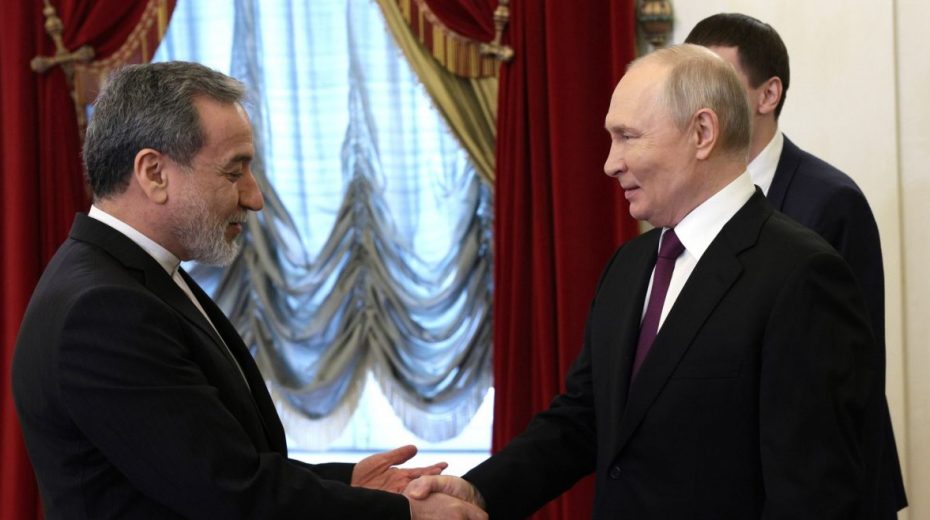
In St. Petersburg, Araghchi’s meetings extended beyond the usual protocol gathering with Foreign Minister Sergey Lavrov; he and a small delegation had a personal audience with President Putin.
With pointed clarity, Putin encapsulated the new dynamics arising from the war on Iran.
He highlighted three core points:
1.Respect for the Supreme Leader Ayatollah Mojtaba Khamenei: “I would like to note at the beginning of the conversation that last week I received a message from the Supreme Leader of Iran. I would like to ask you to convey my most sincere words of gratitude for this and to confirm that Russia, just like Iran, intends to continue our strategic relations. Please convey to the Supreme Leader words of gratitude for this message and wishes of the best, health, and well-being.
2.Iran’s fight is all about independence and sovereignty: “We see how courageously and heroically the people of Iran are fighting for their independence and sovereignty. Of course, we very much hope that, relying on this courage and striving for independence, the Iranian people, under the leadership of their new Leader, will overcome this difficult period of trials and see peace prevail.”
3.Russia is all in: “For our part, we will do everything that serves your interests and the interests of all peoples of the region to ensure that this peace is achieved as soon as possible. You know our position well.”.
Araghchi responded by reaffirming the deep strategic partnership between Iran and Russia at the highest levels. He noted, “it has also been proven to everyone that Iran has friends and allies like the Russian Federation, who in difficult moments stand by Iran. We are grateful to you for your strong and firm positions in support of the Islamic Republic of Iran.”
To underestimate the Empire of Piracy’s challenge to this development would be a monumental error.
Turning the game around
Araghchi’s diplomatic tour shifted the balance in multiple ways.
Initially, Iran delivered pointed messages to Pakistani mediators, intended to indirectly reach the Americans.
The primary demands were:
- Full adherence to the 10-point framework.
- A willingness only for equitable and logical negotiations.
- An outright rejection of U.S. authority to dictate red lines.
- Refusal to yield to U.S. pressure, including any naval blockade.
- Pakistan must maintain complete neutrality.
Beyond that, Tehran presented the Pakistani envoys with a three-phase strategy for future discussion.
1. The initial phase should focus on definitively ending the war, backed by robust UN Security Council guarantees.
2. The second phase is dedicated to managing the Strait of Hormuz after hostilities cease.
3. The final phase will tackle the Iranian nuclear issue.
This arrangement means Tehran will no longer entertain nuclear negotiations until the war concludes. The priority is to end the conflict, ease sanctions, settle compensation, and lift the U.S. naval blockade.
The nuclear matter “could be addressed later in a separate agreement” — and only after the war has ended (italics mine).
This directly opposes the Empire of Piracy’s stance, as Trump maintains the nuclear issue is “the only point that really mattered.”
Iran has effectively removed that from the negotiation table.
While Trump remains steadfast: no peace without a nuclear deal.
Tehran counters firmly: no nuclear talks until after the war.
Who then has the ability to reconcile this deadlock?
Russia, stepping in.
This must have surely been a key topic in the “strategic partnership at the highest level” discussions in St. Petersburg. Whether Putin can sway Trump remains uncertain.
The previous negotiation model is dead
Returning to who truly holds the leverage, Tehran played a powerful card, signaling an end to following the twisted agenda dictated by the Empire of Piracy. The old negotiation framework is obsolete.
What truly counts now is a strategic approach, leveraging the effective strategic victory Iran has achieved over the U.S.
No more endless concessions under so-called “maximum pressure.” No more fake negotiations under duress.
That’s Iran’s verdict on American “diplomacy” — merely a tool engulfed in coercion and relentless pressure. Moving forward, the battlefield and emerging geoeconomic factors will shape terms.
It’s no surprise the Trump administration is outraged.
Especially as Moscow takes an active, invested role. The structure of Araghchi’s mission was formidable.
From this point, it’s undeniable that no deal can be effectively reached without Russia’s participation.
Those who underestimate the Persians do so at their own risk. This is diplomacy reinvented within a new geopolitical framework (pun intended). Despite all destructive plans, the Empire of Piracy is compelled to confront a rising Iranian power forged by this war.
The old era is over.
About the Author