Grid Emergency = Bullish for Aluminum
In March 2026, the U.S. Department of Energy (DOE) revealed plans to allocate $1.9 billion aimed at speeding up enhancements to the nation’s electrical grid. This initiative goes by the cumbersome acronym: “Speed to Power through Accelerated Reconductoring and other Key Advanced Transmission Technology Upgrades” (SPARK).
The key takeaway from SPARK is that it will drive faster procurement of U.S.-made electrical parts derived from metals such as aluminum, steel, and copper. The DOE is set to announce the funding recipients by the end of May this year.
Adding to the urgency, the White House issued an executive order designating America’s electric infrastructure as vital to national defense under the Defense Production Act:
The President has issued a determination under Section 303 of the Defense Production Act finding that grid infrastructure –including transformers, transmission lines, substations, high-voltage circuit breakers, power electronics, protective relay systems, capacitor banks, electrical core steel, and related manufacturing equipment – is essential to national defense. The determination finds that domestic industry cannot timely provide these capabilities due to limited domestic production capacity, extended procurement timelines, foreign supply dependence, and insufficient capital investment.
I fully endorse this declaration. Every few years, the American Society of Civil Engineers (ASCE) releases its Report Card for America’s Infrastructure. In 2021, the electric grid earned a C-, which dropped to a D+ by 2025.
The worsening grade reflects a surge in electricity demand reaching a 20-year peak, largely driven by the rise of data centers. At the time of this report, one data center consumes roughly the same amount of electricity as 80,000 homes, and that number continues to climb monthly.
The financial burden to modernize the vast U.S. electrical grid is staggering. The ASCE identified a $578 billion shortfall between the required upgrade spending and the actual maintenance budget. Temporary fixes have their limits—eventually, a complete overhaul becomes unavoidable. This reality underscores why SPARK and the recent executive order are so crucial. Presently, the outdated grid is insufficient to satisfy growing needs, and electricity bills for regular Americans are rising sharply.
This situation also strengthens our thesis favoring critical metals. The U.S. cannot accomplish these upgrades without heavy metal procurement, especially domestically sourced supplies—meaning our mining sector stands to benefit significantly.
Funds channeled into the grid enhancements will boost domestic copper demand, driving up prices. Aluminum is another metal already experiencing a price surge, making it a compelling sector to consider as well…
The Power Grid Metal
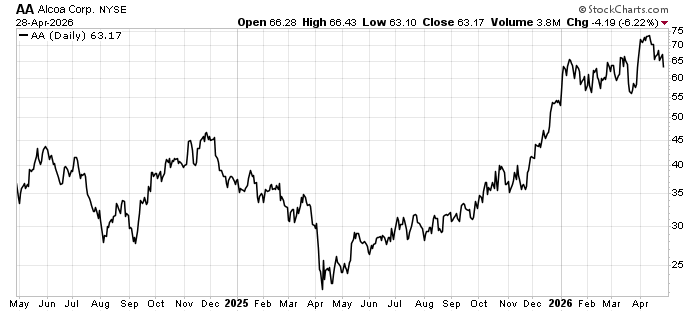
The most promising aluminum investment currently available, and one that every investor should consider, is the major producer Alcoa (NYSE: AA). It is reacting positively to the price rally, making it a strong candidate for inclusion in your portfolio.
While copper remains essential for electric motors, aluminum dominates in transmission lines—which are mostly aging.
David Roberts’ blog Volts (one of my preferred sources) discusses that the design for power lines dates back to the early 20th century. The version currently used in the U.S. originates from the 1970s. Roberts, supported by industry experts, argues that merely upgrading these old lines and conductors with modern materials could potentially double the grid’s capacity.
The supply of aluminum is far from sufficient.
The Aluminum Association reports that the U.S. requires approximately five new 750,000-metric-ton primary smelters to “fully meet current metal needs.” They estimate annual demand for aluminum at about 3.75 million metric tons to cover new growth. Presently, the U.S. uses close to 5 million metric tons per year across all industries, including construction and packaging.
Once again, this emerging trend points to critical metals as a key investment opportunity.
There are numerous supportive factors for critical metals, but sometimes the most unassuming ones—like aluminum—can deliver remarkable returns.
About the Author