This article is adapted from a speech given at the Ron Paul Institute Spring Conference in Lake Jackson TX on 25 April 2026.
Let’s start our look into the US-Israel alliance by journeying to a place far removed from Tel Aviv or Washington — and back over three and a half decades.
On December 20, 1989, the United States launched an invasion of Panama to remove its leader, General Manuel Noriega, who had outlived his usefulness to US interests. This was the largest American military action since the Vietnam War and set the stage for a series of ongoing regime-change interventions. Operation Just Cause resulted in 23 US fatalities and 325 wounded service members.
At that time, I was a newly commissioned platoon leader with the Army’s 5th Infantry Division stationed at Fort Polk, Louisiana. Among my comrades in a battalion rotating through Panama, two soldiers perished during the assault on the Comandancia—the Panamanian Defense Forces’ headquarters.
Though not directly involved in the initial invasion, my Military Police unit was soon deployed to Panama to carry out joint patrols in Panama City alongside the nation’s newly reorganized and demilitarized security forces.
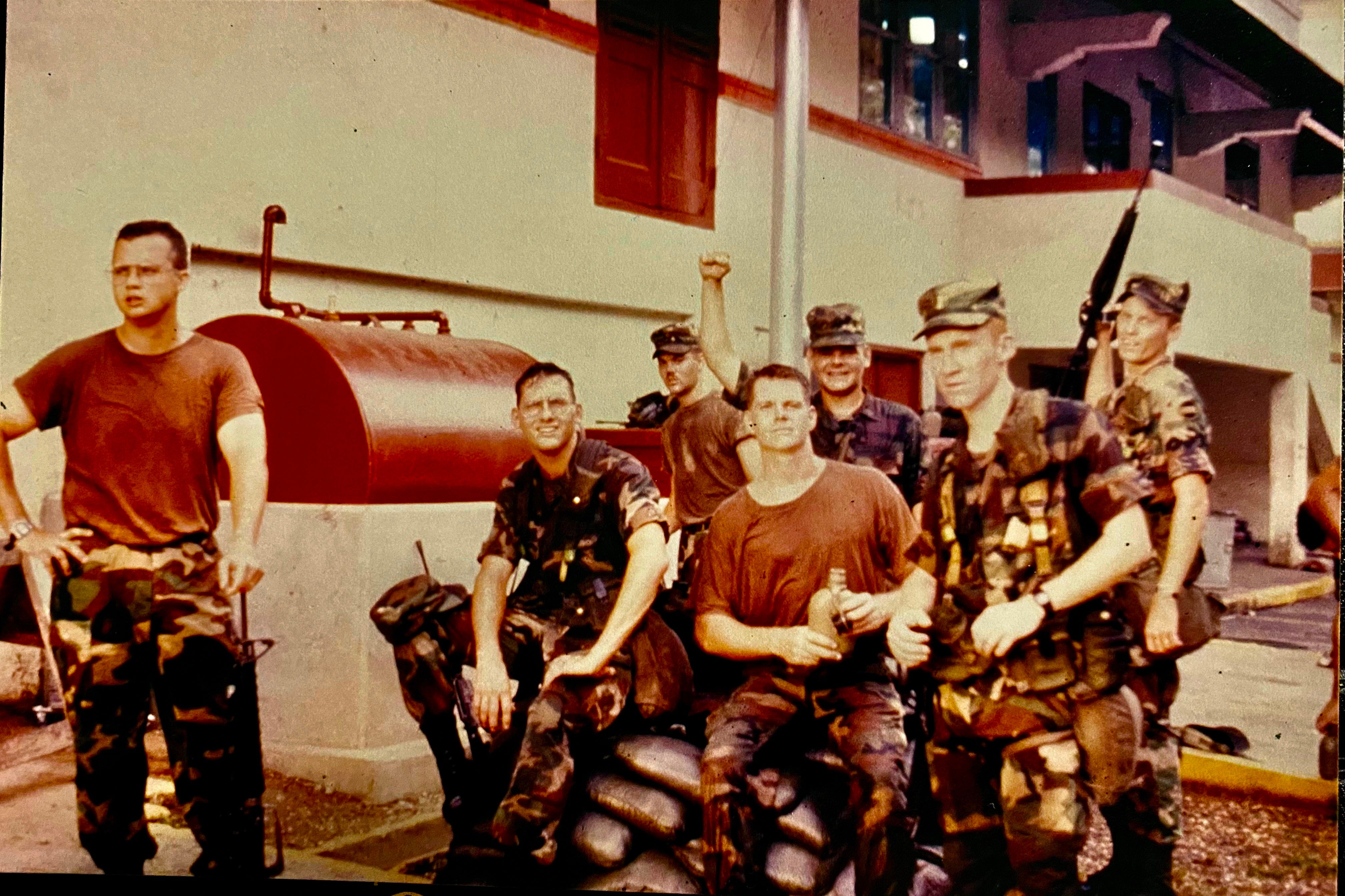
Second from right: The author, then-Second Lieutenant Brian McGlinchey, with fellow soldiers who deployed to Panama after the 1989 US invasion
A few weeks into my deployment, while outside a police station near Tocumen International Airport, I spoke with one of the Panamanian officers assigned to work with us, a major. He revealed that on the night of the invasion, he had been at the Comandancia, the site of one of the bloodiest battles. Recognizing the trauma he must have endured, I silently expressed my respect.
Then, unprompted, he told me, “We knew you were coming.”
“How?” I asked.
He responded, “The Israelis told us.”
That moment, under the blazing Panamanian sun, marked the beginning of my understanding of the true dynamics behind the US-Israel alliance.
This relationship is unparalleled in global history. It’s arguably the most unusual partnership between two nations ever witnessed.
The world’s foremost economic and military giant effectively submits to a tiny state that, without US backing, would be nearly insignificant. Beyond transferring vast wealth to this affluent country, America wholly adopts its geopolitical agenda, often taking drastic actions that damage its own interests while devastating countless innocent lives.
The price of US support for Israel extends far beyond financial figures, yet to start, let’s consider the money—always borrowed and costly.
The commonly cited figure is “$3.8 billion a year,” the minimum amount pledged by the US under the current decade-long memorandum of understanding. However, with supplemental funding, actual aid frequently exceeds this baseline. For instance, following Israel’s October 7 Hamas incursion, Congress allocated an extra $8.7 billion in assistance.
Israel consistently ranks as the top yearly recipient of US aid by a wide margin, except for a brief disruption due to the Ukraine conflict. Since World War II, Israel has received nearly twice the aid allotted to the next largest beneficiary. Consider this: Israel accounts for only 0.12% of the global population but has obtained about 30% of total US aid since the war.
Such figures become even more startling when factoring in Israel’s status as one of the wealthiest nations globally, ranking 20th in per-capita GDP, ahead of Austria, Germany, the UK, Canada, and France. Yet Israel often receives more than twice the aid that the entire sub-Saharan Africa region combined receives from the US.
But direct aid is only part of the story. The US also spends substantial sums on behalf of Israel. Egypt, the second-largest total aid recipient since World War II, effectively receives funding as part of the Camp David peace accord with Israel.
Likewise, Jordan, which ranks third in recent years due to the 1994 treaty with Israel, adds to the total financial commitments linked to Israel’s strategic interests. Essentially, these funds secure Egypt’s and Jordan’s compliance.
Additionally, the US government often employs bureaucratic methods to mask the true extent of aid to Israel. In only half a year post-October 7, the Biden administration approved over 100 arms deals structured carefully to avoid detailed Congressional reporting. Other covert approaches include providing US weapons from stockpiles within Israel designated for US use.
All US assistance to Israel comes as military aid, representing over half of global military support to one country. Remarkably, because Israel’s share of US aid is so substantial, its advocates actually encourage increasing aid to other allies—not to enhance their security, but to lessen Israel’s disproportionate share.
Israel’s aid package includes highly favorable terms: unlike other countries, Israel receives its entire annual aid at the beginning of the fiscal year, deposited in a special Federal Reserve account where it accumulates interest.
Here’s a stark truth: every single aid dollar sent to Israel violates US law. The Glenn and Symington amendments forbid aid to nations that have developed nuclear weapons outside the Nuclear Non-Proliferation Treaty, of which Iran is a member.
However, the largest toll comes from regime-change wars, which Donald Trump firmly vowed to end.
Adopting Israel’s priorities, US foreign policy focuses on preventing the emergence of any potential regional competitors. With Egypt and Jordan, obedience is “rented,” but elsewhere, Israel’s dominance is ensured by continuously destabilizing rival states.
The most extreme tactic is regime overthrow, exemplified by Israel and its US allies’ roles in the invasion of Iraq to remove Saddam Hussein and the prolonged, brutal effort to dislodge the Assad regime in Syria.
Financially, these campaigns represent a colossal expense. The Brown University Costs of War Project estimates that the US expenditures linked to securing Israel’s regional supremacy have reached $2.9 trillion.
A significant portion of this includes long-term healthcare and disability payments for veterans—men and women who enlisted to protect the United States but instead served the interests of a distant, small nation.
Shifting focus from monetary cost to the immeasurable human suffering:
In Iraq alone, 4,600 US troops lost their lives, and 32,000 were severely wounded. Furthermore, a tragic trend of suicides among soldiers afflicted by traumatic brain injuries, PTSD, and moral injury continues. The latter refers to the profound psychological distress resulting from actions or omissions that violate an individual’s moral beliefs.
While Iraq and Syria are notable examples, numerous other US deployments trace back to the US-Israel relationship. For instance, the 1983 truck bombing of a Marine barracks in Beirut killed 241 Americans. Their presence was part of a peacekeeping mission following Israel’s invasion of Lebanon, which saw horrifying atrocities.
Many might not grasp that the 2012 attack in Libya, which claimed the lives of a US Ambassador, a foreign service official, and two CIA contractors, is also linked to Israel. Why was the Ambassador in Benghazi? Why was there a CIA safe house nearby? As Seymour Hersh reported, weapons were being smuggled from Libya to Syria to support the effort to remove Assad in alignment with Israel’s agenda.
Beyond these American casualties, these wars have wreaked havoc on millions of civilians abroad, causing massive death, displacement, and suffering on an immense scale. In Iraq and Syria, estimates range around half a million fatalities, with many more dying indirectly from factors like disease. Millions became refugees, straining host nations.
The US doesn’t only deploy military might to inflict hardship for Israel’s benefit; economic sanctions also impose widespread suffering.
Many view sanctions as a peaceful alternative to warfare. However, as Ron Paul enlightened me, sanctions amount to another form of warfare.
Conservative estimates suggest that 100,000 Iraqi children have died due to malnutrition and disease caused by US sanctions. When UN ambassador Madeleine Albright was presented with the higher estimate of 500,000 child deaths, she shockingly remarked, “we think the price is worth it.”
For decades, Iranian civilians have endured hardship under sanctions. These are not abstract economic metrics but real human tragedies: Iranians forced to buy rotting produce because it’s all affordable; young people unable to find jobs or housing; children in cancer wards deprived of medication since manufacturers fear US Treasury penalties despite exceptions.
This year has seen yet another aggressive war, ignited under false pretenses amid negotiations—a war that killed 150 young schoolgirls in its opening hours and threatens global economic collapse and widespread famine. This conflict only adds to America’s record as a source of global suffering spanning decades.
All the damage inflicted on Israel’s behalf reverberates back and threatens life within the US. Dr. Paul famously told Rudy Giuliani and a GOP presidential debate audience that Americans pay dearly for backing Israel in the form of terrorism fueled by rage and resentment.
A prime example is 9/11. Although framed as an assault on “our freedom,” clear evidence shows US support for Israel was a core motivation:
- In his 1996 declaration of war, bin Laden referenced an IDF massacre of 106 Lebanese civilians seeking refuge in a UN compound, blaming the US for arming and financing “your Zionist brothers in Lebanon.”
- He later stated he was motivated to attack American skyscrapers after witnessing Israel destroy Lebanese apartment blocks.
- The 9/11 Commission noted that Khalid Sheikh Mohammed’s hostility toward the US stemmed from “his violent disagreement with US foreign policy favoring Israel.”
- 9/11 hijacker Mohammed Atta signed his will on the first day of Israel’s 1996 Operation Grapes of Wrath attack on Lebanon. A friend reported Atta was enraged and dedicated his life to the cause through his will.
- An acquaintance of one hijacker asked why Atta and his comrades never smiled. He replied, “How can you laugh when people are dying in Palestine?”
Without US backing of Israel, 9/11 likely would not have occurred. While other factors contributed, the core Israel-Palestine conflict was central. And without 9/11, the Afghanistan war—responsible for 2,400 American deaths, 20,000 injuries, and $2 trillion in costs—would have been avoided.
“How can you laugh when people are dying in Palestine?” Like others in the 9/11 plot, United Flight 175 hijacker-pilot Marwan al-Shehhi victimized innocents because of US support of Israel
9/11 is only the most well-known case. Many other attacks stem from hostility related to US support for Israel and American interventions serving Israeli interests. These include the first World Trade Center bombing, the 1998 African embassy bombings, shoe-bomber Richard Reid, the 2017 Times Square bombing attempt, and the Pulse nightclub mass shooting in Tampa.
Given Israel’s recent strikes on Gaza and Lebanon using US-supplied arms—killing at least 72,000 Palestinians and devastating vast areas—we can only dread what the future might hold.
Besides risking American lives, the US-Israel bond increasingly threatens civil liberties, with a powerful pro-Israel lobby exploiting the government against political adversaries.
More than 30 states have outlawed doing business with individuals or companies that boycott Israel. In Texas, hurricane victims faced demands to pledge not to boycott Israel before receiving disaster aid.
The Heritage Foundation devised a scheme labelling pro-Palestinian activists as “effectively members of a terrorist support network,” enabling harassment, deportation, lawsuits, job losses, and social exclusion.
The Trump administration aggressively pursued this policy, initially targeting foreign students. Notably, a peaceful Tufts University PhD candidate in child development was arrested, shackled, and jailed in Louisiana for co-authoring a student op-ed urging her university to recognize Israel’s Gaza conduct as genocide and divest from Israel-linked investments.
While targeting foreign nationals was easier, similar punishments against Americans are also on the horizon. In countries like Germany and Australia, even uttering “from the river to the sea, Palestine will be free” can lead to imprisonment.
For years, falsely accusing Israel critics of antisemitism has been a key silencing tool. But that smear is increasingly written into laws and policies, as many governments adopt the International Holocaust Remembrance Alliance’s “working definition of antisemitism.”
Under this definition, it can be considered antisemitic to:
- Compare Israel’s actions to Nazi Germany
- Claim Israel is inherently racist
- Advocate for a new governance structure for the 15 million people, about half Palestinians and half Jews, living between the Jordan River and the Mediterranean
The US Department of Education now uses the IHRA definition to launch Civil Rights investigations against universities, imposing millions in fines, coerced donations to Jewish groups, mandates to adopt IHRA standards, and revisions of Middle East studies programs.
What is framed as civil rights enforcement is, in truth, a campaign to eliminate criticism of Israel and the US-Israel partnership across campuses.
Supporters of this alliance often offer circular logic. They argue backing Israel is necessary because many in the Middle East harbor hostility toward the US. Yet, most of that anger arises precisely from America’s support of Israel and the enabling of Palestinian oppression.
Essentially, their logic boils down to: “The US must arm Israel because Middle Easterners hate the US for arming Israel.”
When they defend support from a geopolitical perspective, they portray Israel as a critical “bulwark” against Iran. Asked why America needs such protection, the answer comes: because Iran opposes Israel. None of this reflects genuine American interests.
This flawed reasoning becomes even more problematic when Americans are targeted by terrorists angered over US Israel support. Predictably, Israel’s defenders argue such attacks justify increased backing for Israel.
Israel is also touted as a vital intelligence ally. Yet, repeatedly, it has fed false information to manipulate US policy.
Recall Netanyahu’s assertion before Congress that Saddam Hussein was “feverishly” developing nuclear weapons. Israel has disseminated fabricated intel on Iran’s nuclear ambitions, including forged documents circulated through groups like the MEK.
Last summer, early in the current conflict, Netanyahu claimed without evidence that Israel had intelligence of Iran planning to provide future-developed nuclear weapons to terrorist proxies—a statement retracted quietly after no one believed it. It was a trial balloon, nothing more.
At present, the fallout from unreliable Israeli intelligence is significant. In a notorious mid-February briefing to Trump, Mossad made absurd predictions: that Iran’s missile abilities would vanish in weeks, that citizens would rise against their government, that Kurdish forces might invade Iraq sparking a ground war, that Iran was unlikely to strike US bases nearby, and that Iran couldn’t close the Strait of Hormuz.
Thank you, Vital Intelligence Partner and Greatest Ally in the Region!
Besides being a ridiculously costly war for Israel, this conflict is depleting the US military’s readiness for other threats.
In the past seven weeks, the Pentagon has exhausted half its global Patriot missile stockpile. Within only four days, more Patriots were fired than supplied to Ukraine in four years. The military has also used nearly half its Precision Strike Missiles, THAAD antimissile systems, and about a third of Tomahawk missiles, requiring years to replenish.
Sometimes, Israel withholds valuable intelligence if it sees a benefit to leaving the US vulnerable. Former Mossad agent Victor Ostrovsky recounted that before the 1983 Beirut Marine barracks bombing, Mossad learned of Shiite militants building a massive truck bomb likely aimed at a US target. However, they believed such an attack would fuel American hostility toward Arabs, aiding Israel, and so only issued vague warnings that allowed the bombing to proceed.
The US Marines’ barracks in Beirut: A former Mossad agent said Israel concluded militants were plotting a major truck-bomb attack on a US target but withheld information about it (AP: Jim Bourdier via US State Department)
Claims that Israel is a vital intelligence partner overlook that it is also a significant intelligence adversary, conducting extensive espionage within the United States beyond what other traditional allies have done.
Former CIA officer John Kiriakou has described being briefed about the FBI uncovering 187 undisclosed Israeli intelligence operatives spying inside the US—surpassing the KGB—with most focused on stealing military technology.
In 2014, a congressional staffer reported being briefed on Israeli espionage in the US, describing the revelations as “very sobering…alarming…even terrifying.”
Among disturbing disclosures, Edward Snowden revealed the NSA regularly shared raw intelligence—including intercepted communications of American citizens—with Israel, which only pledged not to misuse it. There is no reason to believe this practice has ceased.
And recall Jonathan Pollard, perhaps the most damaging spy in US history, who stole 360 cubic feet of classified materials from CIA, NSA, State, Pentagon, and DOJ. Upon release, billionaire GOP donor Sheldon Adelson flew Pollard to Israel, where Netanyahu personally welcomed him, signaling disdain for the country manipulating America.
What about Israel’s intelligence cooperation during the USS Liberty incident? In June 1967, the Liberty, the world’s most advanced spy ship, operated in international waters off the eastern Mediterranean during the Six-Day War. Israel launched a brutal attack killing 34 and wounding 170. This was not a mistaken nighttime strike but a deliberate, extended assault in daylight involving multiple waves from bombers and torpedo boats. While the exact motive remains unclear—possibly a false flag to draw the US into the war on Egypt—the aftermath featured a rushed, sham investigation aimed at denying any intentionality. Survivors have persistently sought justice, including Phil Tourney, who is present today and deserves recognition.
Among softer claims supporting US-Israel ties is the assertion that Israel is “the only democracy in the Middle East.” Though Israel holds elections, this is misleading since voting rights extend to only about half the people living under its control.
Despite talk of future annexation of the West Bank and Gaza, Israel has ruled territories between the River and the Sea for 58 years. Millions of Palestinians in these areas do not participate in Israel’s exemplary democratic system.
Palestinians in the West Bank live under martial law, subject to military detention without trial and judged by military tribunals. They suffer political disenfranchisement, violence by settlers, and constant humiliation by IDF soldiers.
Another common justification is that the US and Israel share values. Consider this in light of the horrors witnessed in Gaza and Lebanon, including accusations from IDF soldiers themselves:
- Systematic destruction of homes, villages, farmland, and olive groves
- Deliberate blocking of food and medicine supplies
- Use of 2,000-pound bombs in crowded civilian areas
- Deployment of deadly force for crowd control at food distribution points
- Drones dropping grenades on civilians wandering into unmarked no-go zones
- Use of Palestinian civilians as human shields to clear buildings
- Targeting of ambulance convoys and hospitals
- 72,562 deaths in Gaza and climbing
- Doctors worldwide expressing horror at clear patterns of intentional gunfire on civilians, including women and children
- A British surgeon from Gaza noting strange clusters of precise gunshot wounds, concluding IDF soldiers appeared to be “playing some sort of game”
- The IDF’s routine targeting of journalists, with Gaza war casualties surpassing the combined total killed in the Civil War, WWI, WWII, Korean War, and Vietnam War — combined. Another journalist was killed recently in Lebanon.
- The twisted IDF social media trend of male soldiers donning women’s underwear found in homes abandoned by Palestinians fleeing the IDF offensive
Worsening the situation, Israeli society itself demonstrates rising extremism. A recent poll revealed 82% of Israeli Jews support forcibly expelling Gaza’s Palestinian population abroad, and 56% favor expelling all Arab citizens within Israel.
This next poll is particularly sobering, conducted by university professors and published in Israel’s oldest newspaper.
The question asked: “When conquering an enemy city, should [the IDF] act like the Israelites did when they conquered Jericho under Joshua, that is, kill all its inhabitants?” Astonishingly, 47% of Israeli Jews answered yes, kill them all. FORTY-SEVEN percent.
Such values clearly do not reflect those of this audience or most Americans. Despite the flaws in American society, it is certain that most US citizens do not share those views. From an international relations perspective, it is difficult to conceive a worse declaration than “America shares Israel’s values.”
Yet, here is something positive about the US-Israel relationship: a significant shift is underway, as the American public grows increasingly fed up with it.
According to a recent Pew Research survey, nearly two-thirds of Americans hold unfavorable views of Israel. The share expressing very unfavorable opinions has tripled.
Though a significant divide remains, bipartisan consensus is emerging. 80% of Democrats and 41% of Republicans view Israel negatively. Among Republicans under 50, 57% feel unfavorably, and 74% of Gen Z sympathize more with Palestinians than with Israel.
Another notable development in this midterm election year is the growing number of politicians—increasingly Democrats—pledging to reject Israel lobby funding and criticize opponents accepting it.
Simultaneously, allegations of antisemitism, once effective in silencing critics, now often provoke defiance or ridicule.
These accusations have been directed at me for my writings and will be for this speech. But I assure Benjamin Netanyahu, Mark Levin, oligarch-funded politicians like Miriam Adelson, and the defamatory Anti-Defamation League that with every false jab, their weapon grows duller.
My story began with an episode following the Panama invasion known as Operation Promote Liberty—a name prophetic for a 22-year-old lieutenant who would later embrace Ron Paul’s noninterventionist ideals.
Now is the time for Americans across the political spectrum—conservatives, libertarians, liberals, progressives, socialists—to unite in forming a broad coalition to liberate ourselves from the many harms of the US-Israel relationship, including:
- Freedom from foreign influence, which George Washington warned is “one of the most baneful foes of republican government”
- Freedom from the relentless transfer of American wealth to what is already one of the world’s wealthiest nations
- Freedom for America-First patriots—who should no longer be slandered as antisemites for opposing one of America’s most entangling alliances
- Freedom from terrorism fueled by US support for Israel and disastrous American wars fought to advance Israel’s agenda
- And freedom for American service members, who must no longer be sent to sacrifice their lives, limbs, and minds in morally bankrupt wars aimed at benefiting an undemocratic, expansionist, and apartheid state.
Original article Stark Realities via ronpaulinstitute.org
About the Author