To say not much happened during Trump’s two days in the Chinese capital, as a lot of people seem to think, is to miss the forest for the trees.
By Patrick LAWRENCE
How refined and subtle are the Chinese in their conduct, enriched by two thousand years of experience in governance and diplomacy. They can communicate to an important visitor that the nature of relations — and with them, the global order — has shifted, all before a cup of lapsang souchong is served.
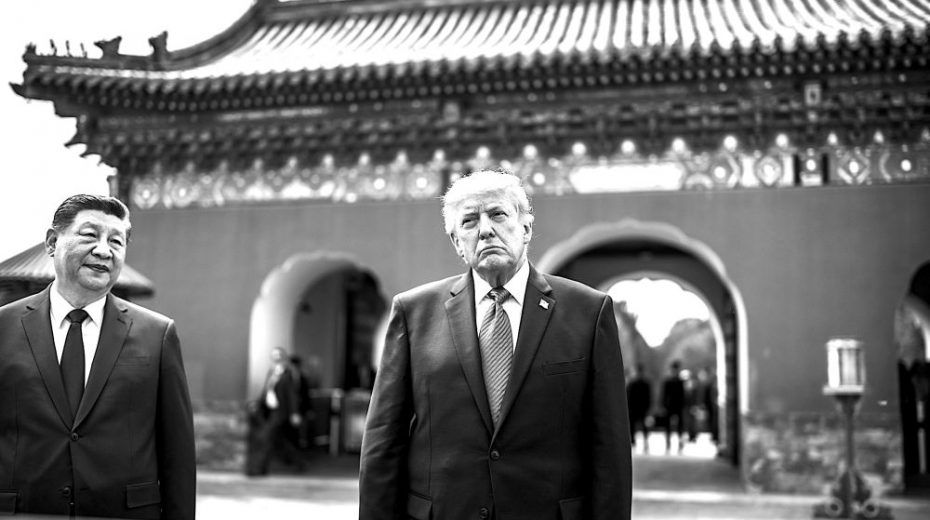
Donald Trump encountered this full diplomatic nuance. This became evident the moment he stepped down from Air Force One last Thursday for his two-day meeting with Xi Jinping. Notably, the Chinese leader did not come to welcome him at the airport; instead, children waved flags while Vice President Han Zheng, a less prominent figure, greeted Trump.
Silence spoke volumes—a hallmark of Chinese diplomatic style.
Later, at the Great Hall of the People, the symbolism grew clearer: Xi remained at a distance, not advancing as Trump, bearing his trademark slouch of exhaustion, approached him. Here is the CBS News footage worth observing closely.
The meticulousness of Chinese protocol is indeed impressive.
Claiming that Trump’s two days in Beijing were uneventful, as many suggest, overlooks the bigger picture. From arrival to departure, Xi made it unmistakably clear—without exaggeration—that the so-called leader of “the free world” no longer holds global primacy.
This is my interpretation of the events in Beijing last Thursday and Friday.
Historically, power has moved westward: from Imperial China to Europe, across the Atlantic, then over the United States.
The shift toward the Pacific has been apparent for a while. Xi seized this moment to inform the 47th U.S. president that the transfer of power is irreversible and that both nations must accept their places within a new global framework.
Beijing’s timing is unsurprising. After a year plus into Trump’s second term, his administration has demonstrated an utter lack of seriousness in preserving any form of global order.
Even before Trump, China and Russia viewed the U.S. and its so-called “rules-based order” as a destabilizing force. The reckless conduct of Trump II finally compelled Beijing to respond, primarily through diplomacy, to prevent a descent into chaotic international disorder.
Retreat From One China Policy
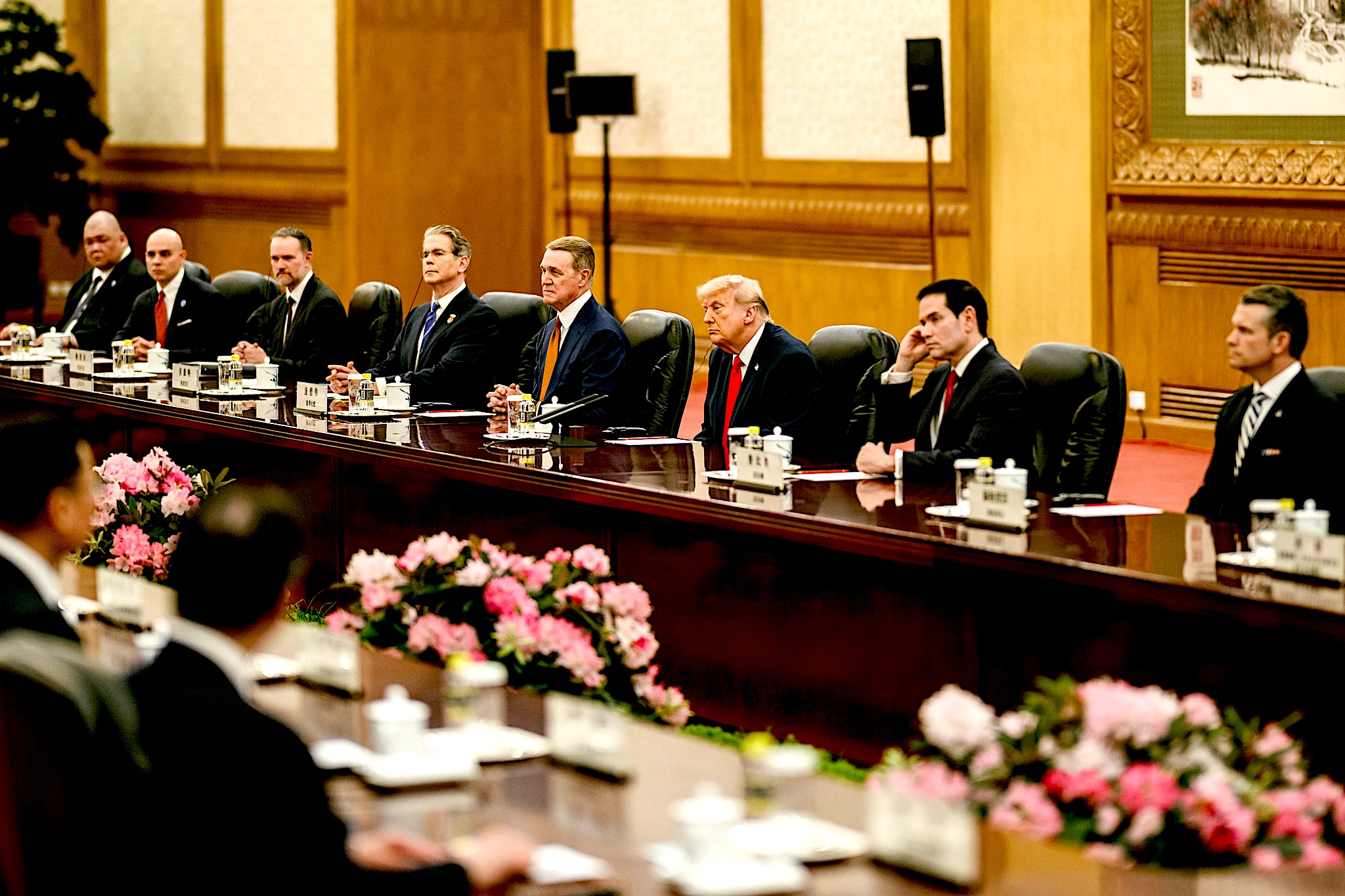
Trump and his delegation meeting with Xi and Chinese counterparts in the Great Hall of the People in Beijing on May 14. (White House/Daniel Torok)
On a bilateral level, Washington has persistently sought—since Biden took office—to undermine China’s technological progress while simultaneously retreating incrementally from the commitments made in 1979, when the Carter administration endorsed the One China policy by shifting recognition from Taipei to Beijing.
Massive arms sales to Taiwan—more than 30 during the Trump and Biden administrations combined—constant U.S. Navy freedom of navigation operations in the Taiwan Strait, provocative visits by figures like Nancy Pelosi, Biden’s repeated pledges to defend Taiwan militarily, and tacit endorsement of the island’s independence movement have all infuriated Beijing. With another $14 billion arms sale pending, Xi made this a primary subject of discussion with Trump on their first day.
This message, however, is not new. Taiwan is to China as Long Island is to the United States. The incessant phrase “Taiwan, which China claims as its territory” must be especially vexing to the Chinese.
Yet Xi’s pointed and immediate warning to Trump last week was unusually firm in my view—an unmistakable declaration signaling, The game’s up. The Foreign Ministry’s summary of their first-day talks quoted Xi as saying:
“The Taiwan question is the most important issue in China–U.S. relations. If it is handled properly, the bilateral relationship will enjoy overall stability. Otherwise, the two countries will have clashes and even conflicts, putting the entire relationship in great jeopardy.”
That sounded like a rebuke, and it appears to have been intended that way. Notably, Trump quickly distanced himself from the recent “salami-slicing” tactics, stating in a Fox News interview from Beijing last Friday:
“I’m not looking to have somebody go independent, and you know, we’re supposed to travel 9,500 miles to fight a war…. I’m not looking for that. I want them to cool down. I want China to cool down. We’re not looking to have wars, and if you kept it the way it is, I think China’s going to be O.K. with that.”
It’s bewildering how anyone could then conclude that little occurred in Beijing. This statement effectively returns U.S. policy toward the One China principle (or nearly so) and acknowledges cross-Strait issues as internal matters rooted in the civil war that ended in 1949.
Granted, Xi listened as Trump rambled on the Taiwan issue, and China will need luck with that. It’s also probable that Trump will eventually approve the $14 billion weapons sale that China hawks demand.
Interestingly, when asked on Fox News if he planned to authorize the arms deal, Trump replied, “No, I’m holding that in abeyance. It’s a very good negotiating chip for us, frankly.” That hardly instills urgency about the missiles and air defense systems.
My takeaway after Beijing is that U.S. posture on Taiwan has shifted significantly. The arms deliveries, congressional visits, and naval passages through the Taiwan Strait will now amount to mere symbolism, not decisive action.
Despite pressures from China hawks on Capitol Hill, a military confrontation with Beijing over Taiwan seems virtually impossible. The saber-rattling will remain all talk.
I base this on two points. First, Trump appeared genuinely moved by the stern message implicit in Xi’s Taiwan warning, which should be taken seriously. Beijing’s red line has become unmistakably clearer.
Second, Xi’s confident demeanor throughout their talks reflects the degree to which the balance of power—both in bilateral relations and globally—has swung in China’s favor.
China’s View of US War on Iran
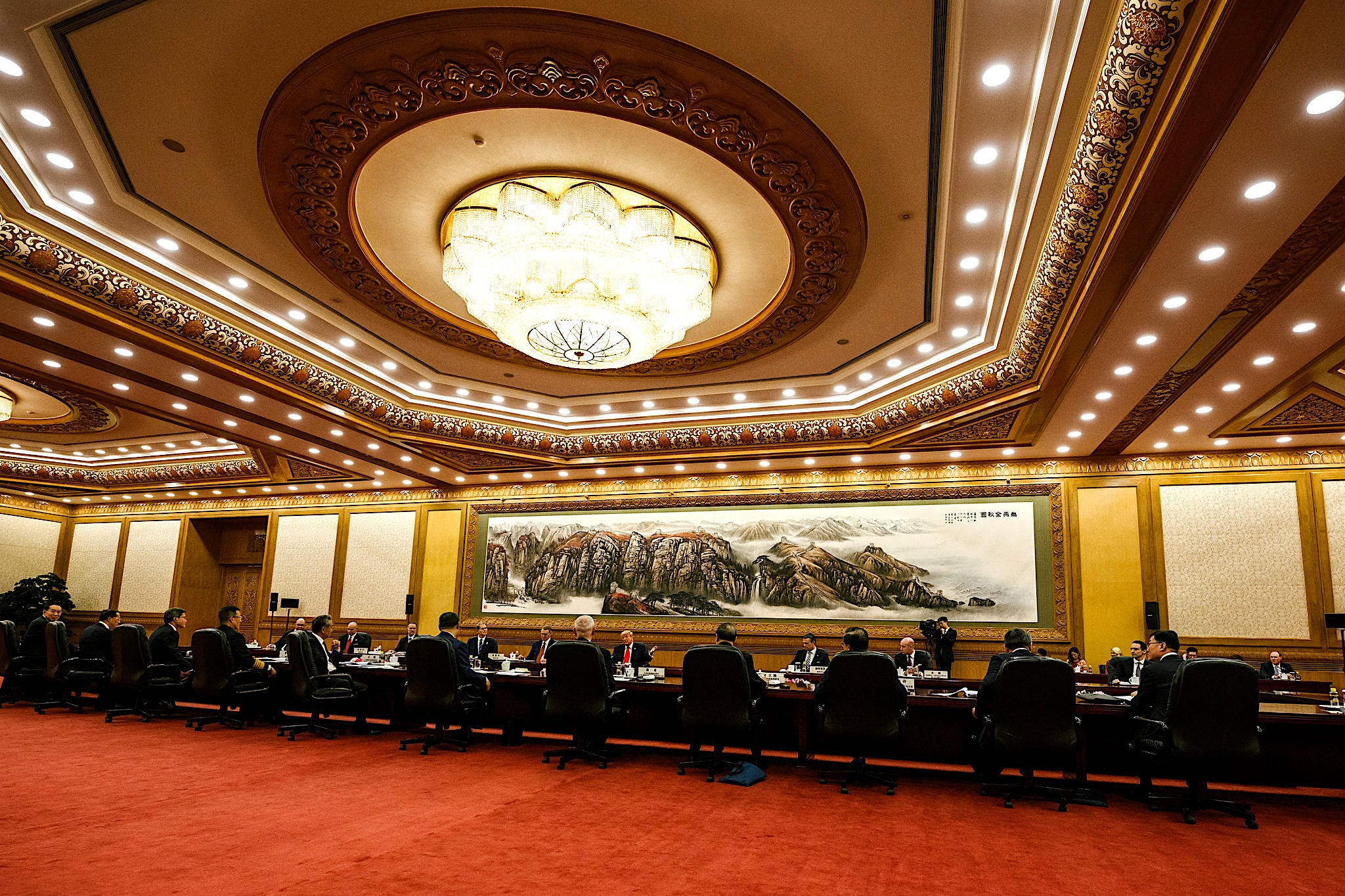
Xi and Trump meeting last week in the Great Hall of the People in Beijing. (White House / Daniel Torok)
Among the various topics discussed, Beijing’s stance on the conflict in Iran was critical. Here, Trump resorted to distortions and fabrications, attempting to suggest he gained concessions from China.
The French might need to coin a new term for him: a dedicated bullshitier.
The official White House statement on China’s position regarding the Strait of Hormuz reads:
“President Xi also made clear China’s opposition to the militarization of the Strait and any effort to charge a toll for its use, and he expressed interest in purchasing more American oil to reduce China’s dependence on the Strait in the future.”
That is misleading. Xi only emphasized support for an “open” Strait without mentioning “militarization,” “tolls,” or increased purchases of U.S. oil to replace the roughly 40 percent sourced from the Persian Gulf.
Trita Parsi, executive vice president of the Quincy Institute, explained Friday in Responsible Statecraft:
“Based on my discussions with Chinese diplomats, ‘open’ to the Chinese means that traffic flows through the Strait. Oil, gas, and goods come in and out. Money exchanges hands. Trade prevails.
It does not mean that there cannot be a mechanism where regional states charge a fee for the transit. Even with the fee, the oil can still flow. A blockade [as in the United States’ current effort] is what keeps the Strait closed — not the fee.
While their [the Chinese] preference understandably is that there is no toll at all, proposals are floating around that the Chinese are open to. They can live, for instance, with a regional mechanism that charges an environmental management fee. That is, a toll that isn’t framed as a toll.”
It is noteworthy that Chinese ships have regularly traversed the Strait since Iran asserted control, with the U.S. Navy never daring to block them. Also, following U.S. Treasury sanctions against Chinese refiners processing Iranian crude, Beijing instructed them to disregard this extraterritorial overreach.
Adding further complexity, proposals like those Parsi mentioned are circulating. Reuters reported Saturday that Iran plans to introduce “a mechanism” to oversee Strait traffic. Ebrahim Azizi, chair of the National Security Committee in Iran’s Majlis, stated that passage would be allowed only for vessels “cooperating with Iran” and that fees for “specialized services” would be charged.
Importantly, Iran is not labeling these charges as “tolls.”
Regarding the nuclear issue, the White House said, “Both countries agreed that Iran can never have a nuclear weapon” in its summary of the Xi–Trump conversation about Iran’s nuclear program.
Despite Trump’s crude methods, their audacity can sometimes astound. This statement is simply false.
China joined the 1970 Nuclear Non–Proliferation Treaty in 1992 and was part of the “P–5+1” group that negotiated the 2015 deal restricting Iran’s nuclear ambitions. Beijing’s position on nonproliferation is clear.
However, China also understands deterrence well. Its nuclear program began in the mid-1950s, during intense U.S. hostility toward the nascent People’s Republic. At high-tension moments such as 1954 and 1958, Eisenhower even considered using nuclear arms against China. By 1964, China had developed its first atomic bomb.
With this context, consider the Chinese Foreign Ministry’s post-summit statement on the nuclear issue:
“This conflict, which should never have happened, has no reason to continue. It is important to steady the momentum in easing the situation, keep to the direction of political settlement, engage in dialogue and consultation, and reach a settlement on the Iranian nuclear issue and other issues that accommodates the concerns of all parties.”
A few observations are in order.
First, this text makes no assertion about whether Iran should or should not have a nuclear weapon now. The Trump White House’s interpretation is a gross distortion.
Second, it exemplifies Chinese diplomatic style—criticizing U.S. actions without overtly condemning.
Lastly, it resembles a lecture delivered by a stable power reproving one whose reckless and irresponsible behavior calls for correction—the wise advising the foolish, if the analogy holds.
Beyond the nuclear discussion, Xi and Trump covered trade, investments, and drug trafficking. Trump’s sole potential achievement might be securing China’s commitment to purchase more soybeans from Midwestern farmers and additional Boeing aircraft.
If that ends up being the outcome, it’s a sorry spectacle. An American president visiting China only to haggle over “deals”—how undignified. Yet, this is Trump.
“There were no breakthroughs but no blunders,” The Washington Post noted after the summit. “Xi fought the Trump administration to a draw” was The New York Times’ conclusion. This is how major U.S. newspapers soften the blow when the true significance of Beijing’s events is too difficult to accept.
It’s easy to hear Xi’s words about “a new era,” 2026 marking an “historic, landmark year,” and “a new chapter in China–U.S. relations” and simply nod in agreement.
But this reflects a superficial reading of what took place across the Pacific.
Xi also repeatedly referred to the Thucydides Trap, the scholarly idea that a rising power and an established one are destined for conflict. This was no idle talk but a warning. He emphasized “major issues important to our two countries and the world,” demonstrating his deep concern for global stability.
When the leader of the world’s most rapidly growing power speaks about stability to the leader most responsible for jeopardizing it—that is a serious moment.
I was particularly struck by Xi’s repeated mentions of “working together” on these important issues. Let us pay close attention.
This was not a Chinese president asking America how the People’s Republic might support the current global order. Instead, it was a Chinese leader inviting the United States to contribute as China collaborates with others to maintain it.
So, in Beijing last week, history shifted.
Original article: consortiumnews.com
About the Author