TWO Red Hot Sectors — PLUS, “TICKERS!”
Today, we’re diving into two sizzling sectors: gold and military technology. While these topics could fill entire volumes, I’ll keep it brief and highlight key points for you to mull over.
My interest in these areas stems from an upcoming special event on Thursday, June 4, at 1:00 pm Eastern Daylight Time, when Paradigm Press will host a live broadcast exclusively for subscribers from Philadelphia.
This event is part of Paradigm’s ongoing America 250 series. My colleague Jim Rickards, a Philadelphia native, will lead a LIVESTREAM addressing current global developments. Joining him will be myself and several other talented editors from our team.
And yes… investment ideas and stock recommendations WILL be shared. I already hear the “TICKERS” chants!
Don’t Miss Thursday the 4th
As June 2026 begins, and with Independence Day just weeks away, mark your calendar for Thursday, June 4, at 1:00 p.m. EDT. The Strategic Intelligence team will present a FREE live summit call from Philadelphia, the city where Benjamin Franklin once lived and where the American experiment began in 1776.
Reaching America’s 250th anniversary, we’ll explore the forces shaping markets today. Major drivers include the war in Iran, global energy disruptions, ongoing inflation, affordability challenges, critical minerals, gold, energy shortages powered by AI, and the future of the Trump agenda.
Joining the broadcast will be Paradigm’s Aaron Gentzler, alongside macro-economist and New York Times best-seller Jim Rickards, plus Dan Amoss, Zach Scheidt, Matt Badiali, Adam Sharp, and myself. Together, we’ll reveal our newest research, market insights, and investment strategies.
This won’t be your typical dull economic discussion. Expect rapid-fire dialogue, spirited debates, insider anecdotes, and valuable, actionable insights—you guessed it, the much-anticipated Tickers you can apply right away.
Throughout the broadcast, we’ll showcase investment opportunities for your consideration. And remember, the event is completely free—no payment details required! This is our gift to you and our chance to connect directly with our valued subscribers.
The format centers on the Paradigm team analyzing global and national affairs while sharing market perspectives. To view the full program and reserve your place, click here for the special event page.
The Lowdown on Gold
Let’s shift focus to gold, our favorite monetary metal. This month, gold started around $4,514 per ounce, well within its trading range over the last six weeks, roughly between $4,450 and $4,550. Since the Iran war erupted on February 28, the price has dropped about 12%. Here’s the chart for reference:
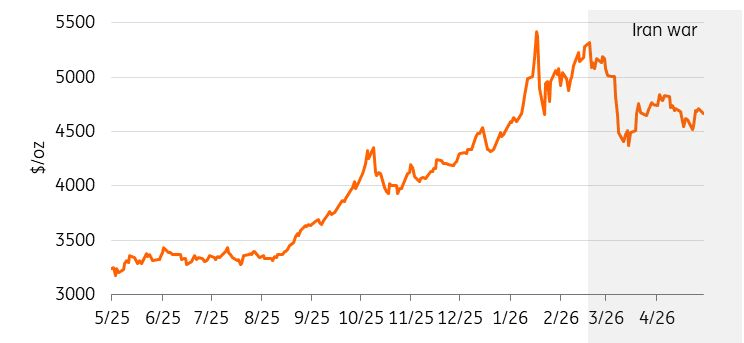
Gold’s price has declined roughly 12% over the past three months.
That $4,514 price level actually mirrors gold’s peak in mid-January, which was celebrated as a record high. So, if your outlook extends over years instead of a few months, gold remains strong.
Over the past year, gold has surged over 34% from about $3,350 per ounce in June 2025. This year-long performance reflects gold’s enduring connection to the dollar more than the short-term volatility tied to recent conflicts.
Gold’s steadier ascent during the last four years owes much to several factors, chiefly U.S. sanctions against Russia following the Ukraine crisis starting in February 2022. Those sanctions froze Russian state assets and caused many countries to begin deliberately moving away from the dollar.
This global shift away from dollars is evident in major gold purchases by central banks worldwide. Unlike traders, central banks buy gold to hold long term, representing generational, large-scale economic trends.
Don’t just take my word for it. On June 2, London’s Financial Times, a paper not known for gold enthusiasm, published an article stating:
“Gold has overtaken U.S. government bonds as the world’s top reserve asset following years of relentless buying by central banks and a historic rally that has seen prices nearly double over the past two years.”
Meanwhile, from a broad market perspective, U.S. government spending is spiraling out of control. In fiscal 2026 alone, around 40% of federal spending will rely on debt and accounting tricks. The national debt has already surpassed $39 trillion, with interest payments now exceeding the entire defense budget.
Over time—and even medium and short term—the dollar’s purchasing power erodes steadily. Rising inflation for essentials like energy and food reflects this trend, accelerated by the Iran conflict and worldwide oil turmoil.
Unfortunately, improvement isn’t around the corner. This Thursday, Jim Rickards alongside Dan, Zach, Adam, Matt, and I will delve deeper into gold’s price trends and highlight promising gold mining stocks.
Already, many miners are generating cash flow and growing profits based on today’s gold prices, not to mention the potential upside as prices climb. We’re just starting to see the true profit potential of well-managed gold mining companies at current price points.
The Expanding MilTech Sector (No Joke)
Turning to military technology — while not exactly “new” news, it’s a sector experiencing remarkable growth, lighting up the investment landscape. I’ll be covering several perspectives in Thursday’s event.
One key topic is America’s shipbuilding challenges, with serious funding flowing not only to coastal shipyards but to manufacturers nationwide. The two primary Navy shipbuilders are General Dynamics (GD) and Huntington Ingalls (HII). Simply put, these two companies dominate big vessel construction for wartime purposes.
Want submarines? Only GD and HII hold the qualifications to build these complex vessels. In fact, just one other U.S. company can even perform submarine hull maintenance, let alone construct these massive underwater ships.
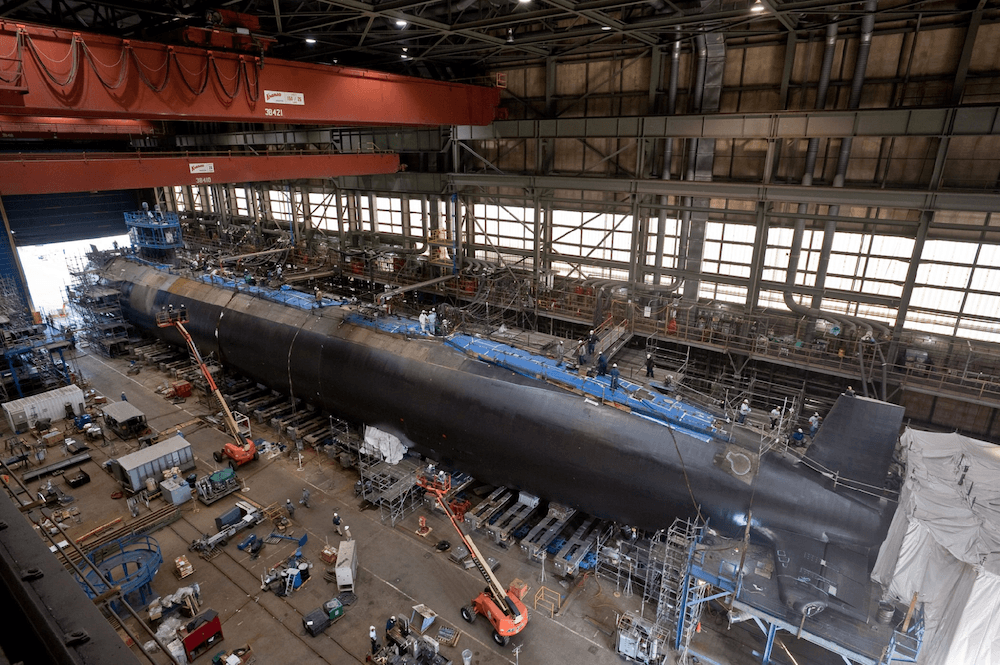
Submarine under construction. Credit U.S. Naval Institute.
Looking at large warships, only HII builds and services aircraft carriers, including refueling and decommissioning. Destroyers like the Arleigh Burke-class also fall under GD and HII’s exclusive domain. While smaller boats exist for purposes like offshore oil, firms capable of handling sizable warships suitable for combat are scarce.
Other vessels such as amphibious assault ships (LPDs) and aviation assault ships (LHAs) are similarly monopolized by GD and HII. Operating a military-grade shipyard is no simple task.
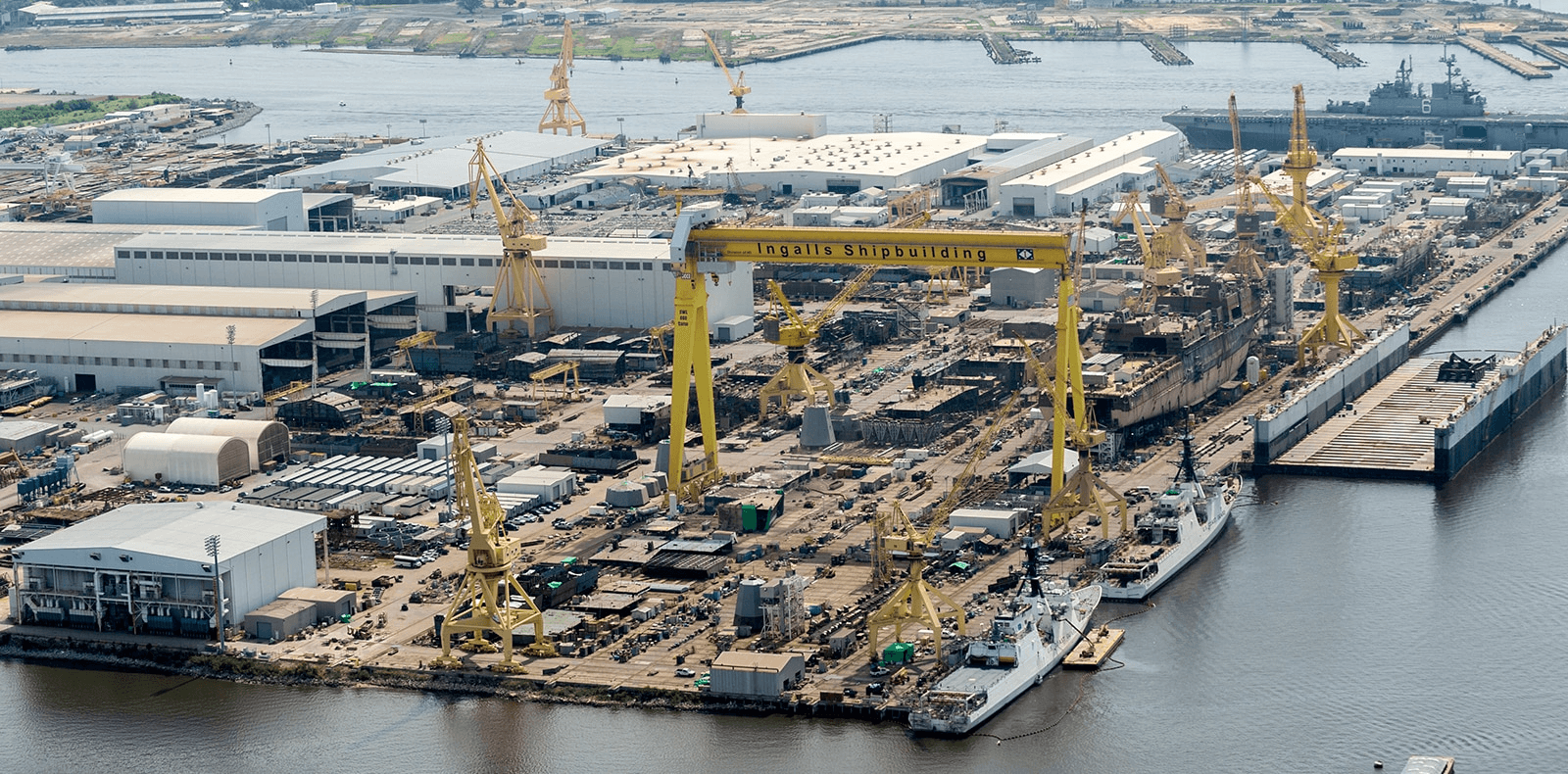
Ingalls shipyard at Pascagoula, Mississippi. Credit HII.
Additionally, Thursday’s session will highlight investment opportunities among suppliers of engines, combat systems, electronics, and nuclear propulsion. On nuclear power, look for upcoming long-lead purchases tied to President Trump’s “battleships,” essentially heavily armed battle-cruisers despite their Navy designation (BBGN).
And don’t dismiss these battleships lightly. I’ve covered them previously, and notably, the Chief of Naval Operations (CNO) recently expressed strong support for bringing these vessels into service.
On the aviation front, the U.S. is undergoing a major air power expansion, purchasing legacy fighters like the improved F-15E, F-35s, and the upcoming F-47, along with the likely in-development Navy F/A-XX.

Notional image of proposed F-47 aircraft. Credit WarWingsDaily.com.
The drone fleet is also growing rapidly. These include small drones throwable like javelins or launched from mortars to massive ones rivaling a Boeing 737 in size.
Alongside ships and planes comes a vast array of munitions—underwater weapons like torpedoes and mines, plus missiles with ranges from short to orbital, capable of intercepting everything from drones to satellites. Some of these armaments carry price tags equal to the vehicles deploying them.
Supporting all this is complex electronics and software necessary for command and control systems. Naturally, AI plays a huge role—how else could the U.S. have targeted over 800 sites per day in Iran during the kinetic phase in March? AI prepared most targeting packages before final human authorization.
Lastly, I’ll address the critical role of exotic metals and materials essential to many MilTech components—rare earth elements and metals across the periodic table from antimony and helium to tellurium and zirconium.
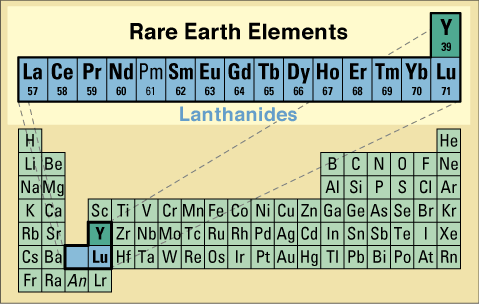
Periodic table, highlighting rare earths. Credit U.S. Geological Survey.
This is a critical piece of the MilTech puzzle: without certain elements possessing unique metallurgical or electronic properties, a weapons system simply can’t function. The details get highly technical, and entire books exist on the subject. But during Thursday’s broadcast, I’ll clarify who is active in this investable sector.
With that, I’ll close for now and thank you for reading and subscribing.
Best wishes… and Be There On Thursday!
About the Author