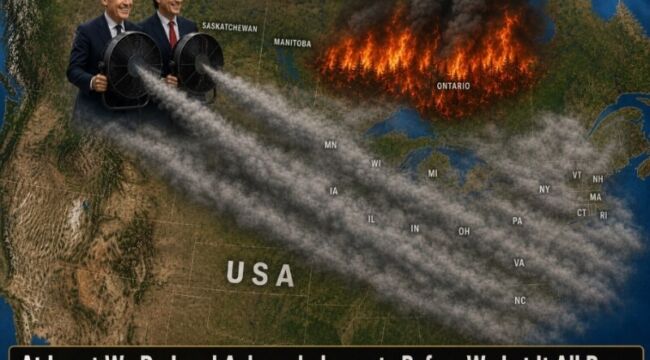
Canada Smokes the U.S.
“O… cough… Canada! … cough, cough… Our home and native land! … cough, cough…”
At least they perform land acknowledgements before allowing the fires to rage.
What on earth is happening in Canada? Just recently, they were choking out those of us down south.
As reported by Canada’s CBC News, “President Donald Trump personally told Prime Minister Mark Carney to stop poisoning American air and take action to put out wildfires burning across the country.”
This past Sunday, during their joint appearance to watch the World Cup Final between Argentina and Spain in East Rutherford, New Jersey, Trump addressed wildfire management with Carney. Speaking at a post-game press conference, Trump said, “I told him, I mean, ‘You got to stop these fires from coming in and, you know, poisoning our air. Our air has been poisoned.’”
When Trump assumed office in early 2025, one of his initial moves was to impose tariffs on various Canadian exports, including aluminum, auto parts, steel, and softwood lumber.
Canadian officials complained and responded by restricting American goods and services imports. As a consequence, Tennessee whiskey has become scarce in Canada, and, outrageously, many Canadians are reportedly boycotting Disneyworld.
Beyond boycotts of whiskey and Disneyworld, Canada has handed the U.S. a severe air-quality challenge that crosses borders. Let’s explore the issue further…
When the Sky Turns to Brass
Last week, the quality of air over the U.S. deteriorated, largely due to winds carrying pollution from Canada. Much of the nation experienced a thick, dingy haze tinted brass-yellow.
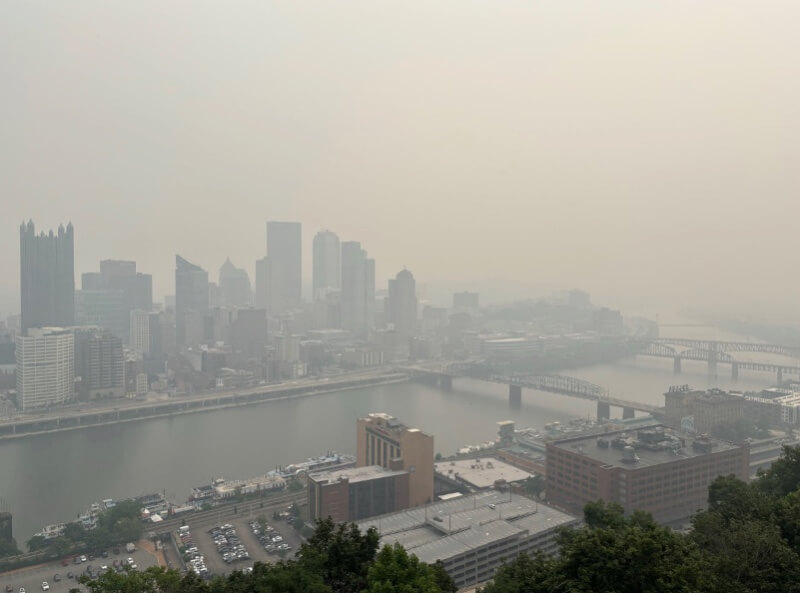
Downtown Pittsburgh this past Friday. Credit WPXI.com.
This image shows Pittsburgh’s city center from “Coal Hill,” also known as Mt. Washington, a few days ago. In 1884, Mark Twain offered a similar view, describing the city’s early industrial era: “We sauntered about the mount and looked down on the lake of fire and flame. It looked like a miniature hell with the lid off.”
Thanks, Mark Twain, but today’s air pollution in Pittsburgh isn’t due to its own industry. Typically, air there is crisp. The haze is neither chemical mystery nor regulatory failure.
Rather, the photo captures smoke originating from Canada’s burning boreal forest. It also prompts tough questions about forest policies, fire suppression strategies, fuel accumulation, budgets, and whether Ottawa and the provinces are tackling the issue adequately.
Last week, air-quality warnings were issued across over 20 U.S. states, extending from the Great Plains to the Atlantic Coast. Major metropolitan areas including Minneapolis, Detroit, Cleveland, Chicago, Pittsburgh, Philadelphia, and New York witnessed skies shifting to orange and yellow hues.
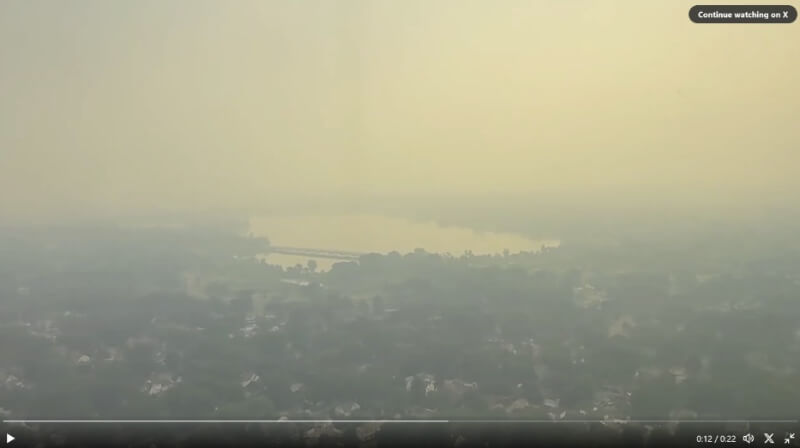
Minneapolis, as seen from aircraft landing at MSP airport. Credit @1labare.
At one point, air pollution levels in Detroit, Minneapolis, and Chicago ranked among the worst worldwide—surpassing pollution in several notoriously smoggy cities abroad.
Data from AirNow showed that parts of the Great Lakes region and adjacent downwind zones reached the highest pollution alert category: “hazardous.”
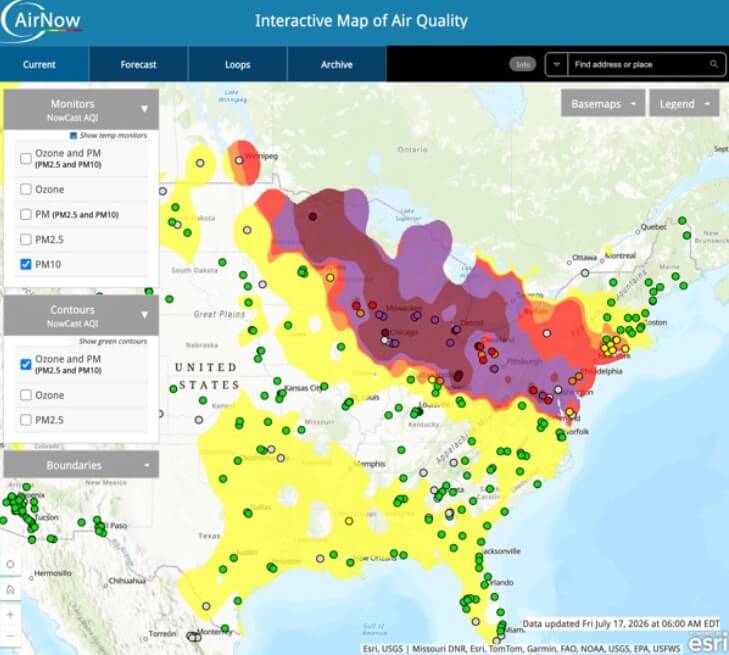
U.S. air quality map from Friday, 17 July 2026. Credit ESRI.
This is no mere summertime nuisance; it represents a cross-border public health emergency.
Not the Old Rust Belt Smoke
Western Pennsylvania experienced the infamous Donora Killer Smog in 1948, a tragic event still spoken of with dread. Growing up in 1960s “Steel City” Pittsburgh, I witnessed pollution from coke ovens and steel mills lining the riverbanks—plenty of firsthand experience with dirty air.
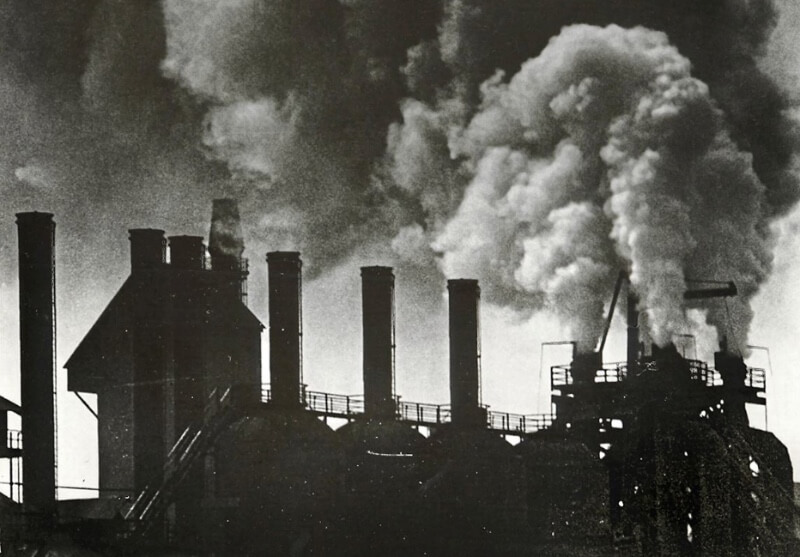
Pittsburgh riverbank blast furnaces, 1960s. Credit Pittsburgh Post-Gazette.
Yet the current haze differs starkly from old Rust Belt pollution. Its origin lies hundreds of miles north—in a resource-rich country whose government frequently lectures the world on climate responsibility even as vast tracts of forest smolder and burn, sending smoke into the U.S.
Canada has funds for national health care, immigration programs, social spending, support for Ukraine, and numerous committees and policy frameworks. The country commits to climate mandates, clean energy goals, vehicle emission standards, carbon pricing, and global environmental advocacy. Recently, Canada pledged $125 million to Brazil for environmental aid.
However, when it comes to consistently deploying national-scale forest management efforts such as thinning, fire breaks, access road maintenance, prescribed burns, firefighting equipment, crews, aerial support, and law enforcement against arson, the results are visible in the soot settling over America.
By mid-July, Canadian wildfire activity ranged from 850 to 950 active blazes, many labeled “out of control” or simply monitored rather than aggressively suppressed. This is not merely due to negligent campers; lightning, human causes, drought, fuel buildup, and policy choices all contribute. The impact is atmospheric and spans across North America.
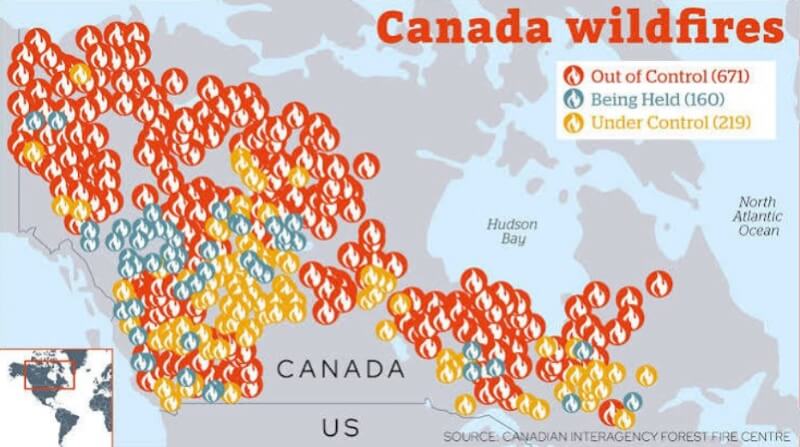
Canada burns, mid-July 2026. Credit Canadian Interagency Forest Fire Centre.
The technical name for the pollutant drifting south is “PM2.5,” tiny particles capable of penetrating deep into lungs and entering the bloodstream.
Smoke from wildfires also contains carbon monoxide and volatile organic compounds like benzene, formaldehyde, toluene, and xylenes. You don’t need advanced scientific training to grasp the issue: if you can smell the smoke outside your door, then Canada’s airborne emissions have reached you.
America Paid Dearly to Clean Its Air
Another frustrating element is that since the 1970s, Americans invested heavily in cleaning the air. Consider the Clean Air Act, catalytic converters, power-plant scrubbers, reformulated fuels, and the closure or retrofitting of tens of thousands of factories that couldn’t afford new compliance costs.
The economy and communities suffered significantly: massive job losses, regional economic disruption, endless legal disputes, and regulatory challenges.
Hundreds of billions were spent to meet stringent regulations—and to some extent, it worked. Today, air quality is far better.
Living in Pittsburgh no longer resembles a chronic two-pack-a-day smoker’s lungs. Yet, summer smoke from Canada undermines these hard-won improvements.
Remote Does Not Mean Harmless
Admittedly, Canada’s boreal forest covers roughly 1.3 billion acres, much of it isolated, sparsely inhabited, and difficult to reach even in ideal conditions. A Canadian academic once estimated that the country has nine thousand times more trees than people.
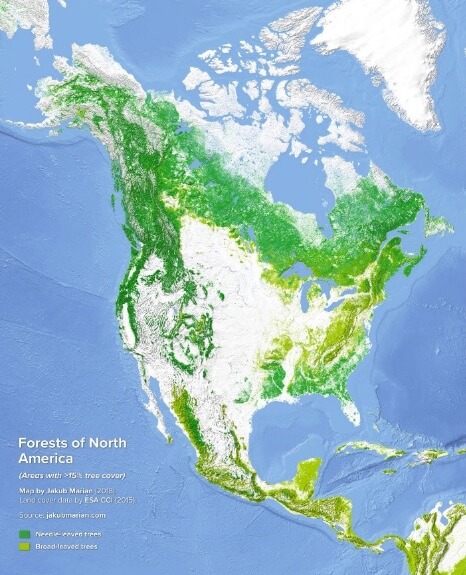
North American forest lands. Credit Jakub Marian.
Indeed, fire is a natural part of these forests, sparked by lightning as it is across North America. Not every wildfire in remote terrain can, or should, be fought.
According to Natural Resources Canada, fire management strategies vary from full suppression to letting some fires burn. Typically, fires in isolated areas distant from people, towns, infrastructure, or commercial interests might be allowed to continue unchecked.
From an American perspective, however, “remote” Canadian fires do not equate to harmless conditions south of the border. Smoke respects no jurisdiction or customs checkpoint. A low-priority blaze in northern Ontario can produce hazardous air levels in Ohio or Pennsylvania. Decisions to monitor rather than extinguish may be aligned with Canadian priorities, but Americans still pay the price in health and air quality.
Misplaced Fire Priorities
Canada has various firefighting resources: intelligence systems, forecasting services, firefighter training programs, equipment grants, and WildFireSat, a dedicated satellite mission for daily monitoring. All positive…
Yet the pressing need is for field crews to deploy backhoes and bulldozers, build fire lines, reduce fuel loads, and apply water to smoldering areas. This boils down to setting the right priorities.
One challenge is that Canada’s firefighting efforts can resemble a patchwork of provincial guilds. The Interagency Forest Fire Centre coordinates resource-sharing nationally, but provinces fiercely protect their certifications, contracts, and territories. This leads to barriers that prevent crews from assisting outside their home provinces, even as large wildfires rage and continental air quality suffers.
For instance, crews and equipment may remain idle in Alberta while smoke from Ontario or Quebec drifts south over the Great Lakes into U.S. cities.
Simultaneously, some U.S. firefighting firms report difficulties obtaining deployment opportunities in Canada, though Canadian aircraft and teams often assist U.S. firefighting efforts under cross-border agreements. Coordination is key.
Canada’s boreal forest is vast, and nobody expects to tame every blaze. Still, the nation could enhance firefighting capacity, fortify high-risk corridors, increase prescribed burns and fuel treatments, bolster arson enforcement, and engage more closely with affected U.S. states that bear the brunt of cross-border smoke.
Most importantly, Canada’s government must stop treating wildfire smoke as mere bad weather. Because fire ignites the smoke; weather only moves it.
Put differently, while fire is natural, government policies influence forest management: determining fuel accumulation, response strategies at local, regional, and national levels, funding allocations, and decisions on which fires to fight and which to monitor until precipitation arrives.
Last week, P.M. Carney gave a speech attributing forest fires largely to climate change. While climate and weather are factors, proper forest management, planned burns, fuel control, readiness, and cross-border smoke impacts warrant serious attention—not just promises to assess damage after the fact.
Having traveled in Canada since the mid-1980s, I’ve observed countless “land acknowledgments” to First Nations—now standard protocol. Yet despite these respectful words, the country falls short in actual stewardship. Paying homage doesn’t replace essentials like brush clearing, fuel thinning, creating fire breaks, maintaining access, mobilizing crews, enforcing laws, and deploying aircraft and pumps where smoke originates. That work is critical.
The Political Bill Comes Due
Now the political consequences surface. Senator Bernie Moreno (R-OH) plans to introduce the CANADA FIRE Act, a sanctions bill targeting Canadian officials deemed responsible for persistent smoke crises. Proposed measures include visa revocations, asset freezes, government contract restrictions, and a study on a victim compensation fund funded by tariffs.
As mentioned earlier, President Trump has publicly raised this issue—a clear “smoke signal.” Canada’s smoke exports are not an unavoidable act of nature but a hazardous transnational nuisance linked to identifiable individuals, agencies, budgets, and policy decisions.
Once again, Canadian wildfire smoke undermines decades of U.S. air-quality progress. Fire diplomacy will soon join trade, tariffs, water, pipelines, defense, and border security discussions.
The takeaway is straightforward. America cleaned its smokestacks; Canada must manage its forests—not by banning fire altogether, but by controlling fuel, funding, access, resources, and response to address this continental public health challenge.
This does not imply Canada can control every lightning strike or extinguish every remote fire. But when smoke regularly crosses international borders, causing public health disruptions, work and school closures, travel issues, and daily inconvenience, the problem transcends local forest policy and becomes continental.
Until that changes, when the summer sky darkens to a brassy brown across much of the Lower 48, don’t blame American air. Ask instead why Canada keeps blowing smoke our way.
That’s all for now. Thank you for subscribing and reading.
About the Author