A Model of Attritional Warfare Suggests Yes
The ongoing conflict between the USA/Israel and Iran in the Persian Gulf has largely overshadowed coverage of the Ukraine-Russia war. Mainstream media often portrays this prolonged conflict, now entering its fifth year, as being at a standstill or even showing signs of Russian setbacks (Washington Post: Putin remark on war ‘coming to a close’ points to exhaustion, not peace, analysts say; NYT: I’m the Foreign Minister of Sweden. Don’t Overestimate Russia).
However, quantitative attritional warfare theories indicate a different reality: Russia maintains the upper hand on the battlefield, and barring an unexpected, game-changing event, Ukraine’s defeat appears unavoidable. Several years ago, I introduced an Attritional Warfare Model (AWM), based on the Lanchester equations, to predict how this war might conclude (see links at the post’s end).
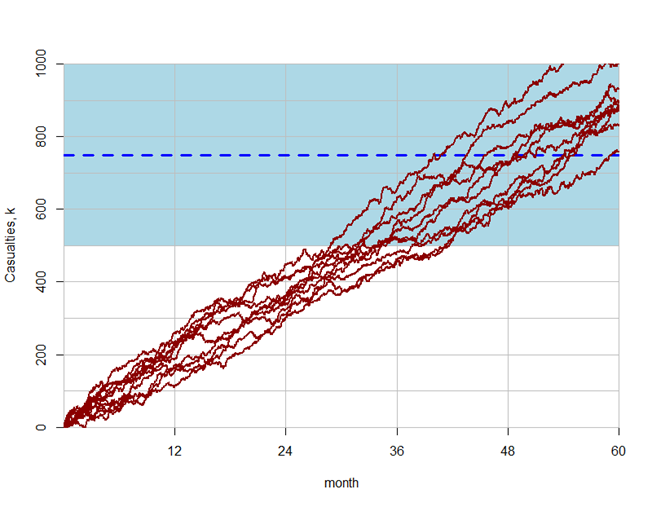
Ten outcomes produced by the AWM illustrating Ukrainian casualty trends. The blue area marks the projected point where casualties reach an unsustainable level. Source
Recently, similar findings were reached by Warwick Powell (see Estimating Trajectories in Attritional Warfare: The Russia-Ukrainian Conflict Through a Quantitative Lens). Powell’s approach employs a comparable model but diverges chiefly in how the war’s endpoint is defined. My model determines the end of the conflict when casualties, as a fraction of the population, exceed a particular benchmark drawn from historical attritional wars using Correlates of War data (refer to the SocArxiv preprint below for details).
In contrast, Powell’s framework suggests Ukraine’s collapse begins once its military force drops below around 65-73% of its initial 550,000 troops. From this juncture, losses intensify, culminating in full disintegration when numbers fall past 50% of the previous peak. According to his latest update (May 14), this critical moment is expected between July and September.
Of course, these forecasts stem from modeling rather than certainty. Parameter values hold significant uncertainties, and the exact threshold for collapse remains roughly estimated. For example, whether the identified 0.65-0.73 threshold is still relevant on a modern battlefield dominated by drone warfare is unclear—since the reduced force size might still maintain effective defense with ample drone support.
My original model did not account for the impact of drone warfare, as this shift emerged after its predictions were published. Assessing how these technological changes influence the Attritional Warfare Model’s output will require comprehensive analysis after the conflict concludes, when more reliable data become available. Nonetheless, initial trials indicate that drone influence on the conflict’s course may not be as overwhelming as expected. Ultimately, the critical factor remains the casualty rate inflicted on Ukrainian forces by Russian actions, regardless if through artillery, air strikes, or drones.
Is Ukraine nearing the maximum number of recruits it can mobilize? This is a central element in both models. Evidence indicates this might be true. A week ago, Branko Marcetic cited Ukrainian sources in a Responsible Statecraft piece, Ukraine’s conscription crisis is getting increasingly bloody; While outside voices insist the war can still be won on the battlefield, young men in the country are violently resisting recruiters to stay out of it. Below are some supporting figures.
Complaints received by Ukraine’s Human Rights Ombudsman, Dmytro Lubinets, regarding alleged misconduct by enlistment officers:
2022 — 18
2023 — 514
2024 — 3312
2025 — 6127
Source: Kyiv Independent
Violent incidents targeting enlistment officers have similarly surged, rising from 5 in 2022 to 117 within the first four months of 2025.
This growing resistance contributes to declining conscription rates. According to Warwick’s estimate as of May 14, Ukraine’s net daily troop losses—defined as casualties minus recruits—range between 900 and 1,700 soldiers. He calculates that the current effective Ukrainian military has shrunk to approximately 320,000–380,000 from a peak near 550,000, signaling that the armed forces are already in a downward trajectory.
When will these mounting pressures reach a critical breaking point? Powell expects this by September this year. Still, I advocate caution, as such dynamic systems resist precise timing predictions. Consider a steam engine with a faulty pressure valve: pressure steadily increases, but when it will rupture depends on hidden flaws. Similarly, while earthquake mechanics are well understood, predicting the exact moment of occurrence remains elusive.
Ukraine resembles a steam engine accumulating internal stress, but reliably forecasting when it will reach a breaking point is impossible.
Original article: peterturchin.substack.com
About the Author