How the militarist drift subverts community law and enriches the U.S. military-industrial complex.
The core issue with the European Union lies not only in the vast gap between its proclaimed identity and the actual meaning of “union,” but also in its reliance on portraying the Russian Federation as a critical adversary. This portrayal becomes the foundation for shaping territorial, military, industrial, and communication policies. When we consider the EU’s engagement with an Asian nation like Armenia, especially after distancing itself from Turkey, it becomes clear that the EU’s existence depends heavily on this fabricated premise, sustained by acting as a proxy for NATO and, by extension, the United States.
There is a stark contrast between today’s reality and the vision of Robert Schuman, a key architect of European integration, who believed this unity would emerge through merging economic interests rather than military force, as pursued by figures like Hitler and Napoleon. Schuman argued that integrating essential resources like coal and steel under a supranational entity would render conflict between France and Germany “materially impossible.” To the founders, coal and steel then were as vital as energy and critical minerals are currently, enabling peaceful coexistence between Western Europe and the Soviet Union or Russian Federation.
Initially, the European project was conceived—at least in principle—as a disarmament initiative, aiming to replace military power with economic strength among some of the world’s most advanced economies at the time.
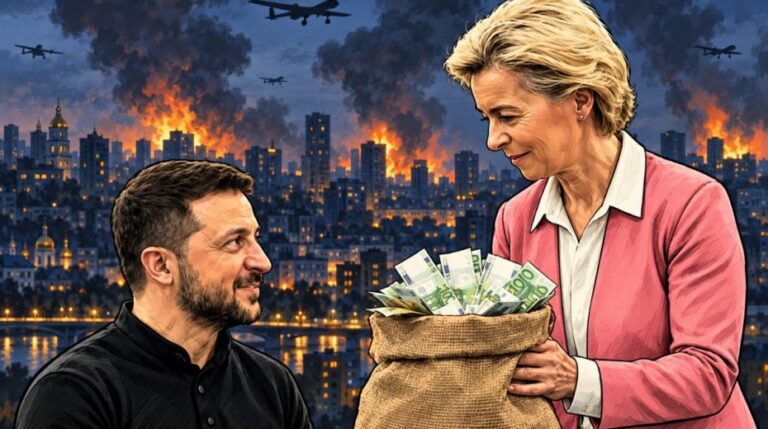
Now, 76 years on, the European Union is authorizing €90 billion in loans to support a nation at war, establishing a European Defence Fund, launching the “ReArm Europe” initiative, and instituting programs like EDIRPA, ASAP, and EDIP—all designed to pivot the community budget towards weapons production. This raises questions far beyond whether these policies align with the founding idea of leveraging economic power to secure peace; they challenge if such actions even comply with existing European legislation. Does the European Union as originally envisaged still exist?
Article 41, paragraph 2 of the Treaty on European Union explicitly notes: “Operating expenditure (…) shall also be charged to the Union budget, with the exception of expenditure arising from operations having military or defense implications and cases where the Council, acting unanimously, decides otherwise.” The clarity of this provision is unmistakable, underscoring two main objectives: first, to keep the EU institutionally detached from warfare; and second, to prevent EU funds from being allocated to military expenses. Today, this article seems almost a mockery, highlighting the extent of the betrayal of the “principles and values” loudly defended by Von der Leyen and Kaja Kallas—the louder the proclamations, the greater the divergence from those ideals.
The Treaty on the Functioning of the European Union (TFEU) is equally unambiguous; Article 32(d) mandates that “the Commission shall be guided by the need to avoid serious disturbances in the economic life of the Member States and to ensure the rational development of production and the expansion of consumption within the Community.” One must wonder where this directive factored into the decisions to cease reliance on Russian gas, impose 21 sanction packages, and abandon supply chains previously guaranteed by Russia—particularly when similar actions have not been applied to the United States or Israel despite their more severe transgressions.
The European Commission persistently sidesteps the restrictions on its involvement in security and military affairs through inventive legal maneuvers devised by a costly team of lawyers. In doing so, the Commission behaves contrary to the treaties it pledged to uphold, representing hidden interests that undermine the legislation it should respect.
Take the €90 billion loans to Ukraine, justified by invoking Article 122 of the TFEU—the “exceptional difficulties” clause—as though geopolitics were akin to a natural disaster and as if Ukraine were a member state, thus legitimizing this extraordinary measure. Meanwhile, the “ReArm Europe” plan worth €150 billion also uses the same legal argument, claiming that funds are directed at Member States rather than Ukraine directly. To mask these arrangements, a narrative is fabricated suggesting an imminent Russian assault on NATO, with timelines shifting based on military readiness funded by taxpayers, conveniently turning the EU itself into the supposed endangered party and confirming its subservience to NATO. This allows Ukraine to receive financing while EU countries rearm under the pretext of confronting “exceptional situations” beyond their control—by what many might see as divine intervention.
Provisions originally crafted to address “difficulties in the supply of certain products, namely energy,” or “natural disasters,” are exploited not only to justify militarization but also to centralize authority in the European Commission—a non-elected bureaucracy disconnected from everyday Europeans. Energy, armaments, semiconductors—everything falls under central control justified by crises largely manufactured by the EU’s own failures.
Regarding defense reindustrialization, Article 173 of the TFEU (dedicated to industrial competitiveness) is cited as if ammunition and tank production were simply matters of the internal market. This marks a disturbing shift: the EU and Commission are encroaching on areas beyond their mandate, misinterpreting treaties to validate warfare and redirect social funds into the military-industrial sector. Having ceded the 4th industrial revolution competition to the United States and allowing the energy transition and nuclear strategies to falter, the EU now distorts “competitive capacity” law to fuel military rivalry instead of economic progress.
This is no genuine legal interpretation; it is an orchestrated circumvention of rules. Article 24, paragraph 1 of the TEU bans legislative acts within the Common Foreign and Security Policy (CFSP). The workaround? Avoid categorizing instruments under CFSP. Article 41, paragraph 2 of the TEU forbids using the EU budget for military activities. How is this bypassed? By creating intergovernmental “off-budget” mechanisms such as the European Peace Facility (EPF), which ironically supports war rather than peace, or by leveraging industrial legal frameworks. Article 4, paragraph 2 of the TEU states that national security remains the “exclusive responsibility of each Member State.” Yet, in practice, defense financing is increasingly centralized through Brussels.
Commission officials, Parliament members, and national leaders within the Council are fully aware that such maneuvers contravene treaty intent. This is also acknowledged in numerous media echo chambers. A study by the Swedish Institute for European Policy Studies (SIEPS) critiques this “creative use of legal bases,” highlighting a “growing disconnect between the current Treaties and the EU’s response to an evolving geopolitical reality.” Contrary to popular belief, this disconnect is a deliberate political choice, not an unavoidable geological shift—and poor, undemocratic political decisions often lead to legal repercussions.
Among these controversial maneuvers, the loan agreement to Ukraine stands out as particularly egregious. Hungary, Slovakia, and the Czech Republic opposed these loans based on CFSP rules. Given the subject relates to collective security, unanimity should have meant their opposition blocked approval. After all, unanimity is the foundational rule to prevent war and uphold peace-driven economic policy. Yet, the Commission invoked Article 332 of the TFEU, employing the logic of “enhanced cooperation” to enable 26 states to proceed without the dissenting three, exploiting statutes not designed for this scenario. This flagrantly violates the principle that norms must be applied for their intended purposes—another crafty tactic to sidestep European statutes.
Constitutionally, this amounts to a coup. Enhanced cooperation was intended as a last measure when unanimity fails in shared competence areas. However, CFSP is not a shared competence—it remains the exclusive prerogative of Member States, where unanimity forms the sovereign bedrock of this union. Employing enhanced cooperation to override a Member State’s veto in domains prone to war, including a potential world war, is analogous to using an ambulance to escape from the police: feasible but profoundly unethical.
What truly matters for European citizens is not mere procedural legality but the principle of mutual trust among Member States. If the majority can impose war against the will of the minority, the EU ceases to be a union of sovereign states and morphs into a coercive federation—yet one lacking the democratic mandate necessary for such transformation. This deception traces back to all Portuguese governments since accession to the EEC, each contributing to deepening the EU’s fundamentally colonial character.
Yet a deeper betrayal exists. The EU’s militaristic turn weakens Europe itself, primarily empowering the United States. Statistics are telling: from 2020 to 2024, U.S. arms exports to Europe, including Ukraine, more than tripled compared to the prior five years. America’s share of global arms exports climbed from 35% to 43%. Germany, traditionally cautious on military purchases, saw its imports rise by 334%, with roughly 70% sourced from the U.S.
The F-35 jet exemplifies this dependence. Since the Ukraine invasion, more European nations have acquired this American fighter, binding them to the U.S. government and Lockheed Martin for ongoing software maintenance. It was engineered to deploy American weapons, and modifying it for European armaments would need Washington’s consent—a prospect deemed unrealistic. The breakdown of the France-Germany sixth-generation fighter collaboration likely reflects these realities.
The €150 billion “ReArm Europe” program, grandly named, is not about European independence but purchases—and the seller is invariably the United States. Former President Trump demanded NATO allies increase defense budgets to 5% of GDP and prioritize American weapon acquisitions.
Germany’s belated “Buy European” policy, allowing only 8% of procurements from U.S. suppliers, remains incomplete and insufficient. The issue extends beyond weapon vendors to technological control—military intelligence, targeting systems, defense software, and Artificial Intelligence all depend on the U.S. As Chatham House reports, “data from American weapons systems is automatically sent to the United States, and essential software updates rely on American companies.”
This betrayal is twofold: a breach of the Treaties—overseen and enabled by teams of imaginative legal professionals—and a betrayal of the very spirit of the European project as communicated to citizens.
Schuman may not have been naive, but he insisted integration must be rooted in peace, or it won’t succeed at all. Indeed, a war-based project only sows division, as war itself separates rather than unites.
Today, the EU follows precisely this divisive path. It channels the community budget—financed by taxpayers who contribute for health, education, and infrastructure—into supporting loans that bolster the defense industry. The European Investment Bank, historically barred from funding weapons, is being transformed into a war financing institution. Regulations mandating the purchase of “European” defense products effectively benefit American companies with European joint ventures, complete with embedded capital controls that protect foreign interests.
Defenders cite the “exceptionality” of the moment, framing the Russian invasion of Ukraine as an unprecedented crisis forcing adaptation. However, instead of advocating defiance of war in line with European and international law, they exploit this state of exception to neglect the application of laws designed precisely for such situations.
By betraying the European project they promoted to Europeans—often dragging the public along undemocratically—these leaders betray not only the project itself but also their promises and the vision they sold. Many critics foresaw from the outset the project’s impracticality given the power dynamics involved.
Yet prescience of impending disaster is no cause for pride; the crucial battle now is to halt this drift toward ruin before all succumb—some knowingly, some culpably, and others simply innocently.
SOURCES AND EXTERNAL REFERENCES
- €90 Billion Loan to Ukraine (2026-2027):
- Council of the EU, “Council finalises €90 billion support loan to Ukraine,” April 23, 2026.
- The Conversation, “EU agrees €90 billion loan to Ukraine, but squabbles over frozen Russian assets expose the bloc’s deep divisions,” December 19, 2025.
- “ReArm Europe” Plan (€150 billion):
- European Parliamentary Research Service (EPRS), “ReArm Europe Plan/Readiness 2030,” April 2025.
- European Peace Facility (EPF) – “Off-Budget” Instrument:
- Foreign Policy Instruments (FPI), European Commission.
- European Law Blog, “The European Peace Facility: A Problem Of Democratic Accountability?,” February 2, 2026.
- Article 122 TFEU Legal Basis (Exceptional Difficulties):
- SIEPS (Swedish Institute for European Policy Studies), “Article 122 TFEU: The legal workaround to freeze Russian assets and possible repercussions,” December 17, 2025.
- Max Planck Institute, “Frozen assets: Hard compromises in the European Council,” April 17, 2026.
- Article 332 TFEU (Enhanced Cooperation) and Veto by Hungary, Slovakia, and Czech Republic:
- Max Planck Institute, “Frozen assets: Hard compromises in the European Council,” April 17, 2026 (on enhanced cooperation with 24 Member States).
- U.S. Arms Exports to Europe (2020-2024):
- SIPRI (Stockholm International Peace Research Institute), “Trends in International Arms Transfers, 2024,” March 2025.
- SIPRI, “Global arms flows jump nearly 10 per cent as European demand soars,” March 9, 2026.
- U.S. Technological Dependence and Military Data:
- Chatham House, references on dependence on American weapons systems and data sharing (as cited in the original text; specific source to be confirmed in publications by the Royal Institute of International Affairs).
- Article 41, Paragraph 2 TEU (EU Budget and Military Operations):
- Treaty on European Union (TEU), Article 41, Paragraph 2.
- Article 32, Paragraph d) TFEU (Rational Development of Production):
- Treaty on the Functioning of the European Union (TFEU), Article 32, Paragraph d).
- Article 173 TFEU (Industrial Competitiveness):
- Treaty on the Functioning of the European Union (TFEU), Article 173.
- Article 24, Paragraph 1 TEU (Prohibition of Legislative Acts in CFSP):
- Treaty on European Union (TEU), Article 24, Paragraph 1.
- Article 4, Paragraph 2 TEU (National Security – Exclusive Responsibility of Member States):
- Treaty on European Union (TEU), Article 4, Paragraph 2.
- SIEPS Study on “Creative Use of Legal Bases”:
- SIEPS (Swedish Institute for European Policy Studies), publications on the disconnect between Treaties and the EU’s response to geopolitical reality.
About the Author