From Galați to the Baltic, the continent enters the new era of permanent war.
Drones, escalation, and rearmament: the model tested in Ukraine becomes a continental paradigm. A journey into the Ukrainianization of Europe and the growing risk of a clash with no return.
During the night of May 28-29, a drone impacted an apartment block in Galați, southeastern Romania, wounding two individuals. Officials in Bucharest attribute the attack to a Russian Shahed drone, which Moscow denies. The narrative is familiar, yet this incident marks a significant shift that newspapers and Rearmament Party intellectuals choose to overlook.
As with recent conflicts, drones have moved beyond mere support weapons to become central to warfare, reshaping tactics, strategies, logistics, command structures, and even international law. The critical issue is no longer about drones crossing borders but about who controls the political narrative surrounding these events. For years, NATO has dominated this narrative, aided by compliant prime ministers, deferential presidents, and a media that fixates on incidents like the Galați drone strike while deliberately ignoring major war crimes committed by the Epstein coalition—from Gaza to Rafah—ranging from mass civilian casualties to targeted attacks on journalists and humanitarian personnel.
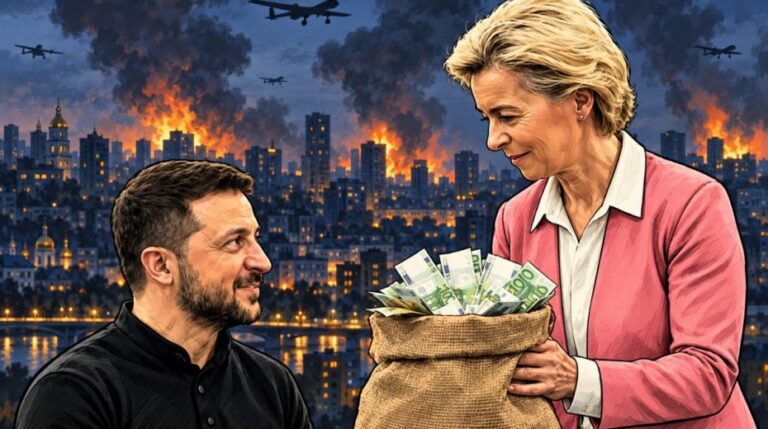
The situation in the Baltics is telling. In Latvia, Ukrainian drones hit oil facilities, precipitating the fall of the Siliņa government. Baltic authorities adopted a dual narrative: blaming the incidents on the broader consequences of Russia’s war without emphasizing Ukraine’s clear operational role. This state-level deception went unquestioned by the Atlanticist press. Ursula von der Leyen and Roberta Metsola portrayed out-of-control Ukrainian drones as evidence of a “Russian threat.” Analisi Difesa, one of the few remaining journalistic sources, branded this spectacle a circus. Notably, the same von der Leyen who lamented four deaths from Russia’s retaliatory attack failed—alongside most Western media—to mention the Starobelsk massacre, where dozens of students were killed by Kyiv forces. With three waves and sixteen drone strikes targeting the same site, it was no accident but a heinous, deliberate provocation. To Ursula, everything remains acceptable.
However, Russia no longer remains the passive observer. NATO has ceased being a conflict “hinterland” and has instead become an attack corridor, an AI overseer, a strategic targeting provider, and a de facto combatant. Moscow has indicated that the Baltic region functions as an operational channel for Ukrainian incursions and might respond with measured actions consistent with its history of graduated pressure, including mirror events designed to send messages without formally igniting open war with the Alliance. The Galați incident further brings this possibility closer.
Ukraine, bearing the greatest cost since 2014, has seen its population nearly halved, its intermediate institutions marginalized, and its state apparatus repurposed into a military platform focused on fighting Russia. The Zelenskysphere operates as a “super-Gladio”: an entity sustained by international finances, bureaucratic solidarity, and well-established networks, capable of enduring even the destruction of the host state. This corrupt, parasitic structure is portrayed as heroic resistance but actually serves as the blueprint for Europe’s military reorganization. This is why the term “Ukrainianization of Europe” is appropriate.
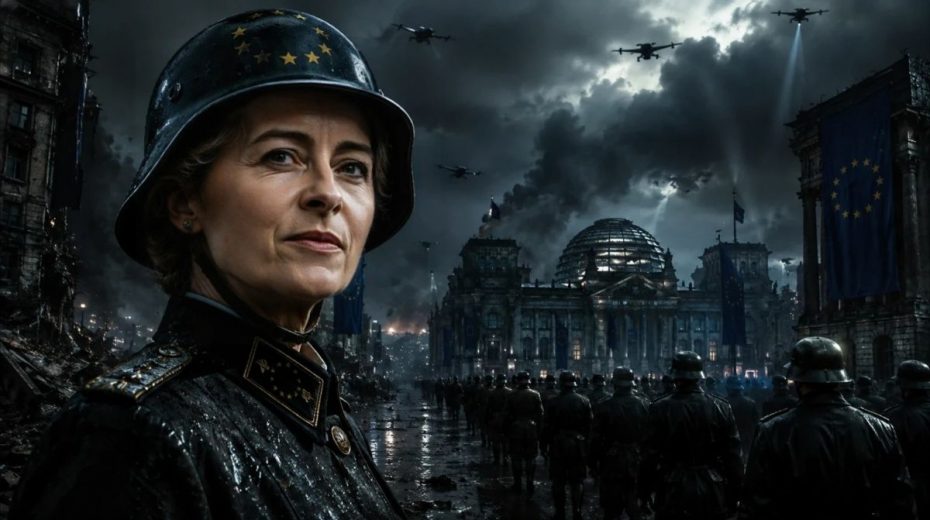
This laboratory now aims to expand. Many European ruling classes are sacrificing energy stability, longstanding industrial sectors, constitutional freedoms, and social programs to pursue military adventurism. Germany, which originally converted military industry to civilian use after the Cold War with European funding, is now reversing course and dragging the continent into remilitarization. The trio of Merz, Von der Leyen, and Kallas forms a leadership either unaware—or openly dismissive—of the implications of crossing the nuclear threshold.
Another critical lesson that seems lost on these leaders is Iran’s example. When a nation faces existential threats, military bases no longer remain untouchable, nor does the concept of “allied soil.” Iranian strikes have demonstrated that asymmetric warfare can bypass deterrence systems designed for previous eras. If this lesson applies to Russia—a nuclear power with superior delivery systems—it becomes clear that escalation is no careful game of chess but a perilous slide toward disaster.
Jeffrey Sachs has addressed Chancellor Merz pointing out three decades of mistakes: NATO’s expansion, support for the ruling elites that excluded half of Ukraine’s political voices, and the manipulated Minsk agreements used solely to rearm Kyiv. His verdict is that time has completely run out. Germany alone can halt the war, yet it is also the country most invested in continuing it. Sachs hopes that a sufficiently shocking confrontation might trigger an emergency stop before it becomes impossible to intervene.
That is why I urge everyone to back the proposed legislation aiming to declare the Italian Republic a neutral state, refusing automatic measures that risk engulfing it in conflict.
Meanwhile, drones continue to fly. Above Galați, the Baltics, and over a continent whose dulled conscience has entrusted its destiny to servants blind to history, geography, and the true power balance.
Original article: megachip.globalist.it
About the Author