Uh-Oh, Silver!
A year ago, silver was trading near $36 per ounce.
Now, it sits around $66. Ordinarily, that would be seen as a positive outcome.
However, silver enthusiasts have experienced quite a volatile journey across these twelve months.
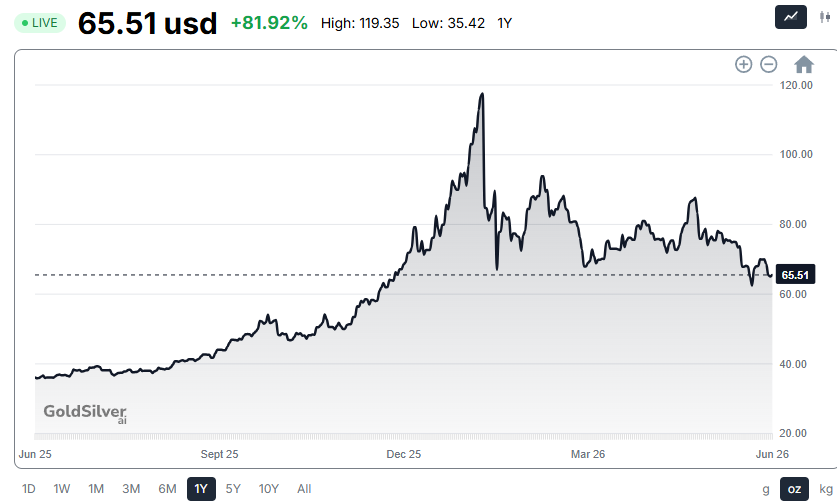
The price movement has been remarkable: a surge from $36 to $119 within roughly eight months, followed by a drop back to $66.
I remain convinced that the silver bull market has many years, potentially even a decade, ahead. Let’s delve into the reasons why.
+$16 Since 1980?
Silver first touched $50 all the way back in 1980.
Of course, the extraordinary silver rally between 1971 and 1980 wasn’t entirely organic. The Hunt brothers famously cornered a substantial portion of the market, controlling about 9% of investable silver through both physical holdings and futures contracts.
That said, silver’s performance in the 1970s wouldn’t have been insignificant without the Hunt Brothers. Inflation peaked near 14.8% that year.
Investors turned to precious metals as a safe haven from stagflation, making gold and silver the top performers throughout the decade.
It’s striking that silver’s current price remains only $16 higher than its 1980 record.
This Isn’t 1980
The year 1980 marked a high point for gold and silver prices that lasted for several decades.
Some precious metals investors might worry that today’s market is approaching a similar peak.
The 1980 peak was shaped mainly by two critical developments.
In 1971, Nixon abolished the last links to the gold standard, freeing the U.S. dollar from its fixed gold peg.
The gold and silver bull market of the 1970s emerged largely from this transition to a full fiat currency system—an evident shift from hard money to paper currency.
By 1980, the Petrodollar system, which required oil to be sold exclusively in dollars, rejuvenated global demand for U.S. currency.
At the same time, Fed Chairman Paul Volcker took decisive action to curb inflation by raising interest rates close to 20%, a move that ultimately quelled inflationary pressures.
With inflation under control, the U.S. entered a phase of robust economic growth.
Back then, stocks were very inexpensive and poised to outperform precious metals for an extended period.
A Different World
Reflecting on the 1970s can be insightful, as it was one of the most significant hard asset bull markets ever.
Yet the underlying crisis differs from what we face today.
We have witnessed an unprecedented buildup of debt over consecutive decades. Governments, businesses, and individuals alike have accumulated enormous liabilities.
The U.S. debt-to-GDP ratio now exceeds 125%, whereas it stayed below 40% throughout the 1970-1980 period.
This level of indebtedness severely restricts central banks like the Federal Reserve in their policy choices. Interest rates cannot be raised much further without risking enormous portions of tax revenue being devoted solely to debt interest. Similar constraints apply to many countries worldwide.
Consequently, I anticipate that the Fed and Treasury will eventually resort to extraordinary interventions—money printing and debt monetization on an unprecedented scale.
This scenario is a key reason I remain bullish on the precious metals market; the bull run is far from over.
Finding Its New Range
Although silver has dropped sharply from its 2026 peak, its long-term trajectory remains upward.
Only late last year did silver finally surpass the historic $50 per ounce resistance level.
Clearing and maintaining above $50 marked a major breakthrough, and silver continues to establish its new trading range.
Demand for silver is robust, with 2026 expected deficits much larger than those of 2025.
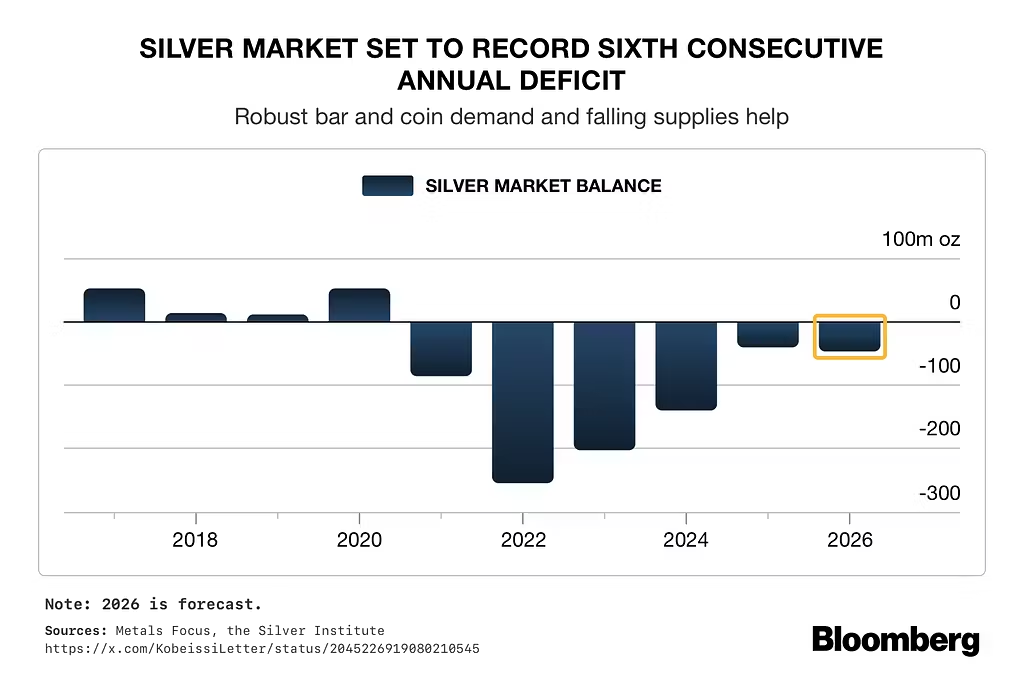
A silver “deficit” indicates consumption surpassing supply—a condition we have steadily faced since 2021.
Notably, initial projections anticipated a smaller 2026 deficit, but unexpectedly high demand for coins and bars, especially across Asia, adjusted those forecasts.
Available inventories on major platforms like the COMEX have dropped from 300 million ounces in 2020 to below 100 million today.
Both industrial use and investment interest in silver remain strong, and I foresee these trends persisting for years.
Mine production has held steady, while recycling has increased, partly explaining the recent price correction. Many took advantage of the price surge to sell off silver holdings.
Nevertheless, the global debt bubble continues to expand, requiring massive amounts of currency creation to sustain it.
Therefore, I’m holding my position. I believe silver is destined to reach $200 within the coming years. Industrial demand has never been higher, and savvy investors will buy on downturns. Furthermore, I expect more governments worldwide to begin stockpiling silver as both the U.S. and China have designated it a key strategic metal.
Silver is an excellent hedge against inflation and an essential resource for cutting-edge technology.
Known as the “poor man’s gold,” silver will continue to experience volatility; however, for those who can endure it, buying the dips is advisable. Risk-averse investors might also consider dollar-cost averaging to mitigate uncertainty about the bottom.
About the Author