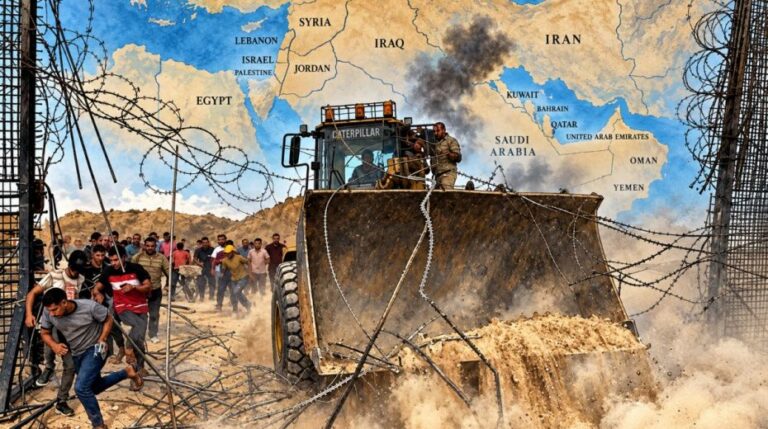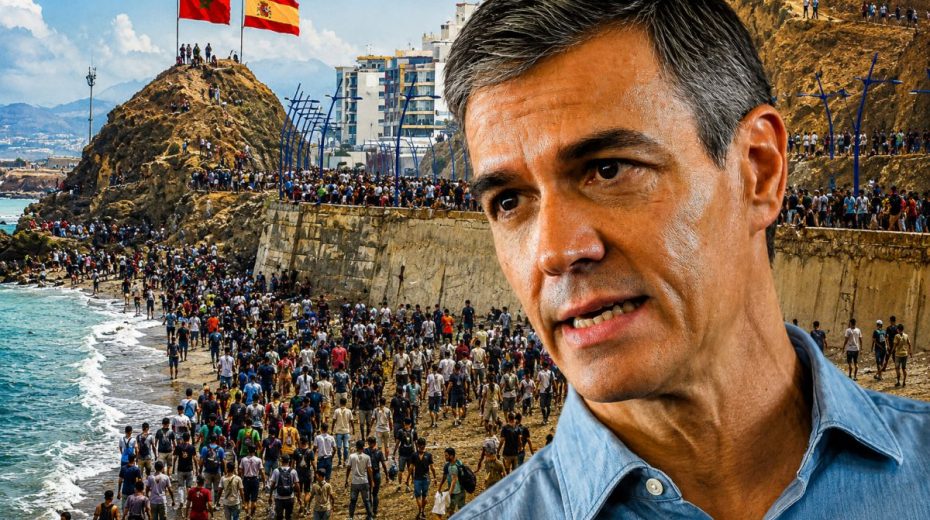
The recent attack on Spain—exploiting impoverished individuals condemned to extreme hardship as mere political tools—serves as yet another example of the despicable tactics wielded by imperial powers, and the West at large, to advance their geopolitical agendas.
Is it really plausible to think that tens of thousands of Moroccans and other African migrants simultaneously chose, at some invisible command from Morocco—or perhaps Tel Aviv or Washington—to storm the Spanish enclave of Ceuta and then disperse throughout Spain?
Who masterminded this operation?
Who managed its coordination?
Who was behind it?
Pointing fingers without proof is either impossible or intellectually dishonest.
Yet we’ve witnessed similar tactics before.
We recognize these approaches.
We understand the strategies involved.
And we can discern the political aims intended.
In my view, there is little doubt about the primary goal here.
It is the ousting of Pedro Sánchez’s government in Madrid.
A government led by the Spanish Socialist Workers’ Party (PSOE) which, unexpectedly, broke with the neoliberal consensus that has become almost mandatory among its counterparts in the Western world.
This break has consequences.
And these consequences are increasingly intolerable to the global power centers based in Brussels and Washington.
The autocracy hidden beneath the façade of “liberal democracy” has thus decided that intervention is necessary.
Motives were gathered one after another.
Excuses piled up.
Parallel campaigns merged.
All aiming for the same political goal: the removal of Sánchez’s administration.
For figures like Ursula von der Leyen, António Costa, or Donald Trump, there is no place for governments valuing sovereignty or leaders willing to question the prevailing orthodoxy within either the European Union or NATO.
The self-appointed defenders of “liberal democracy,” “our shared values,” and “Western civilisation” tolerate surprisingly little dissent within a political system that endlessly praises pluralism while increasingly speaking with a single voice.
Sánchez’s Government Has Been Marked for Elimination
Make no mistake.
Pedro Sánchez’s political fate has already been sealed in Washington and Brussels.
His administration is targeted for removal.
The challenge, however, lies in the fact that Spain is no country that can be disciplined instantly.
It would be a grave error to undervalue it.
Spain possesses a strong sense of identity, history, and remarkable diversity. It has never been a compliant “model student,” nor is it poised to become one now. It knows its political significance, resists intimidation, and intends to avoid dissolving into a supranational entity where nations—and ultimately citizens—are reduced to mere administrative units.
For precisely this reason, Spain has become a hindrance to the power centers in Brussels and Washington.
And hindrances are rarely tolerated for long.
The pressure exerted on Ceuta—by cynically exploiting human suffering and the colonial inequalities still impacting Morocco and much of North Africa—is merely one of the latest tools used in a broader campaign aimed at destabilizing Spain.
Since Pedro Sánchez showed unwillingness to fully embrace the unrestrained neoliberal capitalism model promoted by the US and EU—which is increasingly entangled with military ambitions and geopolitical rivalry—Washington’s political establishment, backed by Brussels, has pursued this objective.
Sánchez is no revolutionary.
He doesn’t oppose capitalism itself.
At heart, he remains a social democrat.
Yet he appears to align with a form of social democracy largely abandoned by much of Europe.
Today, being considered a fully respectable member of the Western political elite means embracing neoliberal orthodoxy almost as a creed.
Sánchez has refused to comply.
This makes him a political outlier.
Or, to use technological parlance, a bug in the system.
Within the current Western political framework, any administration that strays—even slightly—from the approved consensus soon encounters pressure from the opaque, conspiratorial, and often vindictive networks operating behind the scenes in Brussels and Washington.
Nor has Sánchez accepted that Spain’s younger generations shoulder the burden of the EU’s growing militarized drive in support of Kyiv.
He views these ambitions as inseparable from a narrative painting Russia as an imminent threat to all Europe—a narrative that has become highly lucrative for sectors like the arms industry, energy corporations, and major media companies.
On the issue of Palestine, Sánchez has adopted a stance that sets Spain apart from nearly all other Western governments.
He has consistently upheld the rights of the Palestinian people and confronted the Israeli government over its actions in Gaza, accusing it of breaching international law and standing firm against the political intimidation that silences many European leaders who shy away from speaking as clearly.
That may well be the greatest paradox.
Among governments frequently invoking international law, Spain is one of the rare countries willing to consistently apply it in practice.
For the architects of contemporary European orthodoxy, this stance is deeply uncomfortable.
And for some, likely intolerable.
Having Principles Comes at a Price
The opposition to Pedro Sánchez began predictably within domestic politics.
Launched under the banner of anti-corruption—a cause difficult to dispute—Spain’s conservative opposition, led by the People’s Party (PP) and the far-right Vox movement, allied with influential business sectors to paint Sánchez’s government as irreparably tainted.
The irony is that many of his critics have themselves been active in a political culture long plagued by corruption scandals.
Despite backing from a significant segment of Spain’s media establishment, the campaign has so far failed to reach its ultimate aim, instead stalling.
Pressure then escalated on another front.
Sánchez’s refusal to comply with NATO’s request—strongly promoted by Donald Trump—that members boost military spending immediately to five percent of GDP put him at odds with Washington.
His opposition was clear-cut.
From that moment, Sánchez became one of Trump’s favored political foes in Europe.
Spain’s increasingly vocal stance on Palestine deepened tension within NATO and the European Union.
Among Western leaders, Sánchez stands out for moving beyond mere words and adopting concrete measures to exert political pressure on Israel about its Gaza policies.
His position has had an impact far beyond Spain’s borders.
It has encouraged citizens in Europe and the United States to show open solidarity with Palestinians without fear, fueling greater public attention to the Palestinian cause through rallies, public discourse, and the display of Palestinian symbols that were once reluctantly shown.
For those hoping to politically isolate Spain—including voices close to Donald Trump who wished the country would not strengthen its international standing—the outcome has been deeply frustrating.
Despite controversies overshadowing major sporting events, Spain’s football successes became symbols of national pride rather than vulnerability.
Solidarity with Palestine was visible throughout these tournaments.
Fans waved Palestinian flags in stadiums across the games.
Players from national teams such as Egypt and Iran also publicly supported the Palestinian cause.
For many observers, the political symbolism of these acts was impossible to ignore.
Perhaps no image captured this more vividly than Spain’s young star Lamine Yamal celebrating victory while holding a large Palestinian flag, later reaffirming this solidarity in interviews.
Whether praised or condemned, those images circulated worldwide, ensuring the Palestinian issue remained firmly present in international public discourse.
Against this political backdrop, the Ceuta crisis looks less like an isolated migration incident and more like a wider tactic designed to weaken Sánchez’s government.
It is no accident that some of the earliest calls to suspend Spain’s role in the Schengen Agreement came from Europe’s nationalist and far-right groups, claiming Madrid failed to control migration effectively.
From Giorgia Meloni’s allies in Italy to hard-right administrations in Northern Europe and figures like André Ventura in Portugal, demands to politically punish Spain gained swift momentum.
Meanwhile, Morocco’s position in the region has been further bolstered following Donald Trump’s recognition of Moroccan sovereignty over Western Sahara and support for major infrastructure projects linking Moroccan lands with the occupied Sahrawi territories.
For Madrid, these developments bear wider historical and diplomatic consequences, given Spain’s long-standing ties to its former colony and the unresolved legal status of Western Sahara.
For decades, the United Nations championed the Sahrawi people’s right to self-determination through a referendum.
Today, critics argue that geopolitical realities are increasingly replacing this pledge with faits accomplis on the ground.
If this is the trajectory, then international law and human rights risk becoming secondary to powerful states’ strategic goals—a contradiction Spain’s government has increasingly challenged.
The Price of Defiance
A luxury resort in Gaza and a new highway crossing Western Sahara—facilitating exploitation of the territory’s abundant natural resources—would, in the eyes of critics, complete projects amounting to ethnic cleansing in Palestine and North Africa’s last unresolved colonial region.
Such developments would enrich those poised to benefit while turning areas marked by severe human suffering into international tourist destinations.
This is the humanitarian vision now being presented to the world.
The West invites us to believe that peace, civilization, and prosperity can arise on lands devastated by dispossession and war— as if history could simply be paved over.
Another crusade successfully concluded.
Yet behind the scenes where this new, carefully packaged “pacifism” is devised, an unexpected challenge has appeared.
Spain.
History shows that any system demanding ideological uniformity eventually quashes dissent.
The more totalizing the political project, the less room it leaves for independent voices.
Despite mounting pressure and increasingly sophisticated destabilization efforts, Pedro Sánchez’s government has refused to back down.
The Ceuta assault stands as one of the most serious trials to date.
Those orchestrating it showed scant regard for the thousands of vulnerable people caught in the turmoil.
As so often happens when political ends are absolutized, human lives became mere tools.
The timing seemed deliberately chosen.
The migration crisis unfolded while devastating wildfires simultaneously ravaged vast parts of Spain, stretching emergency services and security forces to their limits.
Yet many caught up in the event soon recognized the deception.
Understanding they had been pawns in a political game far greater than themselves, many opted to return to Morocco, narrowly avoiding a trap set by those who never saw them as human beings deserving respect, but as expendable instruments in a geopolitical struggle.
Spain’s experience may offer a broader lesson.
Citizens across the European Union and NATO should pay close attention.
Spain has shown that, however challenging, it remains feasible to defy the prevailing orthodoxy of the so-called Western democratic order.
Whether or not one agrees with Sánchez’s policies, his government has demonstrated that political autonomy survives in Europe.
And that, in itself, may prove the most disconcerting development for those who believe dissent is no longer tolerated within the modern West.
About the Author