Winchester and Bingo in Iran
Let’s simplify the Iran conflict using two key terms: Winchester and Bingo.
If you grasp these two phrases, you’ll understand the dynamics behind President Trump and the U.S. approach toward resolving the Iran crisis and moving forward.
As I’ll outline below, the resolution to the U.S.-Iran standoff hinges on restrictions involving U.S. weaponry—specifically, the shortage of advanced munitions—and critical limitations within the global energy framework. That’s the core of it. Nothing more.
In essence, the U.S. is constrained by an insufficient supply of premium ammunition, while America, its allies, and much of the globe face potential economic disaster due to a lack of crude oil. All other aspects of the Iran “deal” debate are essentially about appearances and political theater.
Keep it Brief, With Brevity Code Words
Let me briefly introduce the concept of “brevity” words.
Back in my time flying Navy aircraft (specifically the Lockheed S-3A “Viking,” if you’re curious), we frequently used brevity codes. These are mostly single words designed to communicate quickly and clearly.
The purpose of brevity words is to send concise information without overloading radio channels with lengthy speech. The military has an extensive collection of these; so extensive, in fact, that the U.S., NATO, and allied forces maintain a whole manual dedicated to them.
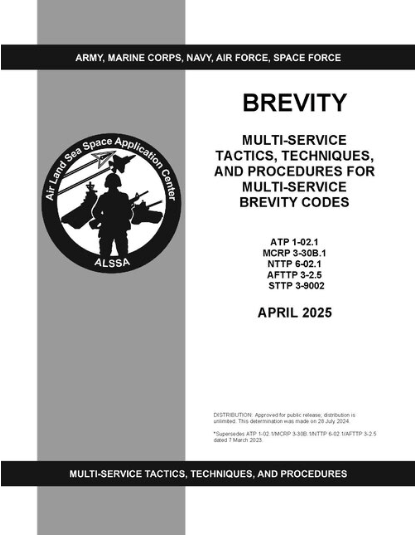
Multi-Service Brevity Codes, April 2025 ed. Credit U.S. Dept. of War.
Typically, brevity words are phonetically distinct, articulated sharply for clarity. Used correctly, they enable communication even under some jamming conditions.
For instance, you may have heard law enforcement officers, truckers, or pilots say “Roger.” This is a military brevity code meaning “I have received your message.” Despite common casual usage meaning “Got it,” “Roger” only confirms receipt, not agreement or action.
If you intend to comply, the response is “Wilco.” And if the answer is negative, you simply say “Negative.”
With this background, let’s focus on those two key brevity terms explaining the current situation with President Trump and Iran.
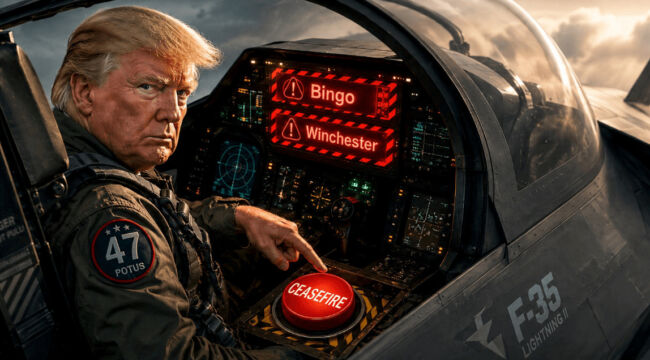
The code word Winchester means you’ve expended all your ammunition. All bombs are dropped, all rounds fired — your weaponry is empty, and your combat effectiveness is zero, leaving only the act of flying and noise making.
On the other hand, Bingo indicates you’re at minimum fuel levels. Without promptly returning to “Homeplate” (another brevity term), you risk running out of fuel and crashing.
Picture this: a voice calls your callsign over the radio and says, “Say Status” — a code requesting your current condition. You respond, “Status is Winchester and Bingo.”
You’re out of ammo and low on fuel. It’s time to retreat and live to fight another day. So, you turn back and head home.
Why Did Trump Call a Cease Fire?
Now, let’s analyze the “ceasefire” of April 8, which President Trump announced after nearly 39 days of intensive bombing of Iran in late March and April’s first week. What caused this halt?
During the active combat phase, U.S. and Israeli air forces had uncontested control over Iranian airspace. The country endured 600 to 800 air strikes daily. Iranian air defenses were reduced to minor harassment from random ground forces and occasional surface-to-air missile launches that mostly helped the U.S. by revealing Iranian positions.
So, what changed? Why did operations stop despite what many called “winning”? Why didn’t Trump press the aerial campaign further?
Was Iran about to unleash a new Wunderwaffe? Some hidden superweapon capable of smashing those “Yankee Air Pirates”?
No chance. By early April, Iran’s air defenses were nearly obliterated. Despite their network of caves, U.S. and Israeli dominance of the skies was complete on ceasefire day. Like it or not, this was the true military balance when Trump decided to stop the bombardment.
So then, was the ceasefire driven by humanitarian concern? Did Trump suddenly grow sentimental and want to spare innocent Iranians after threatening to destroy their infrastructure?
Unlikely. I have no inside knowledge of White House intel, but Trump’s personality suggests he doesn’t easily warm up to adversaries. Based on all appearances, if he dislikes someone, He. Really. Doesn’t. Like. You.
From my outside perspective, I suspect an adviser showed President Trump something like this:
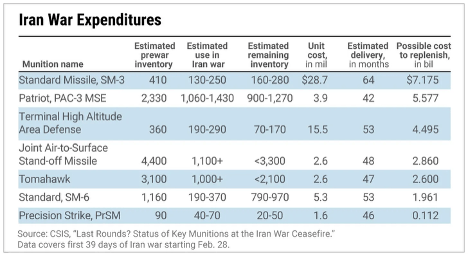
Munitions used during Iran operation. Credit CSIS.
You don’t have to be a missile expert to appreciate this chart. It lists the advanced, costly, custom-made munitions the U.S. deployed during the 39-day conflict. These include air defense systems targeting Iranian missiles and precision attack weapons, representing the highest tier of U.S. ordnance, far beyond standard “smart bombs” stored in ample quantities.
This data shows pre-war inventories, quantities expended, and estimated remaining stock. The results are alarming.
To be precise, the U.S. is not quite at zero—but close. So, not literally “Winchester.” Don’t quibble over that. However, remaining stocks are shockingly low. Look at the “Estimated Remaining Inventory.” It’s staggering. If I were a Pentagon planner (and I once worked on the Chief of Naval Operations’ staff), this would be deeply concerning.
By late March and early April, cautious military advisors—whom the White House counts on—likely warned President Trump, “Sir, these vital munitions are running dangerously low, and we’ll need years to replenish them for potential future conflicts in Asia. We need to stop fighting now.”
Or words to that effect. This is a key reason behind Trump’s ceasefire decision.
My takeaway is this: Winchester, folks. I’m calling “Winchester.”
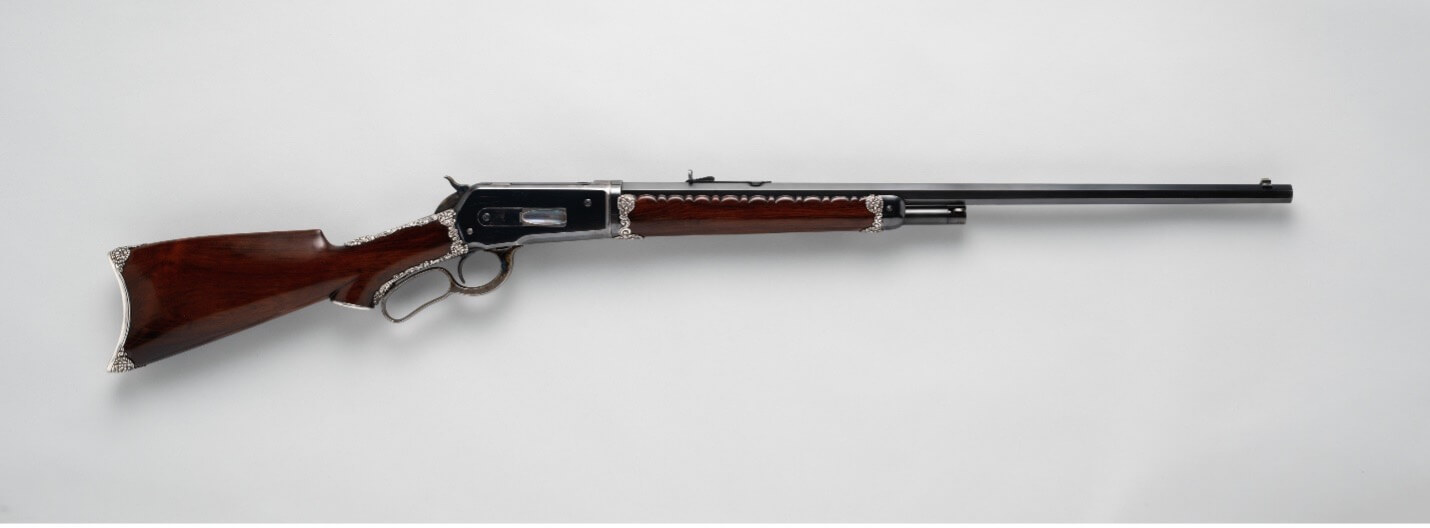
Winchester Model 1886 with Tiffany silver inlay. Credit Metropolitan Museum of Art.
Energy Bingo
Then there’s the global energy predicament, especially oil. Once the conflict escalated on February 28th, Iran promptly announced the “closure” of the Strait of Hormuz, a crucial conduit for 20% of global oil shipments along with liquefied natural gas and other cargo.
What did this “closure” mean in practice? Iran loudly declared Hormuz off-limits, and commercial transit essentially stopped.
Did they mine the passage? Possibly, but intelligence assets and underwater detection systems help identify and neutralize such threats. Modern mine clearance isn’t like the World War II methods your grandfather might recall. In fact, mines are not a lasting military obstacle here.
Did Iran launch drones and missiles against ships? Yes, but the U.S. has effective systems to detect and destroy airborne threats. Still, the Strait remained a perilous zone with weapons flying around.
Mines and drones aside, what truly “closed” Hormuz was a global consensus that passage was too risky. Insurance for tankers and cargo vessels vanished, and most shippers refused to sail, save for a brave few breaking the blockade. This dramatically disrupted worldwide oil flows.
Oil producers sought alternatives, notably Saudi Arabia, which rerouted roughly 8 million barrels per day through an east-west pipeline across the desert to the Red Sea.
Yet some 12 million barrels daily normally shipped through Hormuz were halted, preventing tankers from reaching markets across Europe, Africa, Asia, Australasia, and even California.
With over three months without docking tankers in numerous regions, oil reserves have dwindled to residue in storage tanks in certain places. Globally, about 700 significant refineries exist, many in Africa, Asia, and Australia approaching exhaustion of stored supplies. Some are extracting “line-fill” — fuel remaining in pipes — just to keep processes running.
Closer to home, the U.S. Strategic Petroleum Reserve (SPR) has dropped to levels unseen since the early 1980s.
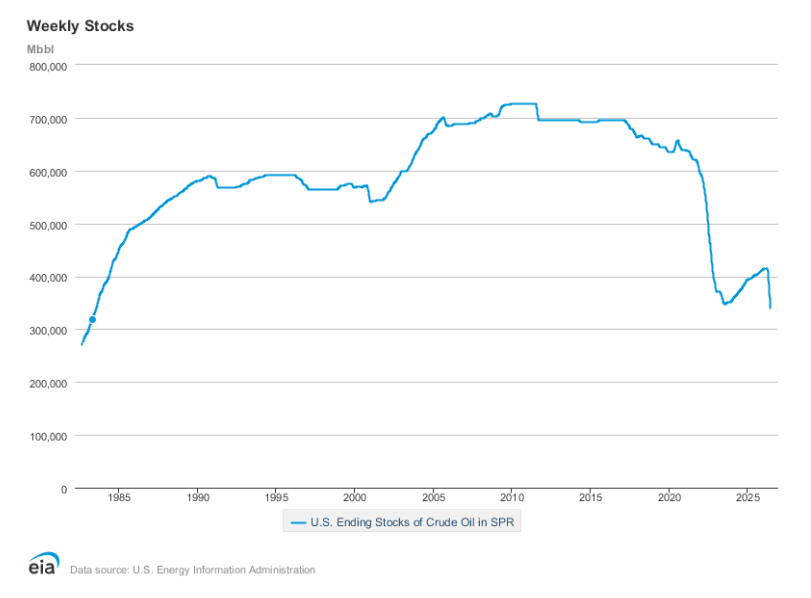
U.S. SPR down to 1983 levels. Credit: Dept. of Energy/EIA.
Of course, this situation isn’t solely Trump’s doing. The graph shows that significant SPR withdrawals occurred under the Biden administration, which released over 225 million barrels during 2021-23 for political reasons, mainly to curb rising fuel prices.
In 2025, the Trump administration initiated a refill effort, but due to the Iran conflict, this reversed out of a “strategic” necessity to supply refineries with proper crude blends and balance oil markets internationally.
On the positive side, the U.S. is relatively stable. It produces over 13 million barrels daily domestically, receives about 4 million barrels via pipeline from Canada, plus around one million barrels from Venezuela and other smaller sources like Brazil and Guyana.
In short, the U.S. crude oil and refined fuel supply is somewhat stable (except for California, which faces a policy disaster). Although prices might feel high at the pump, at least Americans have fuel available.
Outside the U.S., the outlook is precarious in many countries. This isn’t just about expensive gas or diesel; it’s about refineries teetering on the edge of running completely dry, leaving no refined fuel or essential products.
Don’t just take my word for it. Here’s President Trump in a recent press conference, candid and direct: “We run out of [oil] reserves in about four weeks,” he stated.
“If we hadn’t done this deal [with Iran],” he added, “we could have kept bombing for another two weeks, three weeks, or longer. The Strait of Hormuz would have remained shut.”
Trump warned that without the agreement, “the alternative would be a world-wide depression.”
Continuing the conflict, Trump noted, would crash stock markets “to levels nobody has seen before, except maybe 1929. .… And “the one President I did not want to be was the late, great Herbert Hoover.”
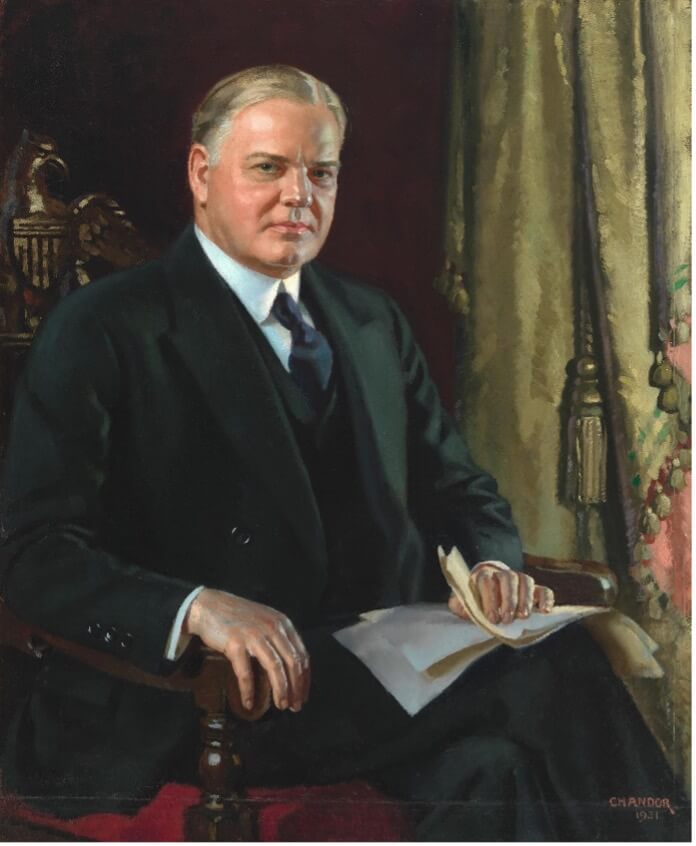
President Herbert Hoover, who President Trump does NOT want to be. Credit National Archives.
Winchester and Bingo
There you have it. This is the lens through which to understand negotiations with Iran: U.S. munitions are nearly exhausted to dangerously low levels, while President Trump has acted out of concern for a global oil shortage that could trigger a worldwide depression and stock market crashes reminiscent of 1929.
Thus, the U.S. is dealing with Iran to keep the Strait of Hormuz open, which it remains as of today. Yet, as with much in life, what unfolds going forward is uncertain.
For now, enjoy the relatively lower oil prices. They might continue, or they might not. Nobody can say for sure. Because—very seriously—our status is Winchester and Bingo.
That’s all for today. Thank you for subscribing and reading.
About the Author