Free at Last
Alan Greenspan, RIP
We were aware. He was aware. We knew he was aware. And — the final twist — he also knew that we knew.
Still, he remained silent as a mute fish, lips tightly shut. The clearest way to maintain a reputation for intelligence is to avoid saying anything that can be proven wrong.
We managed to bring him into our office in Baltimore — Dan Denning, David Stockman, and your correspondent — to ask him the question directly. He was over ninety. His accolades were behind him, pensions firmly in place, and obituaries already prepared somewhere at the Times. A man in that position had no reason to hide the truth. All incentives for dishonesty had faded. We thought it was the moment for him to confess.
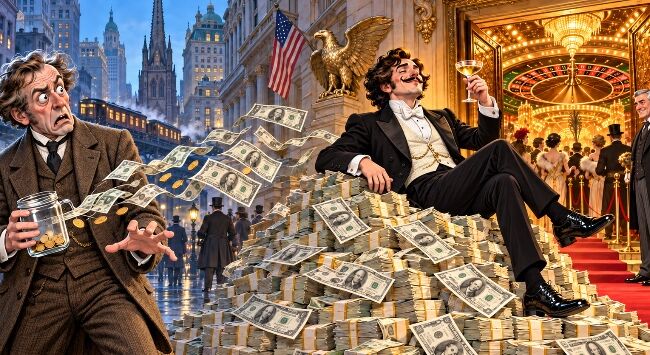
This was a man who had literally ‘wrote the book’ about how fake currency steals from the honest. He grasped better than anyone that operating the printing press chips away quietly at the savings of diligent people, while handing the leftovers freely to spendthrifts and speculators. He knew the scam inside and out.
So we challenged him: knowing all this, why in the name of reason did you do it? Of all men alive, you controlled the lever. Why permit the machine to roar uncontrollably off its tracks?
And the old magician responded with the usual murky excuses — that haze of subordinate clauses and hedged denials that confused a generation of lawmakers and made him the chief priest of American financial nonsense.
Yet humans, the craftiest of creatures, are also masters of self-delusion. Each pursues their own idol. One breaks a sweat in the gym to build muscle; another commands troops to secure dominion; a third hoards dollars, a fourth chases pleasures, and a fifth simply wants to be seen as the smartest in the room. Beneath all these drives flows the same hidden current: the desire to stand out, to be valued, to count for something.
In primal times, a man fought for the right to reproduce…or even to survive. The modern man schemes instead — and none was a finer schemer than Alan Greenspan.
The draft board rejected him during WWII because of “a spot on his lung.” Whatever it was didn’t keep him from playing clarinet and saxophone skillfully, nor from outliving the doctors by about eighty-two years. At such an advanced age, the cause of death needs no inquiry, but the Times provides one anyway: complications from Parkinson’s.
In the 1950s, his first wife introduced him to Ayn Rand, and he was quickly immersed in the chilly waters of “objectivism” and the Austrian economic school. The philosophy is straightforward and, up to a point, valid: whenever politicians meddle with the delicate workings of a real economy — adjusting prices here, printing money there, imposing taxes or tariffs — they corrupt the system, turning honest trade into a fraud.
Manipulating the currency was the ultimate crime. Greenspan found it so serious that he wrote a pamphlet in 1966 titled “Gold and Economic Freedom.” In it, he declared money printing for what it truly is: “a scheme for the hidden confiscation of wealth.”
Rand was ecstatic when her disciplined disciple was called to Washington. Now, she boasted, she had ‘her man’ at the Fed.
But she didn’t keep him long. Principles are expendable for struggling philosophers or weekend sax players; they may treasure them in their parlors for years. Yet running the Federal Reserve demands different values. Volcker had subdued inflation, letting politicians spend and borrow with fewer limits. They now needed THEIR man running the Fed.
This was Greenspan’s true historic role. The famed “Greenspan put” was nothing more than this: he stood ready to catch every gambler who leapt from the ledge — overseeing the grandest charade of artificial prosperity the world has ever seen.
From August 1987 to January 2006 Greenspan sat atop the Federal Reserve and did the opposite of everything his essay defended. After the 1987 crash he flooded the banks with liquidity and taught a generation of traders that the central bank would catch them every time they fell. They named the reflex after him: the Greenspan put.
He cut the federal funds rate to 1 percent by June 2003 and held it there, and you watched housing prices detach from any sane relationship to income. Mortgage credit gushed. He went on television in February 2004 and suggested Americans consider adjustable-rate mortgages, roughly eighteen months before he started hiking rates into those very borrowers. The man who warned in 1966 about the hidden confiscation of wealth engineered the largest credit distortion in postwar history.
Following the announcement of his death, numerous mourners gathered on Facebook, heads bowed solemnly beside the coffin. A “great economist,” one states. He “helped us through a crisis,” another whispers — the crisis, of course, being the one he himself created. A third lays tribute to his lengthy “public service.” The Times joins the chorus, outdoing them all:
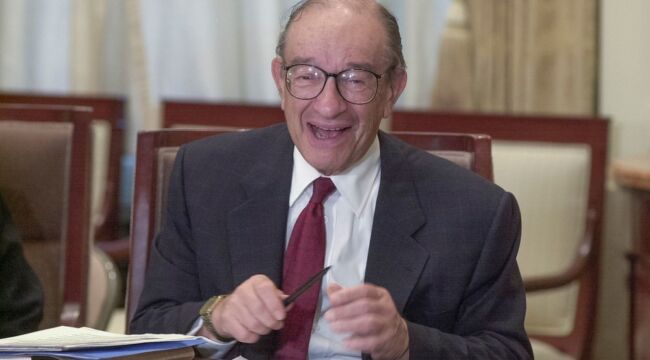
At the peak of his fame, as the economy boomed in the late 1990s, his merest phrase could send the markets sharply up or down, and his face, behind thick glasses, was as familiar as any movie star’s.
Thus, the old trickster achieved what he sought: the applause, the reverence, and the enduring mystique of the oracle…Alleluia, right up to the grave.
Requiescat.
Editor’s note: Read more of Bill’s writing at Bonner Private Research.
About the Author