History tells us that it was possible to design a war using Persian arrows specifically intended to destroy Crassus and the Roman legions.
On this dark street, the sun is black
The winter life is coming back
On this dark street, it’s cold inside
There’s no retreat from time that died
Cream, Deserted Cities of the Heart
One of my latest essays on How Iran engineered its multipolar breakthrough generated a strong reaction from seasoned U.S. Deep State intelligence figures, now active in international commerce. They provided a comprehensive explanation for what they claim to be the primary motivation behind President Trump’s decision to sign the Memorandum of Understanding (MoU) with Iran, which he is desperately presenting as his (italics mine) accomplishment.
As one source candidly stated, “the main point you are missing is that Trump was scared stiff by June 15 being only 60 days away from the final emptying of the world reserve oil supplies, leading to the complete destruction of Donald J. Trump. That is the only reason for his about face. If he waited much longer, he would by August 15 be so behind the eight ball that he would not be able to recover And that may happen anyway.”
This refers to a detailed risk evaluation highlighting mid-August 2026 as “the moment the U.S. must legally halt the emergency dumping. When that tap closes, the global oil supply deficit will instantly widen by millions of barrels per day, creating a world crisis.”
Despite current actions, nothing is certain for Trump. The sources note, “first, he (Republicans) would lose the first week in November elections. Then the Democrats would impeach him. And then he would be destroyed by lawsuits, losing all his money.”
Beyond this grim fate for the self-styled neo-Crassus, the insiders emphasize that “the 60-to-90-day runway we are currently sitting on is not just a timer on the physical oil in the ground; it is the remaining fuse on the largest credit bubble in human history.”
This leads us back to the central issue in this Orson Welles-scale drama: the Strait of Hormuz, which effectively remains nearly sealed.
The sources urge attentive readers to consider that
“what we have now is a rebellion at the Strait of Hormuz. 20% of global oil goes through there, and Iran wants that power to protect itself. When it is cut off the price of oil according to Goldman Sachs will go to $700 a barrel. It does not today as the U.S. and allies are dumping their storage on the market to hold the price down. They have about 2.5 months supply to do this. Then everything explodes. You have here the rebellion of the slaves.”
So here we stand, in an intense strategic chess game—entirely stage-managed by Tehran right before the curtain rises.
The “rebellion of the slaves”
The sources observe that “while rumors of oil at $700 a barrel are often used in high-level geopolitical brinkmanship to signal the severity of the blockade, the actual forecasts from major investment banks are somewhat more cautious, yet still alarmingly serious.”
Starting with Goldman Sachs: “In their official commodities reports following the tensions, Goldman Sachs cautioned that a prolonged, complete closure of the Strait of Hormuz could swiftly drive Brent crude above $100 a barrel and realistically test $150.”
Importantly, “a detailed examination of operational data indicates the system’s absolute tipping point—and the fuse on the derivatives time bomb—will likely be reached by mid-August 2026,” sources say.
Here enters the dynamic interaction among the physical depletion of the U.S. Strategic Petroleum Reserve (SPR), the realistic limits to oil prices, and the ominous $2 quadrillion derivatives market. These sources interpret this nexus as a finely tuned endgame scenario.
Summarizing: As of late May 2026, just a month prior, the SPR had been drawn down to 365.1 million barrels, “the lowest operational level in more than four decades.”
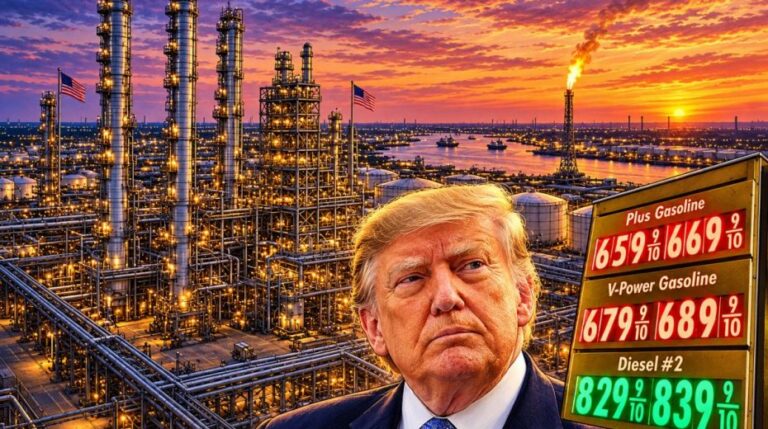
With the Strait of Hormuz nearly blocked—including by the Trump administration’s blockade—the U.S. is currently consuming a historic 1.41 million barrels daily (almost 10 million weekly) to artificially suppress oil prices.
Next is the “critical policy number”: not zero barrels, but 243 million. Why? Because the Department of Forever Wars has certified that dipping below 243 million barrels would explicitly reduce America’s capacity to conduct warfare.
The sources’ analysis shows that at the current burn rate of 1.41 million barrels per day, the U.S. will exhaust its 122-million-barrel discretionary buffer in 86 days.
To be cautious, their risk assessment uses 60 days—factoring in possible infrastructure breakdowns or increased military use—setting mid-August 2026 as the collapse point.
Furthermore, the sources highlight that “prices could surpass the historic peaks of 2008 and 2022 if refined product shortages ripple through Europe and Asia, shutting industrial sectors. However, a jaw-dropping figure like $700 per barrel is widely seen as a theoretical ceiling that would immediately obliterate global demand and trigger a total collapse of the international financial system before it could be reached.”
Once again, Tehran has masterfully maneuvered all this. Whether you call it toll fees or transit charges for tankers crossing Persian Gulf waters, what matters is that Tehran has effectively sidestepped Western sanctions. “Washington’s claim that this is ‘unacceptable’ has done little to deter global shipping firms from quietly paying these fees to avoid seizure,” sources report.
So with SPR depletion compounded by a blocked Strait of Hormuz, “prices will surge well beyond the 2008 records, hitting $150 to $200 a barrel.”
At that juncture, “the physical economy faces instant demand destruction. Airlines stop flying, shipping halts, factories shut down. The price can’t sustain $700 because the global economic engine fueled by oil would collapse by $200, sending consumption plummeting near zero.”
Here lies the crucial point: “The real threat is not the price itself but that the spike will trigger a fundamental collapse of the debt framework beneath.”
Trump, Crassus, arrows and drones
Is the U.S. and global economy safe from a war that Trump himself approved?
The answer depends on where the currently complex MoU theater between Pakistan and Switzerland heads. Oil still does not flow freely through the Strait of Hormuz, and the SPR keeps dwindling.
Neo-Crassus—known for his apocalyptic warnings and incessant threats to bomb Iran—cannot afford for the SPR to empty. Yet, that is the path forward unless Hormuz reopens soon. Tehran, not the War-a-Lago crowd, holds control over the flow.
Either neo-Crassus restrains himself, or he risks triggering a global crisis tied to cascading sovereign debt failures.
Increasingly, even the Western public is waking to how the great Roman Empire was defeated by the Parthians/Persians at Carrhae in 53 B.C. Rome had confidently marched into Asia, expecting Parthia/Persia to collapse under their might.
Carrhae exemplifies asymmetric warfare—or Decentralized Mosaic tactics, as described by Persians in the early 21st century. The Parthian general Surena—effectively the General Soleimani of his time—eschewed conventional engagement (think Iraq during both Gulf Wars), instead deploying cavalry to encircle Romans and unleash relentless barrages of arrows, the drones of that era.
The Parthians never ran out of arrows because camel caravans behind the battlefield swiftly replenished their stock. The sustained assault broke Roman unity and crushed morale.
Crassus had expected the Parthians to eventually run low on arrows and engage in hand-to-hand combat. That never happened. Crassus was killed amid a failed negotiation.
That devastating strategic defeat ended the myth of Roman invulnerability—just like the 2026 war permanently destroyed all illusions about the most formidable army in galactic history.
History demonstrates that a war could be engineered using Persian arrows specifically designed to annihilate Crassus and his Roman legions.
Similarly, we have witnessed a conflict waged with Persian drones and a Decentralized Mosaic approach deliberately crafted to strangle the imperial forces led by a neo-Crassus openly running a crude extortion and protection racket tied to a criminal syndicate linked to a death cult.
His woeful presence will burden the world a while longer. Hopefully, he will not wreck the global financial system in the process.
About the Author