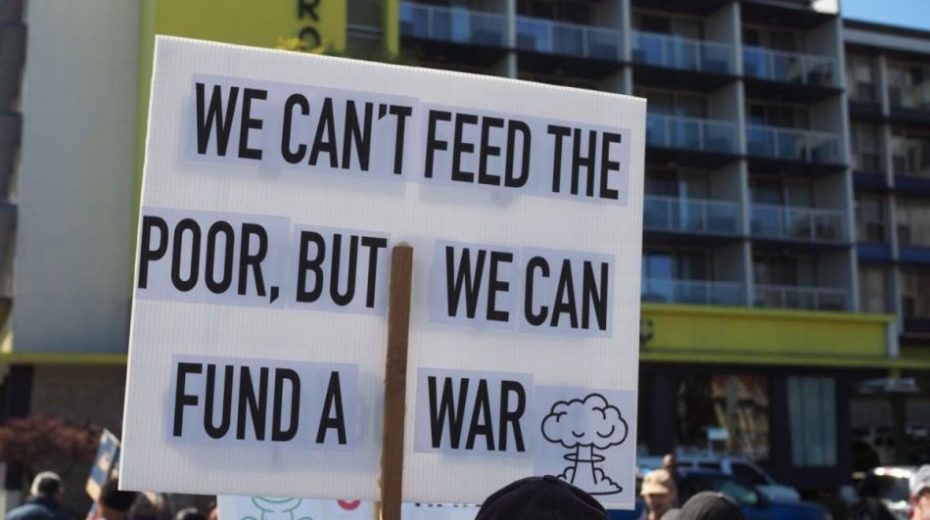
In a time when costs for essentials like fuel, groceries, and housing are soaring, an additional $4,000 could be crucial for many households. Yet, that is precisely what the typical family contributed to funding the Pentagon last year.
Indeed, the average American taxpayer in 2025 paid over $4,000 from their earnings to support the Pentagon, as reported by the National Priorities Project at the Institute for Policy Studies. This figure is expected to grow as Congress debates a $1.5 trillion war budget proposal for 2027.
For the expanding population of low-income workers in the U.S., these funds could mean the difference between covering rent or falling behind, and between affording emergency medical care or going without treatment.
Many Americans view Pentagon spending as a clear betrayal. A substantial majority opposes ongoing military engagements, particularly the recent conflict involving Iran. Approximately half of the Pentagon’s budget is funneled to for-profit contractors, bolstering the fortunes of billionaires—and now trillionaires.
Take SpaceX as an example, one of many enterprises dependent on government contracts financed by taxpayers. Elon Musk’s business owes its existence to U.S. public funds. Ross Gerber, an early Tesla investor, stated, “There would not be (Tesla and SpaceX) if it weren’t for the government.”
Initial government contracts and investments helped launch SpaceX, while continuing Pentagon agreements ensured steady income, making the government one of Musk’s top clients. Presently valued above $1 trillion, SpaceX’s success is not solely due to private funding—American taxpayers played a crucial role.
Musk is not unique in gaining vast wealth through taxpayer-supported industries.
Lockheed Martin earns more than 70 percent of its income from government contracts, and firms like Raytheon and General Dynamics show similar reliance. Without taxpayer funds, these defense giants wouldn’t exist. A proposed $1.5 trillion budget increase would channel hundreds of billions more into the pockets of those who already hold enormous wealth beyond most Americans’ imaginations.
Meanwhile, despite taxpayer dollars fueling the defense sector, employment figures in this field are dwindling, with the military industry employing over two million fewer workers compared to forty years ago.
Even more troubling, the Republican-led “Big Beautiful Bill” passed last year funds ballooning Pentagon budgets by cutting programs like SNAP and Medicaid that support vulnerable Americans.
Millions, including children, have already lost SNAP benefits during this period, which impacts not only families but the farmers who rely on that steady income.
Reese Amxy, a policy organizer with the Illinois Stewardship Alliance, described SNAP as “guaranteed money in the pockets of farmers.” Yet, 150,000 people in Illinois have seen their eligibility revoked.
This trend isn’t limited to Illinois. Arizona has experienced the sharpest drop, with half a million recipients (50 percent) already losing benefits. Other heavily affected states include Louisiana (21 percent), Florida (20 percent), Oklahoma (16 percent), Virginia (16 percent), Texas (14 percent), Wyoming (13 percent), and Arkansas (12 percent).
Both those deprived of SNAP and the farmers who lose income will be expected to pay for the proposed $1.5 trillion military budget. This is nothing short of “Robin Hood in reverse.” Even more disturbingly, the weapons bought with these funds may be used to kill children in places like Gaza and Iran.
The military contractors and technology executives poised to profit from such a vast war budget, along with the politicians they support, aim to perpetuate this cycle on an even larger scale next year. It is imperative for Americans to pressure lawmakers to halt further Pentagon spending and redirect investments toward initiatives that truly ensure community safety.
Original article: www.counterpunch.org
About the Author