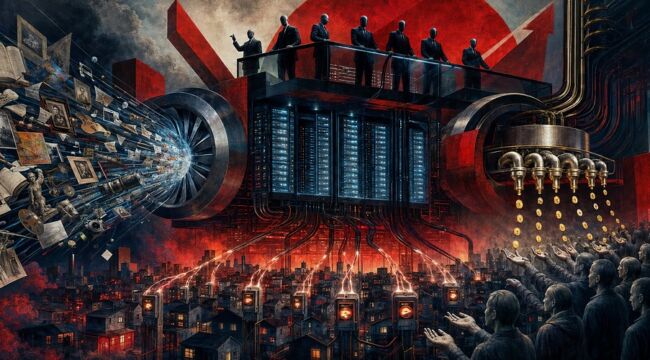
Tech Bros Run the Marxist Playbook
Is Marxism a useful lens through which to interpret artificial intelligence (AI) and the tech bros who drive its development?
This doesn’t imply Marxism is a practical or superior economic system compared to capitalism. It isn’t. However, Karl Marx began his career as a heterodox economist before evolving into an ideological figure, and certain elements of his thought offer valuable insights into economic phenomena, even if his broader vision ultimately failed.
Let’s apply some of these insights to examine the emergence of AI oligarchs and the trajectory of AI technology.
We start with Marx’s central concept: the elimination of private property. What stance do tech bros take on private property? Essentially, they appropriate it. When private property can be taken without permission, its status as “private” is undermined. Marx would likely endorse this.
The AI community achieves this by harvesting enormous amounts of online content to train their large language models (LLMs), including copyrighted books, articles, scholarly papers, images, music, and a variety of other intellectual property (IP).
Do tech bros compensate rights holders? Occasionally, but more often they don’t. They seize what they want much like internet pirates or the Bolsheviks following the 1917 Russian Revolution.
For instance, AI models have incorporated my nine books into their training datasets. Corporations such as Google, Apple, Microsoft, OpenAI, and Meta have provided me no compensation. Anthropic proposed paying $37,000 for some (not all) of my works, an offer I accepted, yet have yet to receive funds. I may need to involve my lawyer before their IPO.
The key takeaway is that much of the AI sector operates similarly to the imperialists of the 19th and early 20th centuries, who exploited resources, land, and human labor—including slavery—while offering minimal or no remuneration.
V. I. Lenin famously described imperialism as “the highest stage of capitalism.” Yet he never encountered a tech bro, who easily outdo imperialists.
YOU Are Paying for the Boom
Marx theorized that owners of production capital profited by underpaying workers relative to the surplus their labor generated. The theory has significant flaws.
Tech bros, however, have refined the concept: eliminate human labor altogether.
AI enables companies to reduce wages for some employees as software increasingly drives productivity. More significantly, AI is eradicating certain jobs, observable in layoffs among software engineers and sectors like healthcare and customer support where automation handles routine tasks.
In this AI-driven economy, capitalists don’t merely claim a disproportionate share—they take nearly everything. Their remedy for widespread job loss is guaranteed basic income, a welfare solution that overlooks the individual’s dignity, largely found through meaningful work.
Other examples of privatizing public resources include the massive strain hyperscale data centers place on electrical grids. Communities across the country risk higher electricity costs as these facilities compete with local residents and businesses for limited power supplies.
This is yet another example of siphoning wealth from ordinary Americans to fuel AI expansion.
The situation escalates further: AI functionalities are being embedded into our laptops, tablets, and smartphones whether we consent or not. This compels manufacturers to produce increasingly powerful devices, driving up consumer prices and demanding extra processing capability for AI features.
Many AI functions run automatically, even if users never consciously engage with them, meaning you may be utilizing AI unknowingly.
Ignoring the fact that AI outputs can be misleading or hazardous, the problem worsens as AI-generated content proliferates online, feeding future training datasets. Additionally, many AI tools gather extensive user data from devices.
Individuals contribute fresh data to LLMs via prompts, interactions, and sometimes through data collection from their gadgets. AI operators crave this input because they have already consumed vast swaths of publicly accessible internet content, all while the quality declines amid a flood of AI-produced material.
Are you being compensated for data harvested from your device? Are you even aware this is happening? Almost certainly not. This represents another wave of digital extraction that lines the pockets of tech bros and bolsters their trillion-dollar valuations.
Besides authors, artists, localities, and everyday citizens, the AI industry also profits from government support. This includes expedited permits for enormous data centers, tax breaks, favorable regulations, and substantial government contracts.
The expenses linked to these benefits don’t fall on the AI firms.
Instead, they are shifted to the public, who bear these costs through taxes, increased utility bills, diminished living conditions as data centers transform small towns, and the dangers posed by powerful AI systems potentially causing major disruptions across critical sectors like finance, communications, and healthcare if mismanaged or malfunctioning.
The Extraction Economy… And New Revolutionaries
China’s role is no better. Chinese AI successes like DeepSeek and Moonshot build upon breakthroughs originally made by leading American AI laboratories—a case of one group of raiders plundering from another.
Both sides depend on intellectual property they did not originally produce, with China excelling at transforming these innovations into cost-effective competitors.
This exploitative conduct resembles imperialism or piracy. The technical economic term is externality: profits and gains from information extraction remain with AI companies, while many associated costs are externalized onto society.
It’s akin to a gold mine that keeps the precious metal but contaminates public waterways with toxic cyanide. The miner receives the gold; the community suffers pollution. Digital form does not legitimize such practices socially.
Perhaps most troubling is Silicon Valley’s normalization of this extractive culture. Many CEOs openly embrace it, flourishing by converting users into unwilling test subjects. A short-sighted focus on immediate gains, contempt for the public good, and greed sustain this exploitative cycle.
A glimmer of hope emerges as some members of Gen Z seem to reject AI, autonomous agents, and excessive screen time.
Widespread exhaustion with constant online presence, coupled with concerns regarding AI’s pervasive reach, signals a shift. There’s growing dissatisfaction with much AI content being dull, repetitive, or plainly erroneous.
Remarkably, some Gen Z individuals are engaging in what now seems radical: They’re reading books.
While multiple factors could cause the AI bubble to collapse, the Gen Z resistance may be among the most underestimated and surprising forces.
About the Author