The Marble Ledger
Over the weekend, from my hotel located in Midtown Manhattan, I took a leisurely walk up Fifth Avenue all the way to the Metropolitan Museum of Art. Alongside renowned institutions like the Louvre, the British Museum, the Uffizi, the Vatican Museums, and the Hermitage, it ranks among the world’s finest museums. (The Hermitage is the only one I haven’t visited yet—hopefully, I’ll get to it once Europe and Russia reconcile.)
Back in my twenties and early thirties, I would wander through the British Museum and the National Gallery in London—both extraordinary places—to ease hangovers during weekend mornings. The experience of admiring exquisite paintings, sculptures, and armor always helped soothe my aching head.
However, this weekend in New York City, I was completely sober. I aimed to achieve my 10,000 steps while still enjoying the journey. Naturally, my curiosity soon took control.
Every time, it’s the ownership plaques that catch my eye. As someone with a finance background, seeing a museum’s benefactor or patron doesn’t inspire thoughts like, “Oh, what a generous donor!” Instead, I wonder, “What assets were they converting into socially acceptable transfer vehicles?”
This isn’t strictly about money laundering. It might simply involve transforming income generated from landed properties into something more liquid. During my visit, two Canova sculptures particularly intrigued me from this standpoint.
Stone Transformed Into Life?
It’s Rome, 1804. A Polish countess named Valeria Tarnowska arrives at a sculptor’s atelier seeking a heroic figure.
She’s not after a portrait; she wants a dramatic scene. Perseus, fresh from slaying Medusa, proudly holding her severed head as a trophy. It’s like Clash of the Titans interpreted through early 19th-century eyes.
She commissions Antonio Canova, the most celebrated sculptor in Europe. Whereas Medusa turned men to stone, Canova animated marble with lifelike vitality.
So, what was Tarnowska purchasing exactly?
Her assets were primarily land rents and cash—dull, forgettable, and cumbersome to move. She converted that capital into an eleven-foot marble masterpiece admired across Europe.
You can’t smuggle rental income across borders, but you can transport a famed sculpture.
Art serves purposes beyond mere decoration: it’s dense, portable, and opaque. Its value is often uncertain, and the true owners may remain concealed. High worth, ease of transport, and numerous intermediaries obscure the transaction’s origins. The U.S. Treasury has analyzed this exact pattern, showing why art remains a favored vehicle for hiding wealth.
Canova was not involved in money laundering himself. Rather, he transformed wealth into a border-crossing form that farms and factories could never match. Plus, owning one of his pieces conferred prestige on the buyer.
The Second Statue Conceals a Capital Structure
A few rooms away, another Canova sculpture awaits: Paris, the legendary judge whose flawed decision ignited the Trojan War. Created by the same artist in the same era, but with a more layered history.
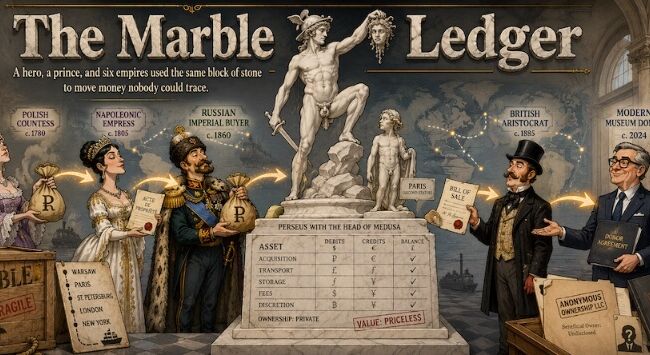
Originally commissioned in 1807 by Napoleon’s wife, Joséphine, paid for with imperial French funds, it was a vanity project. When she passed, the statue wasn’t tucked away—it was acquired by Tsar Alexander I and housed in the Hermitage. It served as both a trophy and a display of power. The artwork circulated from one empire to another, adding prestige along the way.
Canova’s studio capitalized on its success by producing copies. One was bought by the Marquess of Londonderry during a Rome visit in 1823 and transported to his London townhouse, where it stayed for over a century. After the residence was gone, a donor gifted the statue to the Met. What was once a private prize became public treasure.
Consider this sequence:
- Originator: Joséphine, financed by French imperial funds
- Purchaser: Alexander I, for the Russian imperial collection
- Next owner: Londonderry, British aristocratic wealth
- Final home: modern donation to an American museum
The sculpture remained unchanged, while ownership of the wealth behind it shifted. Napoleon fell at Waterloo to Wellington. Empires pivot and fade, and old fortunes transform into museum endowments.
Marble assets endure through regime changes, serving as reliable collateral across centuries.
Same Strategy, Modern Details
Contemporary cases of art-related money concealment mirror Joséphine and Alexander’s story, with the main difference being the sophistication of the legal safeguards. The actors may have deteriorated morals, but the legal framework has improved.
Today’s scenarios frequently involve:
- Sanctioned individuals channeling funds via shell companies to buy high-end art, obscuring true ownership.
- Criminals leveraging art purchased with illicit funds as collateral for loans considered “clean” by lenders who avoid scrutiny.
- Free ports—tax-exempt storage facilities worldwide—where artwork remains unregistered for extended periods, quietly shifting hands.
No counterfeit or stolen art is necessarily involved; it only requires pieces with genuine value and difficult-to-assess prices. This perfectly describes a 200-year-old Canova, just as much as a unique painting without a recent sale reference—think of something like a Hunter Biden special edition.
The real driver is the “story premium,” a term dealers use to describe added intangible value. Though invisible on financial statements, it plays a critical role.
A Perseus statue positioned prominently proclaims, “I possess refined taste,” “I carry historical significance,” or “I have triumphed.”
A numbered Swiss bank account says nothing.
Marble heroes make a statement—capital that loudly celebrates success while discreetly moving across borders. For select collectors, that message defines the purpose of acquisition.
Conclusion
When wandering through the Met, those small plaques mention dates and donors. Yet, few recognize that they represent centuries of ownership history.
In more recent times, grand imperial titles have been replaced by oligarchs and sanctioned officials. Canova’s workshop has become akin to a shell corporation in the British Virgin Islands or an art warehouse in Geneva’s free ports.
The tactic remains unchanged: conceal your wealth in an object that is beautiful, portable, and almost impossible to accurately value, enabling it to cross borders that cash alone cannot traverse.
Perseus still raises Medusa’s head. Quietly, he’s held the wealth of six empires for two hundred years.
About the Author