Recently, Madrid has taken several policy measures that likely irritated the Moroccans.
In April this year, Israel’s Prime Minister Benjamin Netanyahu labeled Spain as anti-Israel and issued a stern warning regarding Madrid’s criticism of Bibi and Israel over the Gaza genocide. “I am not willing to tolerate this hypocrisy and hostility. I do not intend to allow any country to wage a diplomatic war against us without paying an immediate price.”
Could the surge of thousands of Moroccans entering the Spanish enclave of Ceuta—which might ultimately undermine Spain’s position there and bolster UK/Israel influence over the Straits of Gibraltar—have been orchestrated by Bibi?
The context of this unusual event, widely broadcast around the globe, merits deeper analysis. Morocco has historically wielded the influx of unauthorized immigrants into Spain as a geopolitical weapon during recent years—a blunt but effective tactic reminding Madrid that, despite economic disparities, Rabat holds leverage and is willing to use it. This maneuver also serves as a signal to Brussels that Rabat retains this option as a negotiating tool if tensions escalate.
However, what unfolded in Ceuta in the past days was different.
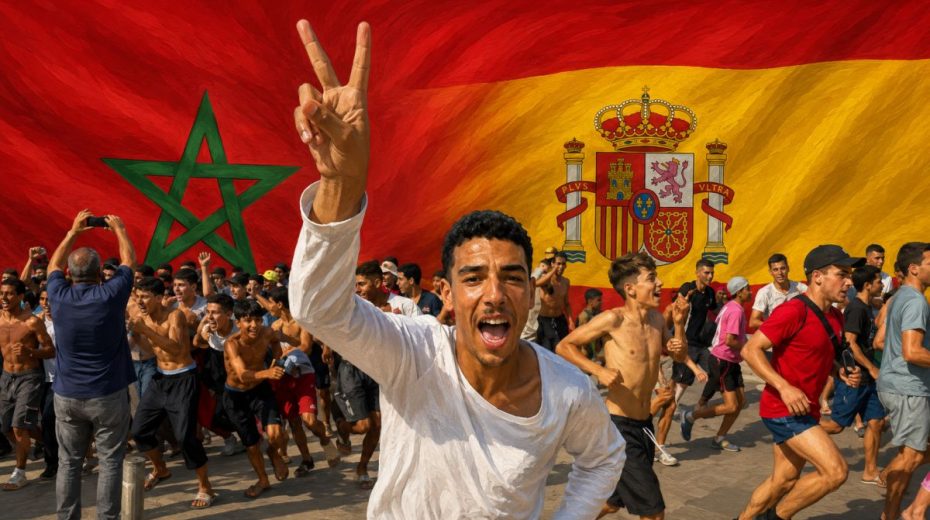
Unlike prior instances involving African migrants attempting to enter Ceuta, in this case, it was Moroccans themselves who seemingly received tacit approval to approach the border. They encountered no resistance from police or Gendarmerie when crossing the fence at the breakwater or opting to swim. Under international law, those swimming were entitled to legal protection upon stepping onto Spanish soil.
Thousands took this route, filling the small enclave and capturing global attention, undoubtedly startling Madrid. Was this a deliberate signal from Rabat to Madrid, its neighboring regional partner? Undoubtedly. Multiple messages were intended, delivered without diplomatic subtlety, using this unconventional method to emphasize their points.
Spain and Morocco maintain generally strong relations. In 2022, Spain adopted a new stance on Western Sahara, endorsing Rabat’s claim over the territory.
Yet, Madrid’s recent policy moves have likely upset Morocco. Spain has initiated efforts to mend ties with Algeria, culminating in gas agreements. Rabat perceives these improving Spain-Algeria relations as coming at Morocco’s expense and resorts to its usual measures to express dissatisfaction.
If this rapprochement were an isolated incident, the reaction might not have been so intense. However, Spain’s parliamentary committee recently approved a recommendation to grant citizenship to the Sahrawi people, indigenous to Western Sahara. It is questionable how Spanish lawmakers expected this measure to pass committee scrutiny and proceed toward parliamentary approval without offending the Moroccan monarch. This action might be seen as a form of bad faith diplomacy by Madrid, harming ties with Rabat, though unlikely to sever them entirely.
The committee’s decision appears to have been made without fully considering its diplomatic repercussions on an otherwise amicable neighbor. One might suspect that alongside thawing relations with Algeria, this marks the beginning of a shift in Spain-Morocco relations. Morocco has demonstrated its capability to flood Ceuta repeatedly with thousands who see relocating to Spain as an opportunity, not merely as pawns of their ruler—a sentiment echoed by some exiled Moroccans on social media.
For years, Rabat has contested Spain’s sovereignty over the tiny enclave, suggesting eventual Moroccan ownership. Recent days have arguably been the closest this has seemed true, as approximately 5,000 Moroccans occupied public areas, school playgrounds, and narrow streets. These events, which attracted global headlines, also serve Israel’s interests, whose leader has threatened Spain and would welcome participation in a power alliance with the UK to control Mediterranean access—another chapter in global maritime strategic dominance. Yet, would Morocco truly join such a final pact if it risked losing Spain, a crucial partner, ally, and trade associate?
About the Author