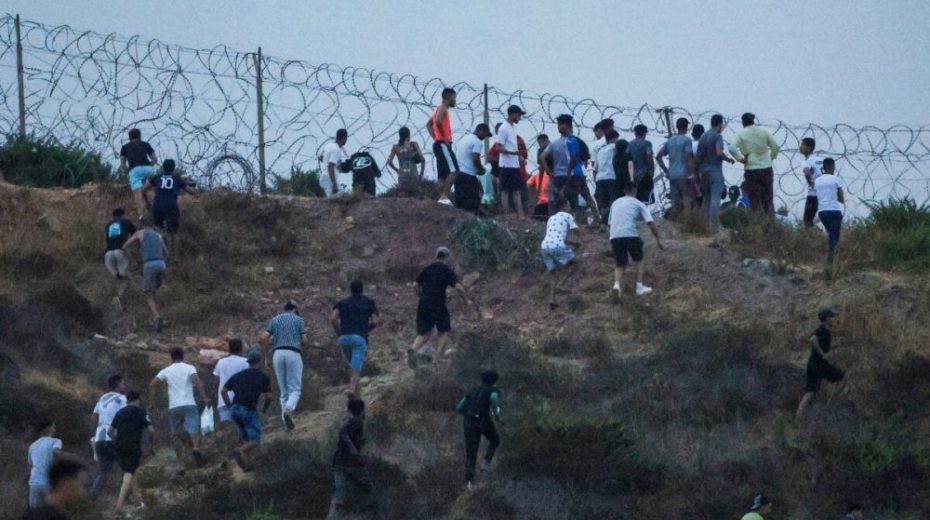
The record influx overwhelmed the tiny Spanish territory of Ceuta, leaving at least 18 dead and prompting Italy to threaten the return of border controls.
Europe’s border has been thrown into turmoil after approximately 49,000 migrants crossed from Morocco into Ceuta, a small Spanish enclave on the North African coast. This sudden surge resulted in no fewer than 18 fatalities and led Italy to warn it might reinstate border checks.
The large-scale crossings at Ceuta and Melilla—both Spanish territories adjoining Morocco—triggered a swift diplomatic crisis. Since these cities are part of Spain, their borders with Morocco form part of the EU’s external boundaries.
According to Spain’s interior ministry, around 49,000 individuals arrived by land and water within a single day. At least 18 people reportedly lost their lives due to stampedes or while attempting to swim past the Tarajal border checkpoint.
In response, the Spanish government deployed 200 specialized police officers and 60 soldiers to the region. Although Melilla did not face the same volume of arrivals, violent skirmishes erupted at its Beni Enzar border crossing, where multiple vehicles were torched and both migrants and law enforcement personnel suffered injuries.
Spanish Prime Minister Pedro Sánchez vowed an “immediate” response, emphasizing that his left-wing administration is dispatching aid while coordinating with Morocco. Sánchez is planned to visit Ceuta alongside Interior Minister Fernando Grande-Marlaska to engage with local officials and police leaders.
Juan Jesús Vivas, the conservative chief of Ceuta’s local government, urged Madrid to declare a national emergency. He called for unified command over the situation and the deployment of additional law enforcement and military personnel. Vivas highlighted that facilities for unaccompanied migrant minors are holding 24 times their intended capacity, while hundreds of newcomers are forced to sleep outdoors.
Alberto Núñez Feijóo, head of Spain’s conservative People’s Party, described the situation as a “national security crisis,” accusing the government of deliberately ignoring the issue. Isabel Díaz Ayuso, the party’s Madrid regional leader, accused Sánchez of tolerating “the invasion of Spain through Ceuta” as a means to divert attention from his legal difficulties.
Santiago Abascal, leader of the right-wing populist Vox party, echoed the term “invasion” for the migrant influx, blaming government policies for encouraging migration to Spain. Juan José Imbroda, the conservative leader of Melilla’s government, labeled the crisis a “catastrophe enabled by inaction” and demanded stricter regulations and increased pressure on Morocco.
Italy responded strongly, fearing migrants entering Spain could freely move across much of the EU. Italian Prime Minister Giorgia Meloni proposed urgent measures such as suspending passport-free movement with Spain. Foreign Minister Antonio Tajani connected the crisis to Sánchez’s initiative to legalize undocumented immigrants residing in Spain. Deputy Prime Minister Matteo Salvini advocated for restoring border controls to safeguard Italy.
French politicians near the border also criticized Spain’s crisis management. Bruno Retailleau, leader of the conservative Republicans and a 2027 presidential hopeful, claimed Sánchez’s policies tempt migrants to undertake the journey. He asserted Europe’s system of passport-free travel cannot persist unchanged. Former French Prime Minister Michel Barnier also cautioned that France cannot continuously bear the outcomes of its neighbors’ immigration decisions.
The Trump administration weighed in as well, joining the debate. White House Deputy Press Secretary Anna Kelly faulted the crisis on Spain’s “far-left globalist policies,” noting that President Donald Trump has long warned Europe about the repercussions of encouraging widespread immigration.
EU officials in Brussels responded with greater caution. Magnus Brunner, European Commissioner for migration, pledged financial assistance, equipment, and hands-on support for Spain. This aid might involve deploying personnel from Frontex, the EU border agency. Brunner also appealed to Morocco to halt further migrant departures toward Spanish territories.
European Commission President Ursula von der Leyen has yet to issue a personal statement. Nevertheless, the EU maintains its stance from the 2021 crisis: since Ceuta is Spanish territory, its border with Morocco is likewise considered an EU external frontier.
The situation has highlighted vulnerabilities in Europe’s border framework. Spain depends significantly on Morocco to prevent migrant flows into Ceuta and Melilla. When this partnership falters, the challenges can swiftly impact the entire continent.
Original article: europeanconservative.com
About the Author