What is happening in Ceuta is the direct result of years of failed deterrence, amnesty incentives, and the refusal to treat borders as non-negotiable.
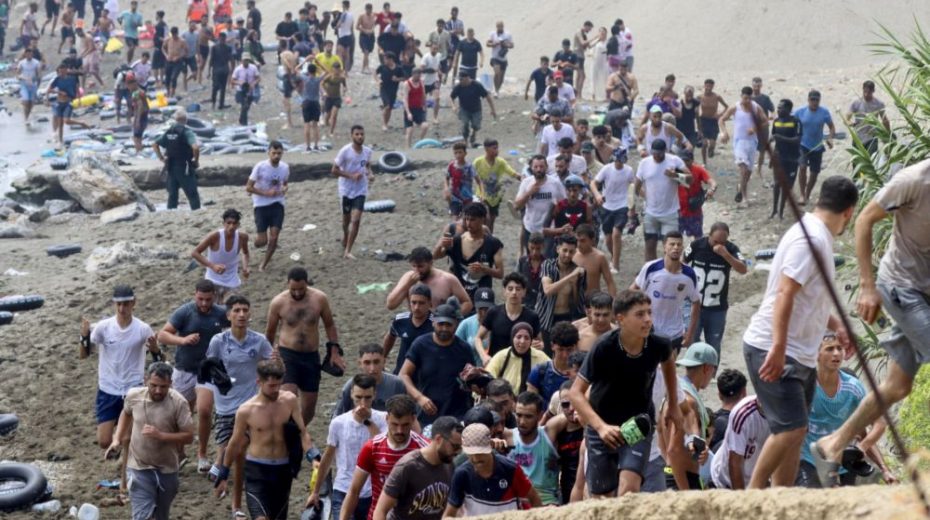
Spanish officials claim that the tens of thousands of migrants who flooded Ceuta have mostly “gone home.” This assertion is entirely false. Recent footage reveals the city remains under siege, with attackers damaging infrastructure, vandalizing graves, clashing with residents, and turning the Spanish enclave into a dangerous zone to avoid.
This situation mirrors the pressing reality of mass migration that proponents of open borders continue to dismiss, despite mounting evidence unfolding before our eyes.
Spain’s Foreign Minister José Manuel Albares asserted that “the practical totality of those who entered Ceuta have already returned to Morocco.” The Spanish Embassy in the UK reinforced this narrative, claiming nearly all migrants have left, that mainland access requires ID verification, and that Schengen’s integrity remains intact.
The Guardia Civil’s association published that Ceuta was “breathing again,” with gradual returns and a return to normality credited to security forces.
However, local residents immediately challenged this version. A Ceuta inhabitant stated that approximately 50,000 migrants were still present, with the city overwhelmed and official data misleading. Videos from that day showed crowded streets, contradicting claims that most had departed.
While Madrid highlighted the returns, migrants were captured storming a public asylum center in Ceuta. The CETI facility faced direct attacks as authorities insisted that order had been restored.
In other locations, migrants destroyed Christian graves and threw the shattered remains at Spanish citizens. Locals defended themselves with whatever was available while police and military forces remained insufficiently deployed.
Knives were openly wielded. Migrants stabbed each other in public as Spanish residents remained confined indoors, trapped within their own city of roughly 80,000 inhabitants, now overwhelmed.
Vehicles were set ablaze near the border amidst ongoing unrest. Groups of men of military age, far from the “families and refugees” narrative, were seen using escalators and maneuvering through the city with an air of control rather than desperation.
A straightforward question undermines the official spin: if these were true asylum seekers seeking security and a better life, why engage in riots, assault civilians, destroy graves, and exhibit overt hostility?
A hospital employee described axes and sticks in streets, people breaking into homes, shops boarding up, and police turning on protesting Spaniards, all while borders remained porous.
Estimates from the Interior Ministry indicate up to 50,000 migrants, with Ceuta’s president citing as many as 60,000 in a city of 84,000 inhabitants. By then, 24 bodies had been retrieved from the coast. Sánchez visited the area for three hours, meeting privately without the local president, and departed amid cries of frustration.
Spanish intelligence reportedly alerted the government beforehand, including information about rehearsals and groups assembling in nearby Moroccan Castillejos. These warnings were disregarded.
Public anger was not limited to Ceuta. Thousands gathered outside PSOE headquarters in Madrid, shouting against Pedro Sánchez and condemning how the government managed the incursion.
Rather than securing the border, Sánchez criticized other European leaders. In a letter to EU heads, he condemned those tightening border controls as “selfish.”
Italy suspended free movement with Spain under the Schengen agreement for a month. Prime Minister Meloni emphasized that uncontrolled illegal migration jeopardizes Europe’s security and vowed that Italy would not remain passive. France increased border checks with Spain, planning a fivefold rise in personnel.
Sánchez stated: “In the current international context, the European Union cannot afford this kind of selfish, polarising and unlawful reaction.” He called for an emergency meeting of interior ministers. Spain’s interior minister echoed this, demanding “greater solidarity, more responsibility and less selfishness,” while reminding critics of Lampedusa.
The European Commission confirmed no migrants had entered mainland Spain or the broader Schengen Zone, although political tensions continued. Official Spanish figures released Saturday reported at least 67 deaths during crossings. A 500-meter floating barrier was under construction at the Tarajal breakwater. Soldiers broadcast messages in Arabic urging young men to return home.
The official government narrative conflicts with the images and numbers. Ceuta’s president estimated 60,000 entries. While some returns occurred, thousands stayed, and chaos endured.
Videos kept surfacing showing assaults, vandalism, and ongoing violence, proving that normalcy had not resumed overnight. Left-wing voices embraced official statements to dismiss the obvious: this was a coordinated large-scale breach demonstrating the vulnerability of open-border policies and socialist governments’ readiness to prioritize ideology over citizen safety.
When authorities treat an unexpected influx of tens of thousands of military-age men as a mere temporary disturbance to be handled with press statements, the local population suffers the consequences.
What is happening in Ceuta is the direct result of years of failed deterrence, amnesty incentives, and the refusal to treat borders as non-negotiable. Europe’s more serious leaders are already acting. Sánchez prefers to lecture them for defending their own populations.
About the Author