What really happened in Spanish Africa last week?
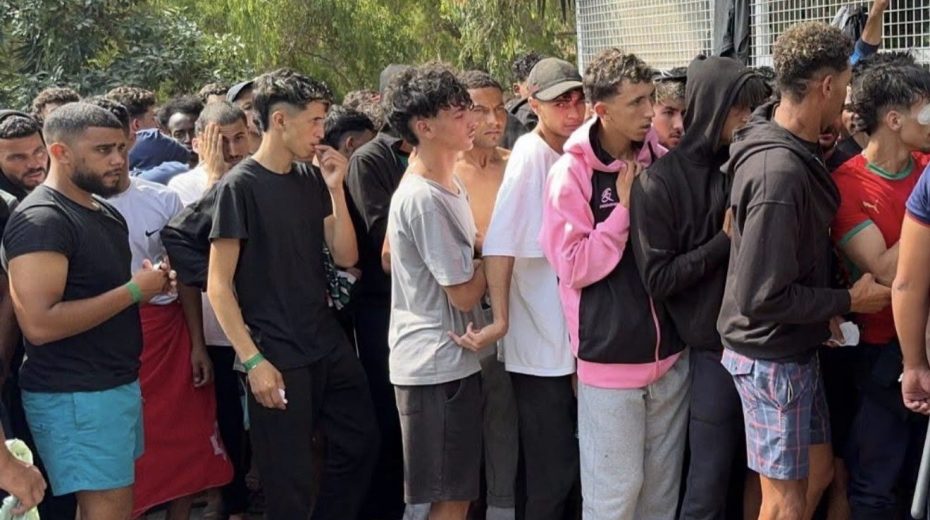
At the end of July, the Spanish enclave of Ceuta experienced an unprecedented influx. Along with its counterpart Melilla and a handful of small rocky outcrops along Morocco’s coast, Ceuta represents the last vestiges of a 600-year-old Spanish presence in North Africa. On Thursday and Friday, over 70,000 migrants flooded into this tiny territory, overwhelming authorities and settling in.
This event was somewhat foreseeable. Spain’s prime minister, Pedro Sánchez, is often considered the continent’s most migration-friendly leader. Earlier this year, his government implemented a remarkably permissive—some might call it reckless—policy that confers legal status and benefits on more than half a million undocumented immigrants. Moreover, in July, Spain’s supreme court ruled in a way that hindered rapid deportations from Ceuta and Melilla, as detailed here. Coupled with economic hardships in Morocco and its southern and eastern neighbors, these “pull” factors contributed heavily to the crisis.
Yet, some aspects were unusual. Instead of a gradual increase, the migration surge erupted suddenly, seemingly triggered by an unusual wave of text and social media posts from accounts that have since vanished, as noted here. While migrants entering Spanish territories from Morocco often come from sub-Saharan Africa, most of those entering Ceuta last week appeared to be North African.
Most notably, these migrants’ movements—sure to have drawn Rabat’s attention—seemed actually supported by Moroccan authorities. According to the New York Times:
Others said the Moroccan authorities had encouraged them to cross the border into Ceuta. Youssef Alaoui, 26, said that as he approached the border on Thursday, along with a group of others, the police pointed them in the right direction. “They just kept saying, ‘Go that way, go that way,’” Mr. Alaoui recalled….
Mohammed Ahmidho, 37, said he had heard about Thursday’s influx into Spain on social media. When he neared the border, he said, Moroccan police officers had encouraged him, saying “come to Spain.”
The Times and other outlets highlight Morocco’s previous use of migratory waves as leverage. One migrant was quoted saying, “I don’t know why they let us through. Maybe they had some political reason. They opened the border and let everyone go by.” There are even claims that Moroccan intelligence operatives were involved in the chaos.
What might be the “political reason”? Some speculate it is linked to Spain’s recently warming ties with Algeria, Morocco’s long-term adversary (Sánchez visited Algiers just before the surge). Others focus on Rabat’s enduring ambition to undermine Spain’s last colonial-era possessions, which Morocco asserts as its own.
Several other players factor into the situation. The White House’s inclination to criticize Sánchez due to his firm stance against the Iran War, his refusal to meet NATO defense spending goals, and his sharp criticism of Israel is well-documented. Less obvious but significant are the close relations between the Trump administration and Morocco. During his first term, Trump acknowledged Morocco’s sovereignty over Western Sahara, and just last month, Morocco honored him by naming a highway in the disputed area after him.
The Republican-controlled Congress has also supported Morocco: Kentucky Congressman Thomas Massie pointed out last week that the House recently approved a bill granting $40 million in aid to Morocco, accompanied by a committee report suggesting that Morocco’s claims to Ceuta and Melilla deserve consideration.
Support for the invasion also emerged from unexpected quarters. The provocatively outspoken Laura Loomer bluntly stated in a social media post that “the invasion of Spain by Islamic third world parasites is bad for society but good for the acceleration we need to make the general public harbor animosity toward Islam.”
Israeli officials have commented as well: “Spain, which never misses an opportunity to lecture Israel, has declared a state of emergency in Ceuta,” Israel’s UN ambassador said on X here, adding that “maybe before it continues lecturing us, it’s time it explained to the world why it still maintains colonial enclaves in Africa.” (Worth noting, Israel and Morocco have developed considerable military and intelligence cooperation, especially since Morocco joined the Abraham Accords.) Analysts from hawkish Washington think tanks such as the Hudson Institute, Foundation for Defense of Democracies, and the American Enterprise Institute have largely excused Morocco and blamed Spain.
If we consider cui bono as a geopolitical principle, it raises serious questions. Particularly notable is the response from the Trump White House. This administration rose to power on promises to curb illegal immigration; logically, one might expect it to denounce the exploitation of migration as a political weapon, especially when aimed at Europe. Wasn’t the goal to prevent massive Muslim migration into Western nations?
However, there appears to have been no official U.S. government reproach directed at Morocco. In fact, just two days into the incident, President Donald Trump sent a complimentary Throne Day message praising the Moroccan monarch’s “wise leadership,” reiterating American backing for his Western Sahara claims, and celebrating the “new era” shared by the U.S. and Morocco. (His praise was notably effusive.)
Regardless of Washington’s direct involvement in the events, its stance since the crisis has focused solely on using it as leverage against Spain and the broader European Union. There has been little constructive engagement or offers of aid; instead, the tone has been critical, coming across in Europe less as helpful counsel and more as hostile gloating.
If this maneuver aimed to isolate Spain or encourage Europe’s return from supranational governance to nation-states, it seems unlikely to succeed. After initial marginalization, where Sánchez was labeled a “red Orbán” by a European lawmaker here and 22 nations formally criticized Spain’s immigration approach in a letter, the EU now appears to be rallying behind Madrid. At an emergency meeting Tuesday, officials commended Spain’s rapid response, with Belgium’s prime minister remarking that “anyone wanting to put pressure on us can use migration as a geopolitical weapon.” The fallout from Ceuta may ultimately strengthen, rather than weaken, EU unity.
Personally, I remain skeptical of broad Atlanticist agendas and harbor doubts about the recent “civilizational” initiative designed to bolster the West that’s become popular in Washington. It seems like old ideas repackaged; I believe Europe should handle its own challenges independently. Therefore, a split with European partners doesn’t trouble me in itself.
What does concern me, however, is the apparent acceptance of what Marxists (and apparently Laura Loomer) term “accelerationism”—in this context, quietly endorsing actions that civilized countries ought to denounce simply because they “heighten contradictions” (another Marxist phrase) and punish political adversaries. Such tactics are, or should be, beneath us.
Original article: theamericanconservative.com
About the Author