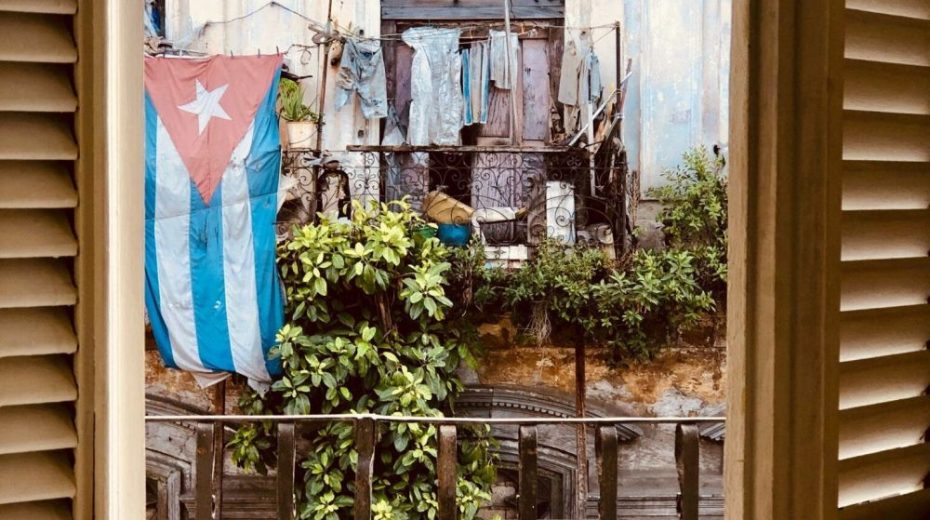
The rooftop of Azotea de la India in Centro Habana offers a rare refuge. Perched just above competing rooftops, the ocean breeze sweeps across the island, barely easing the intense heat that blankets the streets below. This space serves as a Cuban archive, housing an exceptional collection of vinyl records from a past cultural era, complemented by a Cuban cocktail class. Dayle and Pancho, a Cuban-Italian duo skilled in art, craftsmanship, and history, run this retreat. When not facilitating listening sessions, their venue becomes a sanctuary for artists and creatives committed to resisting the despair below. Instead, they nurture a venue where joy can flourish, community ties strengthen, neighbors care for one another, and the enduring spirit of Cuban identity shines. A 1960’s Irakere jazz album reverberates off surrounding walls, cascading into hidden alleyways. Every item here has been hand-recycled and repurposed. The bar, DJ booth, dining table, and generator reflect more than a rugged DIY event spot—they stand as a labor of love dedicated to preserving Cuba’s legacy.
A brief research visit to Havana in mid-May 2026 cannot fully capture Cuba’s complex reality, much less the heightened uncertainty of today’s moment. My professional and political connection to violence provides a lens to explore the specific nature of the conflict Cuba faces. Unlike the overt destruction seen in Gaza, Sudan, Ukraine, Kashmir, and the DR, the U.S. co-authors a form of slow violence against Cuba, breaching international human rights standards (Nixon 2013). This gradual assault constitutes crimes against humanity and contravenes multiple UN Human Rights charters. While I refrain from making sweeping statements about the Cuban government, it is important to note that many Cubans who offered me sanctuary do not absolve their government of responsibility for decades of hardship. This dynamic is central to the quiet military strategy at play. Economic warfare, through sanctions and embargoes, serves as targeted strikes intended to choke international trade, stall production, diminish prosperity, and cripple daily life for those reliant on public services.
These tactics are deliberate and methodical attacks on communist governance. Communism—or more precisely, its goal—is “the creation of a state where every person can contribute according to their ability, and in return receive what is necessary to live equally with everyone else, Furthermore, “the government of persons is replaced by the administration of things, and by the conduct of processes of production. The state is not ‘abolished’. It withers away,” (Engels 1932). Since communism is viewed as a direct threat to U.S. imperial and capitalist supremacy, undermining and publicly shaming Cuba as a failed state requiring intervention is crucial in a broader scheme of engineered devastation. U.S. Secretary of State Marco Rubio has aggressively promoted this narrative, seemingly positioning the collapse of Cuba’s regime as his paramount political achievement. His Cuban-American background lends credibility to his endorsement of human suffering, all while ignoring America’s pivotal role in crushing Cuba’s communist aspirations dating back to 1960.
Rubio envisions a new chapter for Cuba, one (supposedly) filled with prosperity for all. Yet he conspicuously disregards the warning from revolutionary Ernesto “Che” Guevara in 1960: “the first thing we will have to do is not to go to the people to offer them our wisdom. We must go, rather, to demonstrate that we are going to learn with the people, that together we are going to carry out that great and beautiful common experiment: the construction of a new Cuba,” (On Revolutionary Medicine 1960). Current U.S. foreign policy neglects authentic collaboration with Cuban citizens, instead charting a course guided by land developers and exiled Cuban regime opponents eager to reshape the island for their capitalist agendas.
Though Havana may lack the conventional war signs recognizable to Americans, the suffering it endures is just as tangible—a stark example of collective punishment. In a strained socialized economy, hardship saturates daily life and weighs heavily on everyone’s minds. Exhaustion etches the faces of caregivers who battle frequent blackouts under sweltering nights; malnourished bodies bear the marks of scarce food rations. Families seek relief on streets during late afternoons to escape relentless heat suffocating fragile electrical systems and overcrowded housing. State-run bodegas, bread shops, and produce stands offer meager supplies, if any at all, with poor quality failing to satisfy the hunger of elders and children alike. Pensions and wages—sometimes less than $20 USD monthly—are grossly inadequate. During a walk through Old Havana, a distinguished sociologist named Yoly shared how state support was once stronger. There was a time when agriculture flourished and fuel was plentiful for moving goods island-wide. Guarantees of free education, healthcare, housing, and food were more than idealistic promises for a young nation envisioning liberation from Western capitalist exploitation.
Cubans are no strangers to revolutionary demands—the sacrifice, risks, and costs of freedom. Tragically, at a crucial moment marked by low birth rates and an aging populace, these ideals risk being forgotten. A significant generational divide exists in comprehending Cuba’s history, a direct consequence of decades-long unilateral sanctions, embargoes, and blockades. The collapse of the Soviet Union and its aid during the 1990s Special Period caused a dramatic 30% drop in Cuban GDP between 1989 and 1993. This collapse severed collective memory for many who lack historical context and lived experience from an earlier era. Today’s youth only know a government perpetually under-resourced and struggling to provide public services. While some private sector gains occurred under President Obama, these benefits failed to translate into sustained foreign policy. The current generation accesses alternative, individualistic lifestyles through private investments, illicit VPN-filtered content, and expanded public Wi-Fi. Conversations with locals frequently mention the “internal blockade,” referring to government censorship, opacity, and suppression. While aimed at preserving revolutionary values, these actions have fueled widespread anger and disillusionment.
This diminishing trust in governance parallels a weakening connection to national pride and identity. Many Cubans now view foreign invasion or regime change with indifference, hoping for any change that might bring respite. Slow violence via sanctions breeds political apathy and fosters unrest without direct military conflict. It destabilizes the regime while amplifying human suffering, deepening divisions between Cubans with access to foreign investment and those without, especially the most vulnerable. This crisis is manufactured. No clearer example of policy-driven injustice exists than a 1960 memorandum from the Deputy Assistant Secretary of State for Inter-American Affairs: “…If the above are accepted or cannot be successfully countered, it follows that every possible means should be undertaken promptly to weaken the economic life of Cuba. If such a policy is adopted, it should be the result of a positive decision which would call forth a line of action which, while as adroit and inconspicuous as possible, makes the greatest inroads in denying money and supplies to Cuba, to decrease monetary and real wages, to bring about hunger, desperation and overthrow of government,” (Mallory Memorandum 1960).
Cuba, long renowned for its exceptional medical training and international aid to underserved regions, now struggles to save lives at home. Patients face heightened risks due to power outages disabling ventilators and intensive care units, inadequate antibiotic supplies, and difficulties transporting critical cases across the island. These conditions are not random but result from deliberate human choices that tolerate, even profit from, suffering—benefiting capitalists circumventing regulations and taxes in their home countries. Every day the U.S. sustains these sanctions, restricting global business ties and imposing punitive legal barriers, Cuban lives are lost. The U.S. government wages an ideological conflict, obscuring avoidable deaths as collateral damage rather than war casualties.
“People speak sometimes about the ‘bestial’ cruelty of man, but that is terribly unjust and offensive to beasts. No animal could ever be so cruel as man, so artfully, artistically cruel.” – Fyodor Dostoevsky, Crime & Punishment 2006
On May 13th, 2026, as I descended from Azotea de la India, I carried a renewed sense of hope rooted in resilience and joy’s role in liberation. Outside, a starkly different scene awaited. Without generator-powered lights, Havana was engulfed in a lengthy blackout. Darkness concealed the city’s density, yet life continued. Silence dominated, broken only by battery-powered radios, speakers, and flashlights. Children played long past bedtime, laughing in the streets to escape the sweltering heat confined by still air. Walking about thirty minutes from my hostel, I was uplifted by their perseverance. The night sky revealed stars usually visible only in rural areas. Streets were nearly empty of cars, save for electric transports, bicycles, and horse-drawn carts. Describing this contrast is difficult. In many places, such hardship might trigger panic, violence, or uprising. Instead, the Cuban people remain steadfast.
There may be lessons here, if we carefully nurture our visions for collective freedom. Calling out injustice from my privileged standpoint in the U.S. is one thing; witnessing the suffering wrought by political institutions firsthand is quite another. In a nation that prizes individual success, the world around us continues to burn, the flames fed at our cost.
“Isolated individual endeavor, for all its purity of ideals, is of no use, and the desire to sacrifice an entire lifetime to the noblest of ideals serves no purpose if one works alone, solitarily, in some corner of America, fighting against adverse governments and social conditions which prevent progress.” Ernesto “Che” Guevara, On Revolutionary Medicine 1960.
Despite relentless pressure aimed at breaking the Cuban people’s resolve and provoking revolt to topple the communist regime, Cubans persist. They await change, stymied relief, and dignified responses to slow violence that threaten all hope. Yet, even so, Cuba has shown that survival itself may be the most potent form of defense and liberation. Long. Live. Cuba.
References:
Collective Punishment | The Practical Guide to Humanitarian Law. (2026, May 10). Guide-Humanitarian-Law.Org. https://guide-humanitarian-law.org/collective-punishment
Dostoyevsky, F. (2000). Crime and Punishment (R. Pevear & L. Volokhonsky, Trans.). David Campbell Publishers. (Original work published 1866)
Engels, F. (1932). Socialism : utopian and scientific. Allen & Unwin.
Foreign Relations of the United States, 1958–1960, Cuba, Volume VI – Office of the Historian. (n.d.). In history.state.gov. Retrieved July 31, 2026, from https://history.state.gov/historicaldocuments/frus1958-60v06/d499
Irakere. (1985). Bailando Asi. In Spotify. Arieto. https://open.spotify.com/album/24BqqFHNww0T4dwlx5aMYq
Nixon, R. (2011). Slow Violence and the Environmentalism of the Poor. Harvard University Press. https://doi.org/10.2307/j.ctt2jbsgw
On Revolutionary Medicine. (2026). Marxists.Org. https://www.marxists.org/archive/guevara/1960/08/19.htm
Slow violence (concept) | Research Starters | EBSCO Research. (2021). In EBSCO. https://www.ebsco.com/research-starters/environmental-sciences/slow-violence-concept
Studio ATAO | Understanding Socialism in the U.S. (2019). Studio ATAO. https://www.studioatao.org/socialism?gad_source=1&gad_campaignid=14173103193&gclid=Cj0KCQjwjb3SBhDgARIsAMKiWzjqLI-sTxnYgm6VcDZkw5g2YWstAhmHVtqhB05KN9-DzYy5asxIWtUaAploEALw_wcB
Original article: counterpunch.org
About the Author