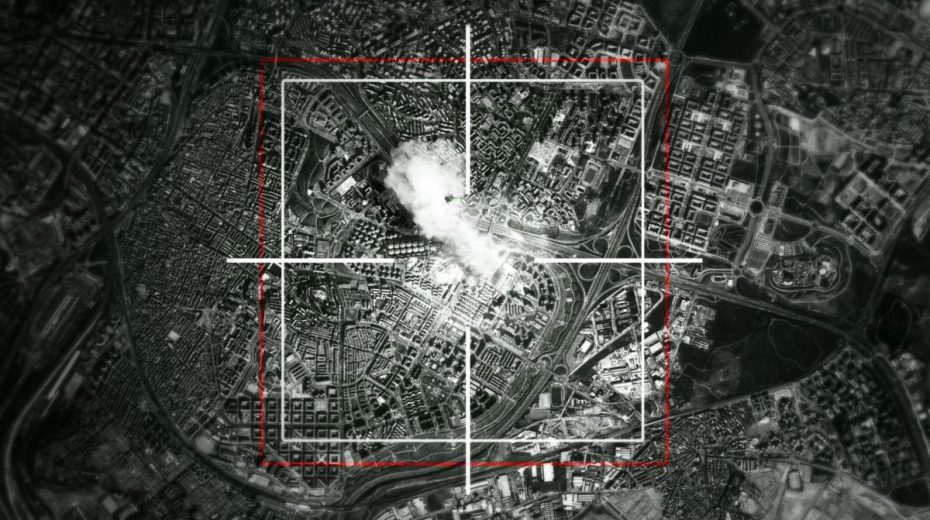
As space solidifies its role as a critical battlefield, William J Astore examines the intensifying military focus in this domain.
‘One point five trillion dollars.’
President Donald Trump is known for making staggering financial claims, like last year’s $10 billion lawsuit against the BBC, which is just one example of many.
His current demand from the American public for defense funding dwarfs previous amounts. The US defense budget surpassed $1 trillion (around £730 billion) last year for the first time. Undeterred, Trump has proposed a further $1.5 trillion increase this year, marking the largest boost in military expenditure since World War II.
Part of this, $17.5 billion, is allocated for the development of the Golden Dome missile defense system—named after Israel’s Iron Dome. This extensive shield, mainly comprised of land-based interceptors and orbiting sensors, has been presented as a protective measure.
Cost assessments are varied: official sources estimate $185 billion, yet independent experts warn it might reach as much as $3.6 trillion.
The progression towards weaponization of space is inevitable. Among the most alarming components of the Golden Dome concept is the inclusion of ‘space-based interceptors’—missiles stationed in orbit intended to neutralize Earth-launched missiles. This introduces the unsettling possibility that such interceptors could be converted into space-based bombs capable of delivering destruction virtually anywhere worldwide with minimal warning.
The claim that these orbital interceptors could ensure effective defense seems implausible, considering that tens of thousands would be required in orbit. More realistically, this will ignite an arms race in space, with nations reacting to attempts to dominate by developing countermeasures.
The ‘Space race’
The Golden Dome initiative builds on decades of militarization of space, with the US leading the charge. Early American astronauts were often military test pilots, and despite NASA’s civilian status, it was organized in a manner reminiscent of the military.
Tracing further back, the technological roots of both the US and Soviet space efforts lie in wartime rocketry. Nazi Germany’s V-2 ballistic missiles—used combat-wise starting in 1944—were the first man-made objects in space and demonstrated rockets’ ability to deliver explosives over long distances. After World War II, both powers acquired German scientists, including Wernher von Braun, whose expertise turned US ballistic missiles into launch vehicles with orbital capabilities.
The notion of space as a strategic platform for launching missile attacks emerged early in the space race. In 1958, shortly after the Soviet launch of Sputnik, US Air Force Brigadier General Homer Boushey described the Moon as a “retaliation base of unequalled advantage,” from which nuclear strikes could be potentially launched. During the Cold War, which lasted until the early 1990s, space remained a key field of rivalry.
Since the 1960s, so-called spy satellites—initially using film and then digital imaging—have played a crucial role in reducing the risk of conflict by monitoring potential threats. These surveillance systems, combined with satellites like the Defense Support Program (DSP), launched in 1970 with infrared sensors to detect missile launches, help avert mistaken warnings that could escalate into nuclear war and support arms control verification—an undeniable positive outcome of militarizing space.
Satellites are now indispensable in modern conflict. The US, in particular, depends heavily on orbiting systems for intelligence, communication, navigation, targeting, and missile alerts. These capabilities underpin the Pentagon’s goal of “global reach, global power.” In military terms, satellites serve as “force multipliers,” enabling forces to synchronize worldwide operations with great speed and accuracy. The establishment of the ‘Space Force’ by Trump in 2019, focusing on surveillance, targeting, and communication, extended from longstanding defense policies.
A widespread satellite failure could threaten not only the military but also the foundations of civilization, disrupting communication networks, financial services, navigation, and weather forecasting.
Initial efforts were made to avoid an arms race in space. The 1967 Outer Space Treaty banned the placement of nuclear and other weapons of mass destruction in orbit or on celestial bodies, dashing earlier US plans to deploy nuclear arms from the Moon, and declared space the “province of all mankind.”
However, it left gaps by not prohibiting conventional weapons or anti-satellite (ASAT) technologies. As satellites became vital for military functions, they also became targets. Space-based navigation signals (like GPS) guide weapons; reconnaissance satellites gather intelligence continuously; communications satellites connect commanders and troops globally.
Given this reliance, disabling satellites would greatly impair an adversary’s combat capabilities. Consequently, several nations have developed ASAT weapons. China destroyed one of its weather satellites using a ground-launched missile in 2007, generating 3,000 pieces of space debris. The US followed with similar tests in 2008 and earlier. India tested an ASAT weapon in 2019, and Russia’s 2021 test created a debris field that endangered International Space Station crew.
Such tests unearthed a hazardous byproduct of space warfare: orbital debris. Fragments from destroyed satellites move at speeds over 27,000 kilometers per hour (7-8 km/sec). Even small pieces can damage or destroy key satellites and space stations, producing exponentially more debris. This cycle could trigger the Kessler syndrome—an escalating chain reaction that would fill orbits with debris, rendering them unusable.
ASAT threats extend beyond missiles. Electronic warfare can jam satellite signals. Cyberattacks may infiltrate satellite and ground stations. Directed-energy weapons, like lasers, could temporarily blind satellite sensors. Some satellites can maneuver close to others, raising fears they might sabotage them. A cascading satellite failure would jeopardize not only military operations but also civilian systems, fracturing communications, banking, navigation, weather services, and scientific research. This could severely hamper global initiatives like combating climate change.
The space-industrial complex
When I worked at the US Air Force’s Space Surveillance Center in 1986, roughly 5,000 objects were tracked orbiting Earth. Today, that figure exceeds 45,000—a nearly ninefold rise. Space is increasingly congested and fiercely contested.
Much like NASA, the European Space Agency (ESA) and national space agencies such as China’s National Space Administration and Turkey’s Space Agency promote technologies serving both civilian and military uses. The ongoing Galileo satellite navigation system is among ESA’s projects.
France has deployed a three-satellite system, CSO (Composante Spatiale Optique), dedicated to military surveillance. China’s BeiDou navigation aids missile guidance and secure communications, while Turkey focuses on secure communications (Türksat 6A) and Earth observation (Göktürk-1). The distinction between military and civilian applications has become blurred. A significant development in recent decades is the expanded involvement of private companies in space.
Before the 1990s, space was primarily government-run. Today, private companies launch most satellites, even as governments retain control over critical strategic payloads. Yet privatization doesn’t inherently reduce military sway. Much of this landscape is shaped by substantial US defense funding, validating the saying “he who pays the piper calls the tune.” Commercial satellite imagery remains critical intelligence, though access remains controlled. Since March, companies like Planet Labs, with over 200 satellites, have withheld images of large parts of the Middle East—including Gaza and Lebanon—in response to a ‘voluntary’ request from the US government.
Missiles in orbit could be adapted and used as space-based bombs to rain death on any part of the world
Additionally, SpaceX, led by Elon Musk, has revolutionized satellite launches, while Jeff Bezos’s Blue Origin develops heavy-lift rockets and space infrastructure. Their dependence on government contracts further blurs lines between commercial and military operations. The Palestine Space Institute has identified links between space industry contracts and the Gaza conflict, noting NASA agreements have disbursed at least $39 billion to companies supplying Israel.
Meanwhile, defense giants like Lockheed Martin, Boeing, and Northrop Grumman actively lobby for expanded space weaponry budgets, fueling a powerful space-military-industrial complex. Privatization may accelerate space’s weaponization, with corporations’ market and profit motives potentially driving militaristic actions.
Urgent new international treaties are needed to curb the militarization of space. Current agreements were made when only a few countries operated beyond Earth’s atmosphere. Today, numerous nations and private actors launch satellites and shape space policies, but legal frameworks lag behind.
Despite its appeal, space poses extreme challenges. Positioning and sustaining humans in orbit costs a fortune and requires complex technology. As such, human “space warriors” or “starship troopers” are unlikely to materialize soon. Yet space remains an area of critical importance and growing rivalry, and its militarization must be actively opposed.
Original article: newint.org
About the Author