Sci-Fi Shapes the Future
Throughout my childhood, I consumed a lot of science-fiction literature.
Surprisingly, these visionary tales helped me understand the world we live in now.
I eagerly read works by Robert Heinlein, Frank Herbert, Arthur C. Clarke, Dan Simmons, Neal Stephenson, Michael Crichton, among others.
When the internet began expanding rapidly in the early 1990s, I already had a strong sense of how vast and unpredictable (and crazy) it would become.
By then, I had explored many books about cyberspace, a term William Gibson introduced in his 1984 novel Neuromancer.
In 1992, Neal Stephenson’s Snow Crash foresaw social media, internet addiction, virtual reality, gig economy, cyber warfare, and more. This novel was a sensation in Silicon Valley and motivated numerous tech innovators.
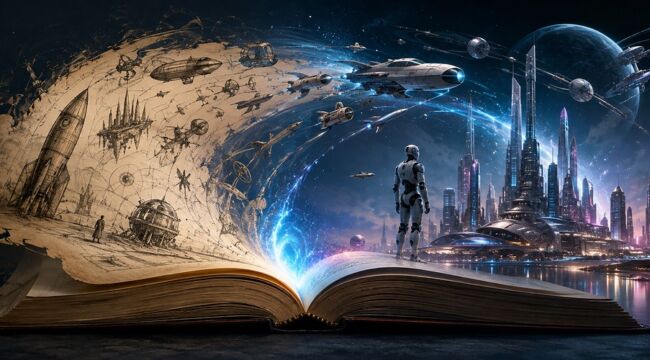
Science-fiction not only predicts the future but influences its course profoundly.
The modern submarine’s creator, Simon Lake, drew inspiration directly from Jules Verne’s 1870 classic 20,000 Leagues Under the Sea. He implemented ideas such as ballast tanks and a periscope.
Igor Sikorsky, known for inventing today’s helicopter, found motivation in Jules Verne’s 1886 novel Clipper of the Clouds, which featured a flying machine with multiple rotors.
Ray Bradbury imagined tiny “thimble radios” small enough to fit in the ear in Fahrenheit 451. Sound familiar?
When Motorola’s Martin Cooper developed the first mobile phone, he cited the Star Trek communicator as his inspiration.
Sci-Fi on AI
Sci-fi consistently demonstrates a remarkable power to influence what’s ahead.
What insights does the genre offer about AI? Artificial intelligence is a recurring theme.
From 2001: A Space Odyssey to Blade Runner, plenty of sci-fi narratives feature AI.
Often, AI is portrayed as a sinister force. Frank Herbert’s 1965 novel Dune, one of my favorites, forbids all machine intelligence, as it nearly led to humanity’s downfall in his world.
One of my favorite lines from Dune goes:
“Once men turned their thinking over to machines in the hope that this would set them free. But that only permitted other men with machines to enslave them.”
–Frank Herbert, Dune
Accordingly, in Herbert’s universe, the primary rule declares: “Thou shalt not make a machine in the likeness of a human mind.”
It’s striking that Herbert penned this in 1965. This idea has occupied my thoughts recently; it resonates deeply and remains highly relevant now.
Recent breakthroughs in agentic AI read like science fiction. The speed of advancement is unsettling. It seems we are caught in a self-reinforcing loop where each AI iteration outperforms the previous one and is deployed to create the next—larger, faster, smarter, more disruptive. Over and over.
Agents now can develop intricate software from just one command. Meanwhile, hackers exploit their new capabilities enthusiastically.
The impact extends beyond coding. Soon, agents will dominate entire knowledge industries such as law, medicine, accounting, writing, marketing, math, physics, and many others.
I can distinctly recognize the risks Dune warned about.
Too Much Power
The dominant players in this field will gain unparalleled influence because AI will soon be deployed to handle virtually every task.
Governments are already seeking to control AI according to their agendas. For example, Chinese AI models do not discuss Tiananmen Square, while American versions hesitate when addressing topics like the Nord Stream pipeline explosions. Each AI system carries its own biases, some deliberate and others inadvertent.
Special interest groups are flooding the digital space with content meant to be absorbed into upcoming AI training data.
These effects might seem subtle now, but they will magnify swiftly. The race for technological dominance has narrowed to two main contenders: the U.S. and China.
The next few years promise dramatic changes. Chinese AI models, which underprice U.S. alternatives by about 90%, are likely to face bans soon. In fact, China has already barred access to leading American models.
Agentic AI systems have proven highly effective hackers; therefore, future access to top-tier AI will probably require digital identification, leading to increased surveillance.
A wide range of developments, both awe-inspiring and alarming, lie just ahead.
This is a sci-fi world, and we are living its reality.
About the Author