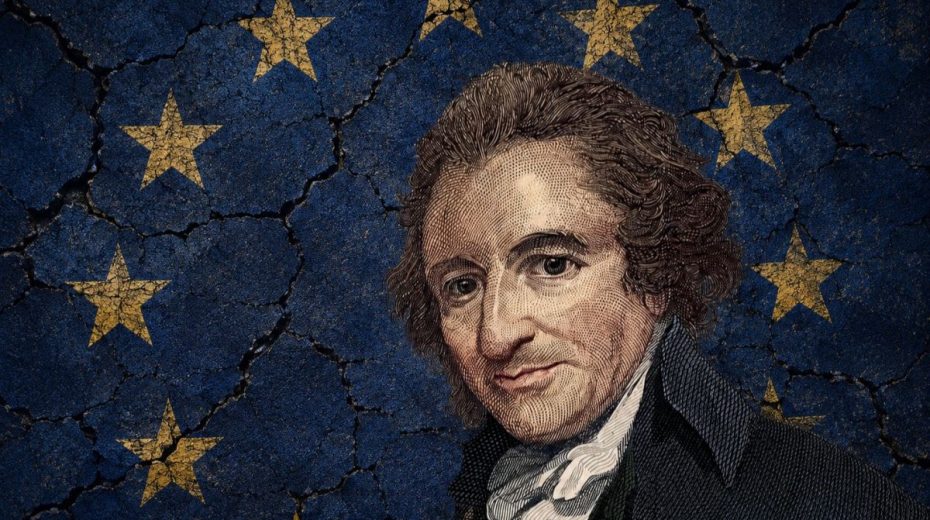
Thomas Paine cautioned: “The people are not to be confounded with their government.” In today’s context, the EU’s convoluted system has made this separation absolute.
“They serve to demonstrate how necessary it is at all times to watch against the attempted encroachment of power, and to prevent its running to excess.“
– Thomas Paine[1]
When Thomas Paine declared that “[t]he people are not to be confounded with their government,” he likely anticipated controversy, since before his time, people and government were seldom seen as adversaries. Chris Hedges even interprets political authority and the populace as separate forces that restrain each other.[2]
But what if not only their roles have shifted, but also their mutual relationship? What if the established patterns of interaction, once clearly democratic, have evolved into something more complex? Those in power would naturally prefer to maintain the familiar image of democratic governance, which the public can recognize without suspicion. Changing the outward appearance risks signaling a shift in strategy, an assumption no one should have to make if the visible structures remain intact.
It is unnecessary now to debate various governance models or argue that Europe’s visible governments remain unchanged, which would nullify claims of transformation. Typically, any critique is met with the assertion that political systems adapt to contemporary challenges but democracy itself remains untouchable. Yet, precisely because the democratic order has visibly shifted, people grew wary that the political playbook had indeed been rewritten.
The European Union represents a novel power arrangement, but its obscurity breeds distrust among citizens, who ought to oversee governmental acts yet find themselves powerless to comprehend or evaluate their political leaders.[3] The EU’s reluctance to make both its decisions and decision-making procedures transparent only deepens this distrust.[4] This likely helps explain shrinking voter participation[5] alongside the resurgence of nationalism and social exclusion, as demonstrated in the widespread vilification of religions and the subsequent marginalization of their adherents.[6]
The danger in politics does not lie solely in isolated events, but rather in exploiting the fundamental human desire to trust governments, since people generally want rulers who serve the public good. History reminds us effortlessly of countless leaders who lost power or life due to ruling selfishly.
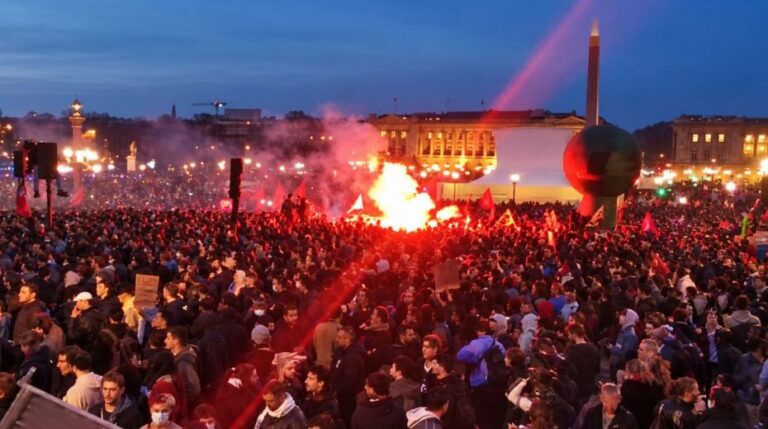
Protests[7], under this perspective, would target not other belief systems but rather the European Parliament itself. The protests do not primarily focus on xenophobia or religious tensions. Instead, because the public cannot grasp EU’s workings or decision processes, they cannot clearly express their dissatisfaction. Conversely, issues like xenophobia or secularism are well-understood by Europeans, so frustration is naturally directed at tangible subjects rather than vague political bodies. Unfortunately, these social tensions stir deeper fears beyond mere political grievances, causing a blurred transformation of abstract political dissent into concrete cultural conflicts that only loosely relate to their original causes.
One might argue that the European Parliament has actively concealed its politics in ways that leave citizens feeling politically marginalized, reflecting a cycle in which exclusion is both experienced and enforced.
Those marginalized groups wrongfully become the focus of protests meant for other targets, while leading politicians’ refusal to engage in dialogue only exacerbates this alienation.[8] If political exclusion triggers protests, ignoring calls for discussion logically provokes further demonstrations. In turn, these counter-demonstrations cannot confront the real source—the EU’s political system—because the opacity and lack of understanding that sparked the original protests also affect their opponents. Naturally, people expect solutions appropriate for modern democracies, and historically, political systems eventually offer compromises that let the public momentarily feel satisfied before returning to everyday life.
However, such solutions only treat symptoms rather than the root problem, which persists without any political incentive for reform—because outwardly, everything appears resolved.
____
[1]Thomas Paine: Right of Man, in: The Complete Writings of Thomas Paine. Collected and Edited by Philip S. Foner. Vol. I, The Citadel Press: NY 1945, page 253.
[2]www.truthdig.com/report/item/thomas_apine_our_contemporary_2014525 (20.12.2014, 06:20 p.m.)
[3]Andrew Williams reported on the EU being sued over their lack of transparency and the restriction of data concerning their biofuels policy on 21.09.2010. See: euobserver.com/economic/30853 (21.12.2014, 01:52 p.m.).
[4]On 10.04.2014, the Greens (German political party) held a conference about this “dark side of democracy“. See: www.greens-efa.eu/de/lobbying-corruption-and-lack-of-transparency-in-the-eu-12113.html (21.12.2014: 01:46 p.m.).
[5]According to the European Parliament, 2014’s turnout was 42.45% and thus about .50% lower than in 2009. See: www.europarl.europa.eu/elections2014-results/en/election-results-2014.html (22.12.2014, 01:55 p.m.).
[6]German newspaper Die Welt gave room fort he opinion that there is an imbalance between how people feel and how they are supposed to feel. http://www.welt.de/debatte/henryk-m-broder/article135586551/Das-deutsche-Festival-des-Wahnsinns.html (22.12.2014, 02:05 p.m.).
[7]http://www.independent.co.uk/news/world/europe/germany-antiislam-protests-17000-march-on-dresden-against-islamification-of-the-west-9941656.html (28.12.2014, 11:54 a.m.).
[8]http://america.aljazeera.com/articles/2014/12/26/dresden-pegida-politics.html (28.12.2014, 03:01 p.m.).
About the Author