An anti-Iran triangulation project ignores the divisions within the Sunni world itself.
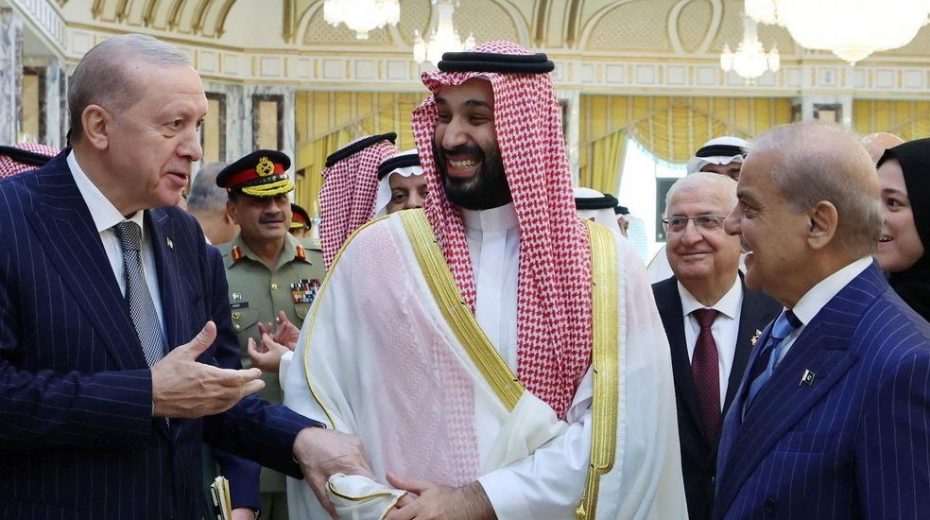
The defense pact signed by Turkey, Saudi Arabia, and Pakistan in Mecca on August 7 has been portrayed as the foundation of a new security framework for the Islamic world. This agreement declares that an attack on any of the three nations will be treated as an assault on all, establishing a collective defense principle. Although its signatories deny targeting any specific country, the strategic rationale behind this move is hard to overlook.
The most credible interpretation suggests that this is an attempt to create an anti-Iranian alliance based on two core ideas: viewing Iran as a shared adversary and leveraging Sunni identity as the basis for a military coalition. Such an alliance would directly align with the interests of the United States and Israel, who are currently engaged in conflict with Iran. Notably, the pact’s announcement closely followed the NATO Summit in Ankara, coinciding with renewed tensions against Iran.
However, these assumptions rest on fragile foundations.
The foremost challenge lies in defining the true adversary. While Turkey and Iran have a lengthy record of regional rivalry, Tehran is not necessarily Ankara’s chief threat at present. Indeed, Israel now presents a more immediate strategic challenge to Turkey, especially given shifting Middle Eastern dynamics.
The dissolution of the “gray zone” that the Assad government once occupied in Syria has caused increasing friction between Israel and Turkey. This strain is further intensified by Israeli activities in the Eastern Mediterranean alongside Cyprus and Greece, as well as its recognition of Somaliland in the Horn of Africa. Consequently, Turkey’s priority has become preventing a regional order dominated by Israel.
Therefore, it is improbable that Turkey would agree to label Iran as the definitive enemy within an alliance it joins. More realistically, Turkey may utilize this defense arrangement to enhance trade relations, promote arms sales, and secure strategic footholds, while avoiding deeper military commitments.
A similar complexity exists with Pakistan. Iran and Pakistan maintain stable relations—Tehran has notably entrusted Islamabad to facilitate its dialogue with the United States. Both countries also share strategic partnerships with China, which would likely intervene to mediate any disputes. Making Pakistan a front-line actor in an anti-Iranian effort would thus be highly complicated.
Another critical question is Saudi Arabia’s actual military contribution to this pact. While possessing vast financial power and advanced weaponry, the Kingdom’s past experience in Yemen highlights the limitations in turning material advantages into strategic victories. Despite years of conflict, the Houthis continue to strike Saudi territory and have intensified their attacks recently.
Yemen thus stands as the first real test for the Mecca agreement. Should the Houthis launch a major offensive again, Turkey and Pakistan will need to demonstrate the practical meaning of considering an attack on Riyadh as an attack on themselves. If they hold back, this collective-defense clause will quickly be seen more as a political threat than a genuine military alliance.
The pact’s strength will also be tested by other challenges, such as Afghanistan. Should the conflict between Pakistan and the Taliban worsen, will Turkey and Saudi Arabia step in to support Islamabad? Even more uncertain is how they might respond if tensions flare anew between Pakistan and India.
Beyond geopolitical issues lies a profound problem: the concept of military unity based solely on Sunni identity. The Sunni community is far from monolithic. Turkey and Pakistan follow Hanafi traditions, while Saudi Arabia’s religious foundation is rooted in Wahhabism/Salafism. Within Pakistan itself, Hanafi Islam is divided between groups like the Barelvis and Deobandis, who hold significant theological and political distinctions. Consequently, Sunni Islam is too diverse a category to automatically forge a cohesive strategic alliance.
The fundamental error would be assuming that opposition to Iran—which, at its core, mainly reflects Saudi concerns—can overcome these internal differences. This is simply not the case. A durable alliance demands more than a shared enemy; it requires aligned interests, mutual trust, and a readiness to risk for one another.
The Mecca pact might endure as a limited framework for military cooperation, but it is unrealistic to expect it to function as a full collective-defense treaty. The issue, therefore, is not whether Turkey, Saudi Arabia, and Pakistan have signed such an agreement—they have—but whether they are genuinely prepared to defend each other in practice.
About the Author