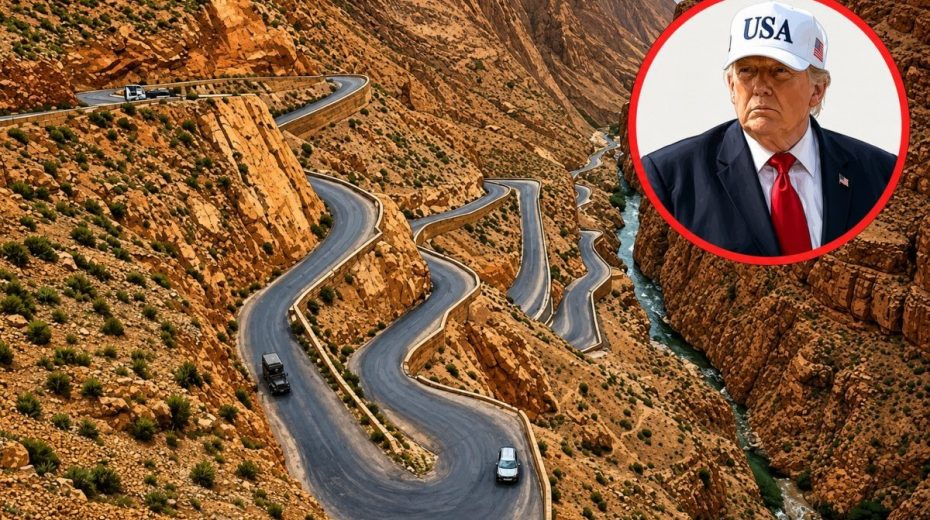
Trump’s highway in Western Sahara isn’t merely a vanity endeavor—it represents the paved foundation of occupation.
The occupation paid in installments
A steel conveyor belt in the Sahara Desert, visible even from orbit, stretches nearly one hundred kilometers, ferrying phosphate from the Bou Craa mine to the Atlantic. This continuous operation has persisted for over fifty years—across conflicts, ceasefires, and a long-delayed referendum. The richest phosphate layer was sold before the Sahrawi people had a chance to determine their own destiny. This relentless machine is the starting point for understanding the July 26, 2026 announcement, when U.S. President Donald Trump shared on his Truth Social platform that a highway running alongside the mine would carry his name.
While some might dismiss this as typical Trump theatrics, doing so misses the core issue. The highway’s name is secondary compared to what it symbolizes. Beneath the “President Donald J. Trump Highway” lies a complex network of political, economic, and dynastic ties connecting Rabat, Tel Aviv, and Washington—a network cemented materially by phosphate extracted from the occupied land. For details, see this analysis.
It’s important to start with the indisputable facts, as everything else builds upon them. The highway in question, the Tiznit–Dakhla Highway, runs 1,055 kilometers along Morocco’s Atlantic coast and became fully operational in January 2025 after roughly ten years of construction. It links southern Morocco to Laayoune and Dakhla, the main urban centers of Western Sahara—a territory administered and claimed by Morocco, yet still classified by the UN as non-self-governing. The entire project cost about 850 million euros.
Regarding the highway’s naming, clarity is necessary because the more aggressive narratives often omit key details. Trump announced the dedication on July 26 through a video whose narration exhibited artificial-sounding speech. However, this was not fabricated: Israeli and pan-Arab media later confirmed that Mohammed VI himself had, in a letter dated July 2, 2026, officially notified the U.S. president of the highway’s naming, expressing gratitude for “the historic recognition, in 2020, of Morocco’s sovereignty over its Sahara.” This detail is vital: rather than the U.S. falsely claiming credit, the naming was a calculated symbolic gesture initiated by the Moroccan monarchy, a diplomatic investment rather than a favor.
The critical point is that the highway existed long before it bore Trump’s name. Morocco had laid the groundwork for its annexation well before Washington’s endorsement arrived. The December 2020 event was not about infrastructure but about formal acknowledgment. That month, Morocco became the fourth Arab nation to normalize ties with Israel under the Abraham Accords, receiving U.S. recognition for sovereignty over all Western Sahara in return. Jared Kushner, Trump’s son-in-law and the deal’s architect, publicly defended this by equating it with U.S. recognition of Israeli control over the occupied Golan Heights: legitimizing one occupation by mirroring another.
Israel contributed further in July 2023 when Netanyahu sent a letter to Mohammed VI affirming Morocco’s claim. A Rabat official candidly stated the letter aimed to stimulate Israeli investments in the territory. Recognition here served as an invitation to invest. The pattern emerges clearly: Israel provides the model for legitimization, Washington enforces it within international law parameters, and Morocco benefits economically. This is a deliberate sequence, not happenstance.
Moving south of Laayoune, the mining operation remains a critical piece of the picture. The Bou Craa mine feeds phosphate along the conveyor belt to Laayoune’s port, from which shipments of the territory’s valuable resources have departed since 1975. According to the Moroccan OCP Group—the world’s leading phosphate and fertilizer producer—phosphate from Bou Craa comprises about one-fifth of their phosphate rock exports, despite representing a mere 8% of total extraction volume. This highlights the economic essence of occupation: disproportionate gains compared to the scale of extraction.
The phosphate quality further reveals the story. Bou Craa’s deposit has two layers. Until 2014, only the upper, higher-quality layer was extracted. Since then, mining has shifted to a lower-grade deposit. As tracked by Western Sahara Resource Watch, which monitors every shipment leaving Laayoune, the high-grade phosphate that rightfully should have remained accessible to the Sahrawi people has already been sold off. What remains is what’s left behind. The 1991 ceasefire agreement with the Polisario Front promised a referendum, but it would occur only after much of the resources have already been depleted.
Legally, these actions are far from ambiguous. The United Nations Legal Counsel ruled in 2002 that exploiting the territory’s resources against the consent of its people breaches international law. In 2018, a South African court declared that ownership of phosphate shipments departing Laayoune had not been legitimately acquired by OCP—the first judicial acknowledgment of Western Sahara resource plundering. The route that Trump chose to name is the fundamental route enabling this commerce. Claiming the highway’s name is, wittingly or not, endorsing the supply chain fueling occupation.
A “Made in Washington” crisis
The path to the U.S. market has been notably circuitous. In 2021, following a complaint from Florida-based Mosaic Company alleging unfair subsidies, Washington imposed a 19.97% countervailing duty on OCP exports. The tariff oscillated for five years until December 2025, when the International Trade Court reduced it to 2.11%, and the U.S. administration withdrew its appeal. Shortly thereafter, conflict erupted.
U.S. strikes on Iran effectively blocked the Strait of Hormuz, a critical route for about a third of global maritime fertilizer shipments. This disruption drove prices up, prompting farmers to use less fertilizer. On June 29, 2026, Trump declared a national emergency citing Section 318 of the Tariff Act of 1930—a Great Depression-era law—and suspended the tariffs completely. The suspension lasts eight months but allows unlimited shipments. A USDA official confirmed OCP’s freedom to export limitless quantities during this period, with the first shipment of 54,000 metric tons sent to New Orleans. This series of events reflects a predictable pattern: Washington ignited a supply crisis, proclaimed an emergency amid the fallout, and then handed market dominance to its normalization partner.
It is instructive to consider what reaches U.S. shores. North African sedimentary phosphate naturally contains cadmium, a carcinogen limited by the European Union to 60 mg per kilogram in fertilizers. In response, OCP campaigned against this cap—engaging law firm Dechert LLP and PR firm Edelman—and requested Brussels raise it to 80 mg/kg. Unlike Europe, the U.S. has no national cadmium limits, relying instead on disparate state rules. Consequently, phosphate rejected by Europe finds an unprotected market in America.
American business acted swiftly. On July 17, 2026, just two weeks after the emergency declaration, Koch Ag & Energy Solutions announced a 50-50 joint venture with OCP at the Jorf Lasfar fertilizer plant, together producing around 2.5 million metric tons annually. Koch also indirectly finances the Israeli tech sector. The intersection of Moroccan monarchy, U.S. private capital, and Israeli economic interests is laid bare in official corporate announcements, replete with precise names and dates.
At this point, the analysis moves from accusation to structural understanding. OCP is state-owned; its profits boost Morocco’s public budget. Yet the royal family manages a parallel system. Through holding companies like SIGER and ERGIS—both named from the Latin regis, meaning “of the king”—the monarchy holds a controlling share in the Al Mada conglomerate, formerly SNI. SIGER’s director, Mounir Majidi, doubles as the king’s private secretary—entrusted with both state affairs and royal finances.
It is through Al Mada’s energy affiliate, Nareva, that phosphate wealth translates into real financial gain. The Foum el Oued wind farm—a wholly owned Nareva subsidiary—provides almost all the electricity needed to operate the Bou Craa mine, keep the conveyor running, and process the rock for export. The equation is straightforward yet troubling: the state exploits phosphate, while the king sells the energy that enables that exploitation. Each ton leaving Laayoune consumes actual electricity. All but one of the wind farms in the occupied territory are owned by Nareva.
This situation raises the query posed by WSRW—one that its own logic answers: why would a ruler profiting from occupation ever genuinely back a UN peace process? The incentives in place render political deadlock not a failure but a predictable outcome. Even corruption fits into this system: the Moroccan paper Barlamane revealed that invoiced amounts for the highway construction far exceeded the actual work, leading the responsible ministry to bar the surveying firm from public contracts for five years. Along the road to Dakhla, even inflated billing has become part of the infrastructure.
An Assessment, and What Remains Uncertain
The documented facts withstand scrutiny. The timeline—including U.S. recognition in 2020, the Israeli letter in 2023, tariff suspension and Koch’s partnership in 2026, and finally the highway naming—is corroborated by multiple independent sources: from Morocco’s official news agency and WSRW reports to Koch’s corporate releases and White House documents. It is a reasonable conclusion, supported by evidence, that infrastructure, legal moves, and finance have collaborated to reinforce Moroccan dominance over contested land, with each participant gaining tangible benefits.
Still, caution is necessary to preserve analytical rigor. While it is credible to interpret these developments as part of a coherent, intentional plan, history also moves through opportunistic decisions later viewed as strategy. Claims about overbilling rely on a single journalistic account and warrant confirmation by official documents. The assertion that Rabat “never uttered the name” aloud—common in heated commentary—is contradicted by the July 2 royal letter, showing the monarchy fully embraced this symbolic act.
The reality is simultaneously more modest and harsher. Conquerors have always built roads through seized land and called it progress: Rome did; France did here in this very desert. July 2026 marked tradition’s most active month—phosphate shipped tax-free to New Orleans, Koch expanding at Jorf Lasfar, and an American president naming a highway after himself that crosses a territory Morocco had no rightful claim to.
The Bou Craa conveyor belt continues its endless flow, the royal turbines spin on, and the receipts keep being printed.
The name has never been the true payment.
About the Author