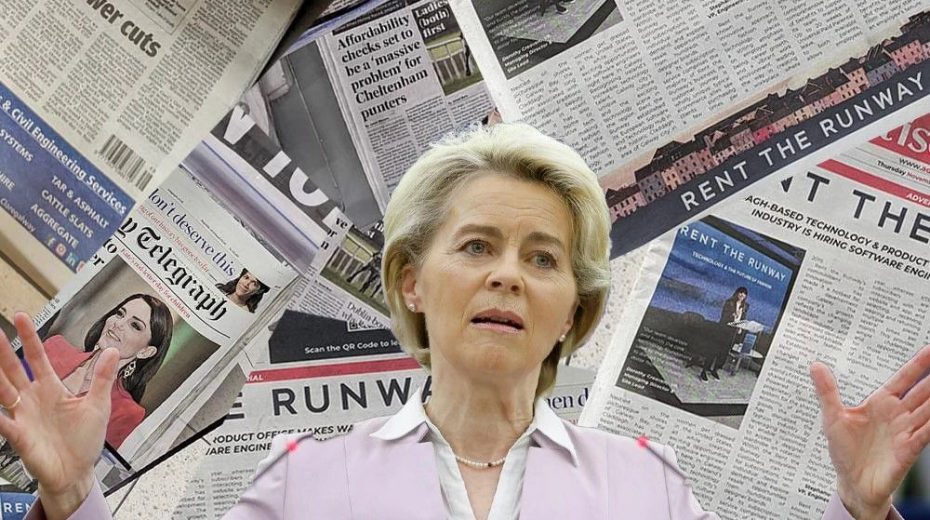
Media integrity is dead – and omission is the weapon.
“Knowing my own heart, and feeling myself, as I now do, superior to all the skirmish of party, the inveteracy of interested or mistaken opponents, I answer not to falsehood or abuse.”
– Thomas Paine (1)
Given the frequent contradictions displayed by the President of the USA, the nature of his statements, and the silence from mainstream media, Thomas Paine’s quoted words might be something worth reminding him of repeatedly.
While integrity is essential—acting as a key to opening or closing many doors—it must be distinguished from the integrity required for legitimate informing (2). Here, our focus will be on the latter: the integrity of the anchorperson within the frame of valid reporting (including choices of topics and their presentation). We identify four intertwined limits on free speech in this context: the anchorperson (1) shapes public discourse (2) through their selection (3) and omission (4) of information.
Before delving deeper, it’s important to acknowledge illegitimate informing. Media can serve both to educate and mislead us, embedding biases within our understanding. Bias doesn’t inherently stem from the act of informing but rather from embeddedness—a relational condition where an actor’s decisions are interconnected with others. As Daniel Little explains, embedded actors operate within and are influenced by the behaviors and expectations of others, thus their choices are socially dependent (3).
The anchorperson is embedded either within an abstract entity such as a news agency (4), or—if acting as an independent journalist—in the bias that comes with their critical but unembedded position. Understanding embeddedness is crucial to grasping how reporting is shaped. It’s easier to categorize a news agency as left-wing, right-wing, or conservative than to discern true critical independence.
Imagine a wealthy individual acquiring a media outlet—often a tax-deductible investment that aligns with personal views. For instance, a right-wing billionaire is unlikely to purchase a left-leaning, labor-friendly publication. Consequently, the outlet’s content tends to reflect the owner’s standpoint, while dissenting voices generally fail to advance and leave. (5) The anchorperson, whether presenter or insider, thus inherits the biases of such media owners. Typically, the bias is discernable through the tone and content of their reports.
Yet there is a subtler but more impactful form of bias. For example, media questions during political press conferences are often pre-approved. If a journalist asks unexpected questions, they risk being excluded from future briefings (6), leaving many inquiries unanswered. Traveling with politicians is a prized privilege granted only to select reporters.
Consider the case of a public servant like Mr. Snowden (to avoid controversy, used here as a distant example). By fulfilling his duty and adhering to the law, he nevertheless faced serious repercussions for his disclosures. Snowden was an embedded anchorperson, employed by the NSA, illustrating how embeddedness curtails integrity.
Embeddedness restricts integrity, which leads us to the second major limitation—and frequently-used tool—of omission. Omitting information can be viewed positively or negatively, though its impact remains powerful. When facts exist but are concealed, this implies some entity decides what should remain hidden.
This control seems deliberate since omission is a purposeful act. Negligent omission is accidental, but positive omission can serve to balance embedded interests and uphold critical content. Conversely, omission can function as an intentional “pantomime of hush,” actively skewing information and influencing public perception. (7)
Take for instance media coverage after the MH17 plane was shot down over Ukraine. (8) Two contrasting reports stand out, both exemplifying omission. The first, less contentious, showed footage of a rebel walking among the debris, displaying possessions of the deceased passengers.
The accompanying narration described him as a gloating terrorist defiling the victims’ belongings. However, the rest of the footage was omitted, including scenes where he breaks down in tears—far from the malicious image presented, but inconvenient for the desired narrative. (9)
The second, more controversial report was by a Ukrainian BBC correspondent who interviewed locals live. She translated their accounts, which included eyewitnesses claiming a Ukrainian fighter jet pursued the airliner and fired a rocket, causing the explosion. This live broadcast was aired only once and subsequently removed from BBC archives.
The act of including or excluding information serves dual purposes: to inform or to bias the public, and to fulfill a yet unrealized aim. Communication requires both a receiver and intent, making the anchorperson the message’s intermediary. Their integrity is the currency in which the message is exchanged. Omission is a potent mechanism that protects the embedded anchorpersons’ reputation, allowing truths to be left unspoken rather than lied about.
When media across print, broadcast, or digital forms loses its integrity and becomes subservient to authority, oversight vanishes, and dominance goes to the loudest and most unscrupulous voice.
(1) Thomas Paine: Right of Man, in: The Complete Writings of Thomas Paine. Collected and Edited by Philip S. Foner. Vol. I, The Citadel Press: NY 1945, page 406.
(2) Cf. Chapter 1.2 On Legitimate Information.
(3) “It is a relational concept; the embedded actor exists in a set of relationships with other actors whose choices affect his or her own choices as well. And this in turn implies that the choices actors make are not wholly determined by facts internal to their spheres of individual deliberation and beliefs; instead, actions are importantly influenced by the observed and expected behavior of others.“ Daniel Little: “Social Embeddedness“. Blog: Understanding Society. Posted on July 31, 2012. http://understandingsociety.blogspot.de/2012/07/social-embeddedness.html (03.02.2015, 03:19 p.m.).
(4) Satirical but accurate perspective on embeddedness of news agencies (publishers) in Germany. https://www.youtube.com/watch?v=VvTWo5ZGcNA (03.02.2015, 04:08 p.m.) The sources of this clip can be found in the section “’Unabhängiger’ Journalismus“ at: http://www.zdf.de/die-anstalt/fakten-im-check-der-anstalt-33119372.html (03.02.2015, 04:16 p.m.).
(5) Silvio Berlusconi is only one of the many examples that come to mind. John Lloyd and Ferdinando Giugliano have beautifully called it an “intimate fusion“ of “media and political power“: https://www.opendemocracy.net/john-lloyd-ferdinando-giugliano/intimate-fusion-media-and-political-power-in-silvio-berlusconis-ital (03.02.2015, 03:56 p.m.).
(6) German journalist Ken Jebsen is just one example that comes to mind. http://kenfm.de/team/ken-jebsen/ (03.02.2015, 06.03 p.m.).
(7) As can be observed in the discussion about Charlie Hebdo and freedom of speech.
(8) http://www.usatoday.com/story/news/world/2014/11/16/ukraine-mh17/19133793/ (03.02.2015, 06:37 p.m.).
(9)This was fittingly brought to attention by the German satire show Die Anstalt at minute 02:41: https://www.youtube.com/watch?v=jSOfQ7tgTLg (03.02.2015, 04:45 p.m.).
A short video can be seen here: https://www.youtube.com/watch?v=VyGsx2x0CIY (03.02.2015, 04:43 p.m.).
About the Author