Dear Canada, Please Read the Map
On July 31, I discussed Canada and how Donald Trump appears to be channeling his inner Benjamin Franklin. That article drew more criticism than anything I’ve penned in the last twenty years.
The majority of the negative feedback came from Canadians—a country where I have traveled and conducted business for over four decades. Perhaps I overlooked something during my time in Canada, or maybe some Canadians lack a clear national self-perception.
“Trump-Trump-Trump,” you say?
Alright then… if you must: “Trudeau-Trudeau-Trudeau!” And “Carney-Carney-Carney!”
Honestly, Canada, take a good look at yourselves. What have you done with your nation? Recently, the U.S.-Canada trade negotiations collapsed, sparking a new tariff conflict. Let’s explore why.
Can Canada Defy the Map?
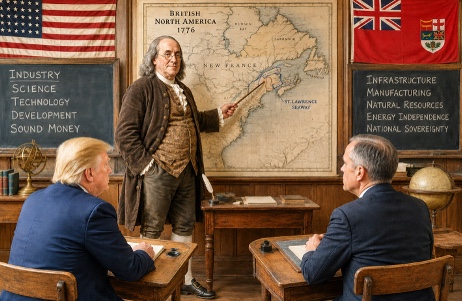
A few weeks ago, I reflected on how Franklin was involved in matters concerning Canada, or “British North America” as it was known in the 1760s-80s. Franklin regarded North America as a unified strategic entity: interconnected rivers, ports, farms, mines, workshops, shipyards, roads, canals, defenses, and markets all linked by geography and necessity.
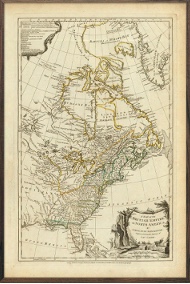
British North America in 1776. Credit: Muir-Way.com.
I believe Trump grasps this concept as well. Despite the heated criticism from Canadian readers, my argument from July 31 remains valid: the U.S. and Canada are extensive neighbors tied by supply chains and common defense, yet now they clash as if geography were negotiable.
Sorry to break it to you, folks, but Canada cannot win a trade war with the U.S.
Canada may retaliate with counter-tariffs, ban American liquor, or boo the U.S. anthem at hockey games. Yet, it cannot replace the world’s biggest economy right next door with distant hopes pinned on Europe or China. This is where Canada’s political elite faces a major dilemma.
Start with Prime Minister Mark Carney, a globalist in every way—except his wealth is largely invested in U.S. assets (check it out!). Add to that how many Canadian officials, mainstream media, and academic circles collectively imagine their country as European, begrudgingly occupying North American soil. Meanwhile, many Canadians desire Scandinavian social policies, Brussels-style regulation, Davos-approved climate activism, unfettered access to the American market, and massive trade deals with China — all on Canadian terms.
Sure… dream on. Regarding China, Canada’s trade ambitions are unrealistic. China does not see Canada as a partner in advanced manufacturing or technology. It produces its own steel, aluminum, and auto parts far more cheaply than anything Canada can offer.
Beijing’s real interest lies in Canada’s vast, post-glacial reserves of water, energy, minerals, farmland, and timber, as well as a comparatively small market for Chinese products.
Strategically, as far as China is concerned, Canada risks becoming just another global resource outpost: extract, ship, then import high-margin finished goods from Asia.
The Benjamin Franklin Frame
This brings us back to Ben Franklin, who would have identified the core challenge. Far from being a “free trader” in today’s academic sense, Franklin established institutions: libraries, fire brigades, postal networks, schools, militias, and civic infrastructure. He realized that prosperity depends on production, infrastructure, credit, skills, security, law, and disciplined citizens.
In the 1760s and 70s, before the U.S. existed, Franklin viewed North America through a strategic lens. During the Revolution and negotiating the Treaty of Paris, he emphasized waterways, boundaries, trade routes, and particularly the St. Lawrence River. In 1783, the Articles of Confederation even extended an invitation for British North America to join the American union, but Canadians declined, and history proceeded accordingly. Fair enough—Canada is Canada for a reason.
However, Canada’s independence today does not erase its geographic reality. The U.S. and Canada share a continent, along with oceanic and aerospace defense challenges, plus rail networks, power grids, pipelines, lakes, ports, and Arctic access. No tariff plan can rewrite geography.
This is why Franklin and Trump are linked in this discussion. Tariffs aren’t merely revenue tools or impulsive moves by the “Orange Man.” They’re part of a 250-year American debate on how trade should support national development.
According to Ottawa’s version of this failed trade saga, the U.S. changed the rules last minute—something about refusing to print French on American product labels. Really? No, mate, I don’t buy it.
From Washington’s perspective, Canada has long allowed Chinese goods to enter, repackaged with “Made in Canada” labeling, then shipped to the U.S. This distorts trade while expecting special treatment in American markets.
An “American System,” Whether Canada Likes It or Not
Following Benjamin Franklin, Alexander Hamilton in the 1790s shaped the young U.S. republic with a blueprint: national credit, sound currency, manufacturing, infrastructure, and a legal framework favoring enterprise. Henry Clay later named it the “American System,” encompassing tariffs, internal improvements, banks, canals, roads, railroads, mines, mills, and farms. This was not just a collection of policies but a strategy to transform a continent into a powerful nation.
Today, Canada aspires not only to maintain independence—which is reasonable—but to reject an economic philosophy that could strengthen North America. One wonders: what’s wrong with Canadian development, infrastructure, value-added industry, abundant energy, dependable defense, and deeper ties with the only market capable of absorbing Canadian production at scale?
Instead, present-day Canada supports policies that block pipelines, stall mining projects, litigate port expansions, tax capital, subsidize chosen sectors, and protect untouchable political interests. Then people ask why investments per worker and productivity lag. Where’s the growth?
Owning vast energy resources, minerals, farmland, and water is insufficient. A prosperous nation must build systems that transform these resources into lasting wealth. This “resource country” issue is one Canadian elites shy away from.
Indeed, many in Canada’s ruling class view resource development either as an insult or a sin. Unlike their Chinese counterparts, Canada’s officials often fail to recognize how energy and resources, when processed through downstream industries, generate wealth creation, good-paying jobs, and national power.
Industrial Policy Before the Term Existed
Over four decades, I’ve observed that Canada’s political elite tend to react defensively, especially regarding the U.S. But a serious Canada-U.S. agreement would not reduce Canada to a mere gas station or rock quarry for America; quite the opposite. Canada could establish a trade framework that makes it indispensable to a North American system: Canadian energy and minerals; Canadian engineering; Canadian infrastructure stretching from the U.S. border to the Arctic. The future should be hemispheric.
Simply put, let Canada be itself—but founded on energy and resource development, alongside high tech and modern industries; not a U.S. colony (and certainly not the 51st state). Also, not China’s resource outpost or a distant European wannabe with fewer people and no castles.
Meanwhile, the U.S. faces its own challenges. Tariffs influence economic growth but don’t build mines, factories, train workers, or launch merchant fleets alone. Industrial policy requires more than White House statements about tariff levels.
The bottom line: access to U.S. markets comes with responsibilities. If Canada wants preferential treatment, it must contribute to a secure North American production base and not exploit U.S. access to funnel Chinese supply chains across the border while embracing European-style regulations.
China Is Not Canada’s Escape Hatch
Let’s reconsider China: China purchases what benefits its own interests. It seeks Canadian resources and access but not lectures on values or partnerships in advanced manufacturing.
Beijing dominates critical global supply chains, covering nearly all Canadian exports. So why would China invite Canada to upgrade its role when it can import raw materials, add value domestically, and sell finished goods globally? The so-called “China option” is an illusion (unless it means selling out).
Geography dictates commerce, and the U.S. is Canada’s closest neighbor. Infrastructure and legal ties already exist, along with a U.S. defense umbrella protecting Canada’s strategic needs.
Absent the U.S. neighbor, Ottawa would face enormous costs securing its coastlines, airspace, Arctic routes, and infrastructure. Canada’s defense challenges are closely intertwined with America’s.
Canada must certainly look after itself, but that requires a strategy aligning resources with ambitions. Criticizing America or booing the U.S. at hockey games might feel satisfying, but it’s time to be productive.
Develop energy, open mines and mills, expand ports, expedite permits, and reverse the current state where de jure regulation acts as a de facto veto. Lower internal trade barriers, encourage investment, restore fiscal discipline, and stop mistaking slogans for strategy.
Canada’s policy is constrained by a dominant globalism mindset, especially the “Davos view.” Many Canadians envision their nation as a mere administrative hub within global governance, where energy is a moral dilemma and industry a net-zero burden. Such thinking harms a country whose natural advantages lie in energy, resources, engineering, agriculture, transportation, and infrastructure.
To thrive, Canada must produce: mine, farm, generate and refine energy. Oh, and read the map! Canada is in North America. This is not hard.
What a Deal Should Look Like
Following this week’s failed talks, Washington and Ottawa should first stop treating the tariff conflict as a permanent situation.
Tariffs are leverage; the ultimate goal should be a continental agreement centered on industry: guaranteed U.S. access to Canadian oil, gas, uranium, potash, and critical minerals; Canadian access to the U.S. market for authentic North American goods. Plus, stricter enforcement against third-country transshipments—i.e., slapping “Made in Canada” labels on imported goods—and joint investments in processing, transportation, power, and defense manufacturing.
Second, close loopholes. If Chinese steel, electronics, or parts enter Canada, get a paperwork makeover, and then enter the U.S. under privileged terms, that’s not “free trade”; it’s money laundering. Without border enforcement, industrial policy is a euphemism for organized crime.
Third, Canada should commit to value-added development. Stop selling cheap raw materials only to repurchase expensive finished products. Instead, move up the value chain within North America.
Fourth, the U.S. must recognize Canada as a strategic ally, not just a convenient political target. Canadian workers from Yukon mines to Hamilton and Quebec mills are not adversaries; many are crucial to a revitalized North American industrial base.
America’s dispute with Canada is with a longstanding protectionist, self-serving system blocking its own progress while demanding privileged U.S. market access for select sectors.
Tariffs Are Now the Message
New tariffs are now in place, marking a regrettable milestone that should prompt reflection from both countries. Washington reminds Ottawa of the value of U.S. market access. Meanwhile, Canada demonstrates how nationalism can be theater in today’s media landscape. But both miss the larger question.
Can North America advance as an industrially integrated continent, or is the Canada-U.S. border destined to remain a battleground for grievances?
Franklin understood the solution: develop energy, boost production, build infrastructure, and generate wealth domestically within North America with friendly partners, avoiding long-term dependence on adversaries.
Understandably, Canada doesn’t want to appear submissive, but empty bravado solves nothing. Canada can grow or falter. It can make deals, enforce rules, build infrastructure, and embrace an evolving “American System”—or not.
The alternative is a confusing mix: a boutique European mimicry, chasing illusory China trade dreams, maintaining open immigration that strains the welfare state, and hoping for the best. Again… good luck, guys.
We return to Ben Franklin, whose efforts to unite British North America with the U.S. ultimately failed. Yet, over the past 250 years, the continental map remains unchanged, and Franklin’s principles still apply. Geography is decisive, and the question remains whether today’s leaders recognize this reality and can act accordingly.
About the Author