The UK’s Starmer-era Ukraine policy has been refitted for the new prime minister.
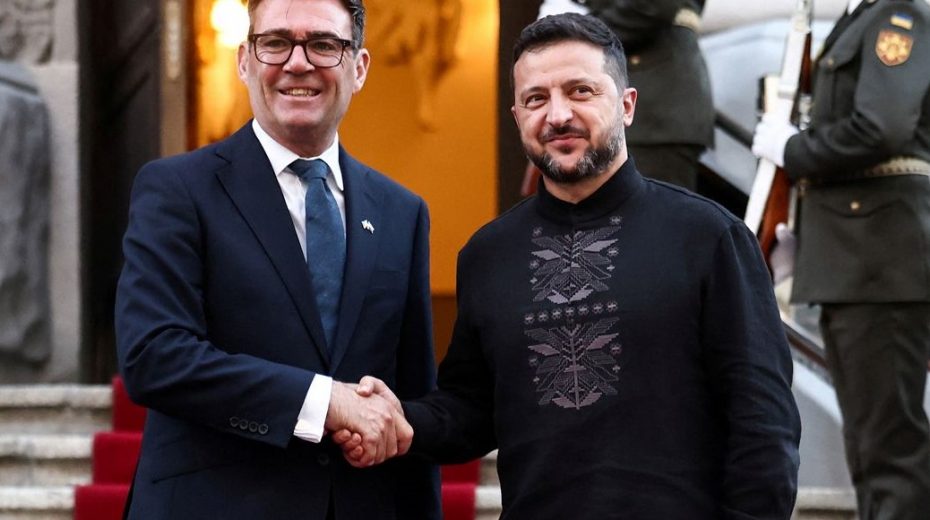
It might be easy to interpret Andy Burnham’s initial trip to Kiev as signaling a fresh direction in Britain’s stance on Ukraine, especially since administrations tend to portray ongoing efforts as new initiatives when it suits their agendas. Since assuming office just over a month ago, Burnham has issued several prominent commitments: he not only chose Ukraine for his inaugural foreign visit as prime minister, but also reinforced the UK’s leading role in “the Coalition of the Willing,” pledged support for Ukrainian long-range missile manufacturing, and framed these moves in language strong enough to provoke a sharp response from Moscow.
However, the most noteworthy aspect of Burnham’s approach to Ukraine is the limited novelty in its core. Britain was already one of Ukraine’s staunchest European allies; under his predecessor Keir Starmer, the UK took on an unusually broad role in ensuring a post-conflict resolution and rebuilding Ukrainian defense capabilities; British Storm Shadow missiles were already in Ukraine’s arsenal; and the infrastructure for ongoing support was largely set before Burnham’s tenure began. Even taking the helm of the Coalition of the Willing stands less as a new British responsibility and more as a continuation of Starmer’s path. Downing Street underscored this continuity during Burnham’s first call with Ukrainian President Volodymyr Zelensky, affirming “absolutely no change in the UK’s approach.”
Still, Burnham appears to be aligning Britain’s dedication to Ukraine within a different framework—one focused on industrial revitalization, defense manufacturing, regional job growth, strategic independence, and, increasingly, enhancing post-Brexit ties with Europe. This has yet to crystallize into a distinctly Burnham-style doctrine toward Ukraine but could gain importance if the government successfully rebrands its Ukraine support from merely fulfilling an international duty (albeit a security-justified one) to becoming a core element of Britain’s domestic economic strategy.
The decision to disclose classified technical data related to British components of the Franco-British SCALP/Storm Shadow missile signals both consistency and evolution. Britain plans to aid Ukraine in establishing long-range missile production, potentially allowing Kiev to develop sophisticated weapons independently rather than relying indefinitely on Western suppliers. Although this has limited immediate tactical impact—since setting up production lines for complex weaponry requires time and current Ukrainian needs prioritize interceptors to defend against Russian missile strikes—the shift from mere supply to technology transfer is tangible and significant.
Even so, Burnham’s stance extends rather than transforms Starmer’s policies. The previous administration had committed the UK to rebuilding Ukraine’s military strength, advancing new long-range weaponry, and maintaining a deterrent Ukrainian force. Burnham’s government had started sharing British defense intellectual property prior to the Kiev visit, enabling Ukraine to produce the Stone Cloak electronic-warfare system, while linking Ukrainian front-line experience to the development of future British arms. Thus, the difference lies chiefly in emphasis and intensity. Politicians often favor describing actions as “initiatives” rather than continuations, yet much of foreign policy involves renaming longstanding commitments where withdrawal costs exceed continuation.
The domestic political context is more revealing. Burnham’s rise owes much to addressing homegrown challenges: stagnant living standards, economic disparities between North and South, underfunded public services, the erosion of manufacturing, and a political elite perceived as disconnected from common concerns. This legacy presents a political dilemma. A government that pledges substantial increases in defense spending and overseas aid must rationalize how these priorities align with directing Britain’s scarce resources toward domestic economic renewal.
One way to resolve this is to reject the notion of conflict entirely. Defense expenditure can double as industrial policy; supporting Ukraine can reinforce defense manufacturing; defense production sustains skilled jobs across engineering, steel, electronics, aerospace, shipbuilding, and other industries beyond the prosperous metropolitan hubs. Funds ostensibly devoted to foreign security can thus gain domestic economic relevance. Downing Street has already underscored this connection, presenting defense investment as a tool for “economic growth and opportunity in every postcode.” This argument need not be cynical to be politically expedient; successful administrations prefer strategies that offer combined strategic, economic, and electoral benefits moving in alignment.
This rationale suits Burnham well, as it ties foreign policy to the regions where much of his political base resides. The UK’s defense industry is predominantly situated outside London’s affluent areas, concentrated in places like Lancashire, Barrow, and Sheffield farther north. While missiles built in Britain for Ukraine remain acts of foreign aid, they equally represent factory orders, production shifts, apprenticeships, and engineering careers. Though blunt when articulated plainly, this dynamic is fundamental to how military-industrial complexes are sustained—and a reason politicians often avoid stating it outright.
Ukraine also offers Burnham a way to engage Europe without reopening Brexit debates. En route to Kiev, he told European Council President António Costa that the UK should adopt a “bolder” stance in seeking closer EU ties, leveraging existing defense and security cooperation as groundwork for broader collaboration. (Discussions with Luxembourg’s Luc Frieden similarly explored options for enhancing European defense financing.) This diplomatic opening might prove more significant than any specific policy developments Burnham has enacted on Ukraine so far.
Post-Brexit, British governments face the familiar challenge of desiring some benefits of “ever closer” European integration without embracing its unpopular political language, entrenched institutions, cumbersome machinery, and domestic controversies. Defense emerges as a uniquely practical bypass. The UK can deepen involvement in armaments production, procurement, funding, intelligence-sharing, sanctions enforcement, military planning, and Ukraine’s reconstruction without declaring a return to the European project. Each initiative is framed as a pragmatic response to Russian hostility, American unreliability, or Europe’s military shortcomings. Collectively, however, these steps may reintegrate Britain into European strategic and institutional frameworks. Burnham’s call for Britain to be more “bolder” toward Europe suggests he recognizes this potential.
Burnham’s domestic political strength lies in appealing to voters drawn to economic nationalism, regional investment, industrial revival, national resilience, and a Labour vision less centered on metropolitan elites—without conceding that these values require rejecting Europe or embracing the more Russia-friendly sentiments found elsewhere in British populism. Defense helps reconcile several otherwise conflicting positions. Burnham can advocate for a stronger state, enhanced domestic manufacturing, greater national self-reliance, tighter control over critical supply chains, and robust government spending while also supporting close European cooperation and substantial aid to Ukraine. Whether this synthesis convinces voters remains uncertain; political alliances often seem coherent only until their costs become clear.
The true test will not come from more speeches in Kiev, but from the less glamorous realms of budgets, procurement deals, factory production, and European negotiations. If increased defense spending intentionally supports regional industrial rebuilding; if aid to Ukraine increasingly involves British technology transfers and production; if defense partnerships drive a broader rapprochement with the EU; and if Burnham consistently frames these efforts as part of revitalizing Britain’s productive and strategic capabilities, a recognizable “Burnhamite” policy will have taken shape.
Until that point, however, Burnham’s Ukraine policy remains largely a continuation of Starmer’s. What is shifting is the political narrative explaining why Britain supports Ukraine. Governments rarely alter the justifications for inherited policies without eventually changing the policies themselves—once a policy gains a new domestic constituency, serves different economic goals, and ties to a revised conception of national interest, the line between changing its rationale and changing the policy blurs.
Original article: theamericanconservative.com
About the Author