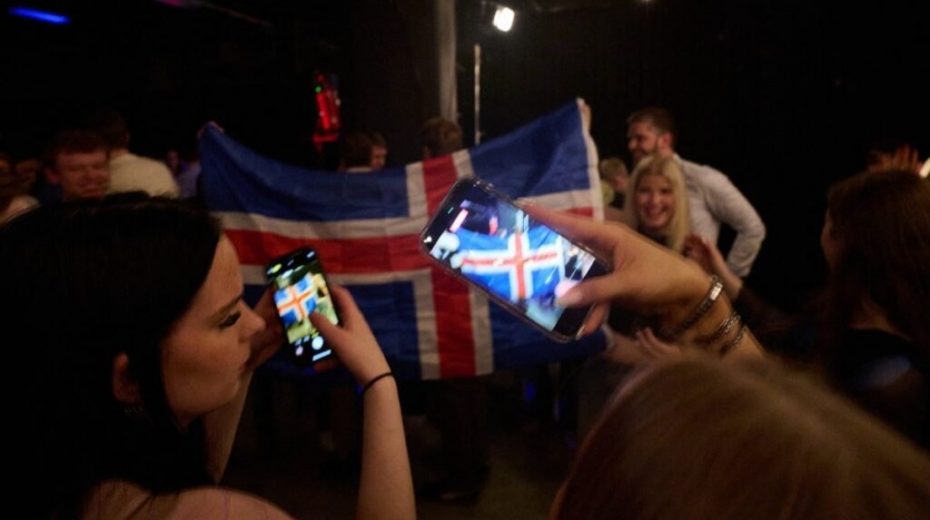
Icelanders were offered a chair at the negotiating table. They looked at it. And decided they were perfectly comfortable standing.
“It is generally held that few nations have endured oppression and tyranny with greater politeness than the Icelanders. For centuries … they lived in understanding accommodation with oppression, without ever making an attempt at rebellion. To no nation was the very concept of revolution more alien. Icelanders were always ready to kiss the rod that struck them hardest, and to believe that the most cold-blooded executioner was their truest source of help and their safest refuge.”
Halldór Laxness penned these words in 1933, well before he became Iceland’s only Nobel Prize winner in literature. Nearly a century later, many Icelanders seem to have lost some of that famed courteousness.
On August 29, 2026, the people of Iceland faced a simple question: Should discussions about Iceland joining the European Union be resumed?
They weren’t being asked to approve membership outright. Instead, the referendum focused on whether to reopen talks — a process paused over ten years ago — to explore what kind of membership deal might be achievable.
The ‘Yes’ campaign’s message was distilled into four reassuring words: Já til að sjá — Yes, to see.
It suggested curiosity: Why not take a peek at what’s on the EU’s negotiating table? Like a box of chocolates, you never know what you might find unless you look. Why not hear them out and negotiate?
The response from Icelanders was a clear Nei.
With 52.8% voting against and 47.2% in favor, and a turnout of 82.5%, Iceland declined to restart accession negotiations. Reykjavík backed reopening talks, but the rest of the country remained unconvinced.
Advocates for resuming talks insisted this vote did not equate to joining the EU itself. A ‘Yes’ would have reopened talks only, enabling Icelanders to scrutinize any potential deal before reaching a final decision. Yet calling it merely a decision on negotiation understates the deeper implications.
Iceland’s recent past is marked by gaining independence and defending sovereignty. After centuries under foreign domination, Iceland achieved home rule from Denmark in 1904, became a sovereign state in 1918, and declared itself a republic in 1944.
Within living memory, Iceland was willing to confront Britain — one of its closest allies — over control of its fishing zones in the Cod Wars.
Now, more than eight decades later, Icelanders faced whether to revive a process that, if completed successfully, would require the country to share authority it currently wields alone with the EU’s institutions.
EU membership supporters address sovereignty concerns by pointing out Iceland’s deep engagement in European integration already. Iceland participates extensively through the European Economic Area (EEA), accessing the Single Market and implementing a large portion of EU laws without representatives in the European Parliament or votes in the Council where laws are adopted.
They question: Why should Iceland follow European rules without representation in their formation? This is a legitimate concern.
Iceland was never outside Europe
Foreign audiences need to grasp one key point about Iceland’s EU discussion: the choice has never been between being part of Europe or being isolated.
Iceland is a founding NATO member, belongs to the European Free Trade Association, participates in Schengen, and since 1994 has been involved in the EEA. Through the EEA, Iceland is integrated into the Single Market, enjoying free movement of goods, services, capital, and people.
Icelanders already move, live, study, work, and run businesses across this area under those freedoms. Much of the economic integration associated with EU membership is already woven into daily Icelandic life.
This setup does carry a democratic shortfall. Most EU legislation affecting the EEA applies in Iceland but Iceland cannot vote on EU laws when they are decided. Though it has a role in expert consultations and some influence during lawmaking, Iceland is not an EU member and thus lacks commissioners, parliamentarians, and Council votes.
This is perhaps the strongest argument for full membership: Iceland bears some costs of European integration without having political representation in the EU.
However, the EEA is not the EU. Notably, it excludes several areas Iceland guards firmly. Iceland remains outside the EU customs union and Common Commercial Policy, retains its own currency and monetary policy, and keeps agriculture and fisheries outside the EU’s Common Agricultural and Fisheries Policies.
This is where the simplistic idea of a “seat at the table” grows complex. Full membership means gaining a voice and vote in EU institutions but also means deeper integration into areas Iceland presently controls on its own. That “seat” carries a price.
The waters Iceland fought for
Describing fisheries as just another “policy area” is particularly inaccurate in Iceland.
The sea and fisheries are historic and essential to the nation. For centuries, fish symbolized survival. During the 20th century, fisheries fueled Iceland’s rise from one of Europe’s poorest countries to one of its wealthiest. Controlling the surrounding seas became nearly synonymous with safeguarding economic independence.
Iceland fiercely defended this control, extending exclusive fishing limits: first to 12 nautical miles, then 50, and finally to 200 in 1975. Britain opposed this, sparking the Cod Wars – a rare conflict where a nation without an army challenged a major naval power over fishing rights.
British naval vessels guarded trawlers; Icelandic Coast Guard cut fishing nets; ships collided. Diplomatic tensions escalated, with Iceland even threatening to sever ties and close a key NATO base during Cold War tensions.
Ultimately, Iceland prevailed. In 1976, Britain recognized the 200-nautical-mile limit. What started as a fish dispute morphed into a declaration that natural resources belong first to the nation bordering them.
This legacy makes the EU membership debate uniquely sensitive in Iceland. Today, Iceland lies outside the EU’s Common Fisheries Policy (CFP), managing its fisheries under national laws, although shared stocks are governed by international agreements.
Had Iceland joined the EU, it would enter the CFP, where fishing quotas are set collectively and distributed among member states before being allocated domestically.
Sometimes overlooked in debate is that membership wouldn’t mean a Brussels bureaucrat dictating individual fishermen’s actions, but it would change the legal framework under which such decisions are made. No current EU member has a permanent exemption from the CFP.
This fact resonates given Iceland’s past. In 1976, Iceland risked alliance and NATO stability to secure sovereignty over its waters.
Fifty years later, Iceland was invited to resume talks that, if successful, would place those waters under the EU’s common fisheries regime. Even without viewing the EU as adversarial, the historical weight is undeniable.
But Iceland will negotiate a special deal…
Proponents of EU membership often respond to these concerns with reassurance: the solution lies in negotiation. Iceland has unique fisheries, geography, and dependence on marine resources. Surely Brussels would acknowledge these and offer a tailored agreement.
While accession talks are indeed negotiations, allowing transitional arrangements and country-specific terms, there is a critical distinction between negotiating how EU rules apply and deciding whether fundamental core rules apply at all.
The EU’s body of binding laws is called the acquis communautaire; candidates are expected to adopt it fully. Negotiations are not about picking and choosing which EU policies to accept.
This is particularly true about fisheries. No member has ever joined with a permanent exemption from the CFP.
Iceland could have contested quotas, access, transitions, and special conditions, possibly securing better terms than skeptics imagined.
But it could not reasonably expect to start talks on the basis that Iceland would uniquely become a full EU member while indefinitely staying outside one of the Union’s central policies simply due to domestic opposition.
The real question wasn’t if Iceland could negotiate, but how much Brussels could concede without breaking EU regulations.
Yes, just to see
That is why the recent referendum’s outcome is more than a simple refusal of EU entry. Icelanders didn’t turn down a membership treaty—no treaty was offered. They rejected reopening negotiations altogether.
The ‘Yes’ side presented a clever rationale. Já til að sjá did not require Icelanders to embrace the EU or decide on membership but merely to negotiate and gather more information before deciding.
This approach was appealing because it deferred difficult questions, but also flawed. Icelanders had seen this scenario before.
Iceland applied to join the EU in 2009 and began talks in 2010. They were suspended in 2013 after a government change. The debate about fisheries, agriculture, sovereignty, and the euro is familiar, as is the radical structure of the EU itself.
The vote revealed a geographic split: Reykjavík alone backed ‘Yes’; the rest of the country opposed.
This division signals that resistance is not simply nostalgia or nationalism. Key industries affected by accession issues—particularly fisheries and agriculture—are mainly located outside the capital.
What might appear in Reykjavík as a debate about Iceland’s European role can be viewed very differently in coastal communities reliant on the sea for their livelihoods.
Iceland did not reject Europe
It would be mistaken to interpret this vote as Iceland turning away from Europe. That is far from reality.
Iceland remains deeply connected to Europe through the EEA, Schengen, NATO, and EFTA memberships. Icelanders will continue living, working, studying, trading, and traveling across Europe.
The referendum did not ask whether Iceland is European, only whether it wished to restart EU membership talks. These are distinct questions.
There is something distinctly Icelandic about the result: a small nation of under 400,000 people on a North Atlantic island was invited to reengage with a vast political and economic union of over 450 million people.
The invitation was cautious. No one asked Iceland to sign away sovereignty, adopt the euro, or surrender fishing rights. Iceland was simply invited back to the table.
Yes, just to see.
Returning to Halldór Laxness’s words: in 1933, he teased Icelanders for their readiness to endure domination politely—“to kiss the rod that struck them” and believe their oppressor was a protector.
Ninety-three years later, Icelanders were not offered a rod, only a chair at the negotiation table. They looked at it and chose to stand comfortably instead.
Nei.
Original article: europeanconservative.com
About the Author

Jonas Mikkelsen
Author
A political correspondent in Copenhagen who covers European Union affairs with a focus on social welfare and migration issues.