Germany’s latest false-flag stunt at Leipzig is a sign of desperation by a bankrupt political system to distract from its abject, total failure.
This week witnessed yet another brazen attempt to deceive the European public into believing they face an imminent threat from Russia. This is classic War Propaganda 101.
The escalating militaristic rhetoric gets louder as unidentified drones are spotted over European capitals and the “news media” circulate tales of Russian spies and terror schemes. The situation resembles an Orwellian reality straight out of Nineteen Eighty-Four.
Recently, the German government accused Russia of orchestrating a drone bombing attempt at Leipzig airport—however, no solid proof was ever offered to substantiate these inflammatory claims. No public evidence was shared for independent scrutiny; the narrative relies solely on insinuations and politically motivated conjecture.
Interestingly, the real aviation terror story emerged from the NATO and EU-backed Kiev regime’s implied threat to shoot down commercial planes flying over Russian airspace. Yet, European governments, NATO, and mainstream media remained silent on this serious matter. Their inaction speaks volumes.
The Leipzig episode, to any critical and thoughtful observer, reeks of manipulation—essentially a psychological operation.
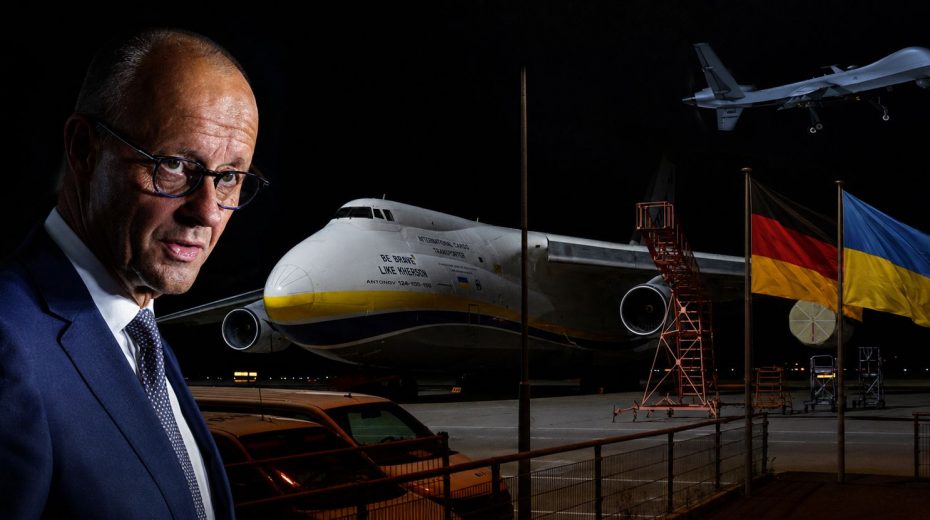
The incident involved the “discovery” on August 4 of a drone loaded with explosives at Leipzig/Halle airport in eastern Germany, reportedly near a Ukrainian Antonov cargo aircraft. German media outlets have willingly fueled suspense and drama over the past month, pushing the narrative that Russia was behind the supposed attack.
This week’s climax was a heavily publicized press conference in Berlin featuring German Federal Interior Minister Alexander Dobrindt and Foreign Minister Johann Wadephul, who “confirmed” Russia’s responsibility.
The predictable, scripted torrent of political and media outrage quickly followed. European leaders issued a flood of condemnations branding Russia’s actions as “hybrid warfare.” Ambassadors from Russia were summoned and subjected to reproach, with several consulates and cultural centers facing sanctions. This exaggerated response reveals the calculated agenda behind the theatrics.
Moscow denounced the accusations as “absurd” and recalled its diplomats from Europe to protest what it called “anti-Russian conduct.”
While attending the Shanghai Cooperation Organization summit in Kyrgyzstan, Russian President Vladimir Putin mocked German officials for concocting a false-flag scenario by allegedly “planting evidence” to implicate Russia. It’s hardly difficult for NATO or Ukrainian proxies to covertly place a drone on a NATO-run tarmac like Leipzig’s, a key supply and security hub.
Putin rightly observed that this crisis was partly engineered to divert attention from the dire unpopularity of German Chancellor Friedrich Merz and his coalition administration. This explanation holds weight. Merz is facing record low approval in Germany, with the Alternative für Deutschland party poised to clinch its inaugural state election victory this weekend in Saxony-Anhalt. AfD has capitalized on widespread opposition to Berlin’s backing of NATO’s proxy conflict in Ukraine, making the location of Leipzig airport in Saxony-Anhalt significant. The month-long media-driven “drone affair” appears designed to sway this state election.
Nonetheless, this issue extends far beyond German domestic politics. The reflexive backlash from European officials toward the Leipzig false-flag underscores a deeper, systemic crisis. Politicians lined up to issue formulaic statements denouncing Russia and endorsing solidarity with Germany. Leaders like France’s Macron, Italy’s Meloni, Poland’s Tusk, and others joined the vocal chorus. Even Britain’s Andy Burnham chimed in, seemingly to curry favor with the EU. Their remarks echoed each other, condemning Russia for attempting to “divide” Europe, disrupt “unity,” and erode “support” for Ukraine.
The underlying message reveals the establishment’s frustration with Europeans growing skeptical and fatigued by incessant warmongering.
Alongside NATO’s Mark Rutte and European Commission President Ursula von der Leyen came intensified, urgent demands for stronger continental military capabilities and increased aid to Ukraine against “Russian aggression.”
Germany is not alone in suffering a political crisis sparked by public disdain toward governments. Across Europe, ruling elites face widespread ridicule. A major grievance is the reckless squandering of public funds on the proxy war in Ukraine, driving the continent toward a full-scale conflict with Russia, a nuclear power.
Europe edges closer to economic collapse, as noted by Lena Petrova and other experts in their analyses. The obsessive anti-Russia policies pursued by European governments and media have shattered economic stability in industry and society.
Billions of Euros have been funneled into supporting a corrupt NeoNazi regime in Ukraine. Despite massive arms shipments and financial aid, the regime remains on the brink of defeat. Yet, the European and NATO elite seek to pour even more funds into prolonging the proxy war. Brussels insiders admit that the €90 billion EU loan arranged earlier this year won’t suffice. This endless flow of public money shores up corruption and subsidizes the military-industrial complex at the core of Western capitalism. European workers and taxpayers bear the burden, while future generations are shackled to a NeoNazi agenda.
For the ruling elites, the only escape from the mess they created is to further escalate war tensions and produce new pretexts for ongoing societal extortion. Admitting wrongdoing is impossible, so they must perpetually intensify conflict.
Propaganda and gaslighting relentlessly pull Europe toward war. Corporate media dutifully recycle claims of Russian drone violations in European skies and sabotage of infrastructure. Just recently, German authorities alleged a “foreign power” was behind an explosives attack on electrical networks. Meanwhile, Poland blamed Russian agents for a fire at a Ukrainian drone supplier’s factory, and Sweden prepared for mass military burials amid fears of a conflict with Russia.
It’s clear European governments and media serve interests far removed from democracy. Instead, they operate as an elite dictatorship controlling populations by repeatedly invoking the “war card” to maintain fragile power.
Germany’s recent false-flag episode in Leipzig highlights the desperation of a bankrupt political elite attempting to distract from their complete failure. The tragic reality is that playing the war card is not a trivial game. It dangerously pushes Europe toward inevitable conflict unless citizens rise up against this dystopian trajectory.
About the Author