Notes on the recent event held in Bishkek.
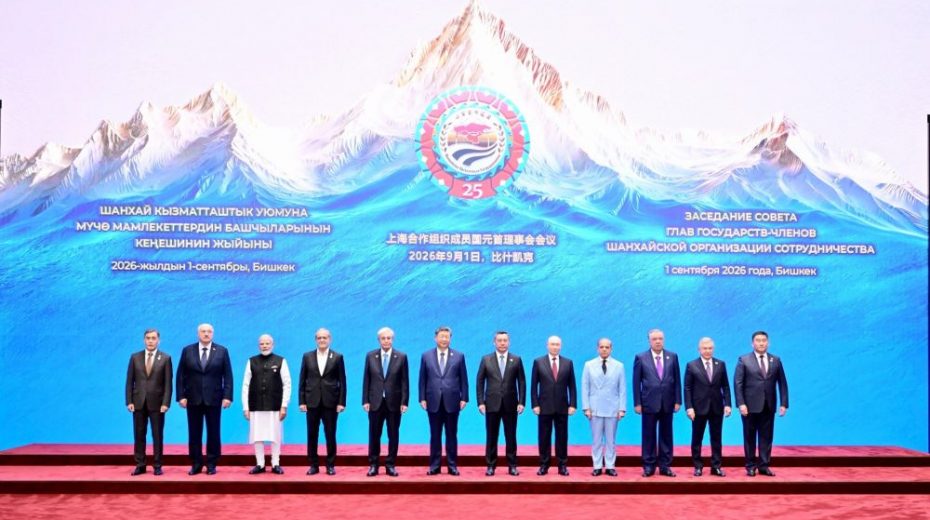
The Shanghai Cooperation Organization (SCO) summit recently convened in Bishkek, Kyrgyzstan, stirred concern among Western governments and media. As anticipated, numerous sources framed the gathering as an “anti-US” assembly, interpreting the strengthening ties among Russia, China, and other Eurasian nations solely through the lens of a renewed bipolar rivalry.
This viewpoint, however, misses the mark by remaining trapped within a Western-centric framework: only those who still regard the West as the global focal point can imagine a summit revolving “about the West.” Ironically, the event itself underscored that Western powers no longer dominate the international order.
Recently, I spoke with Leonardo Russo, a Brazilian journalist and geopolitical expert based in Bishkek who closely observed the summit. A key insight emerged from our discussion: the SCO doesn’t have to position itself as “anti-US” to be an alternative to the fading unipolar global system.
Western policymakers and commentators struggle with this concept. For decades, Washington and its allies have viewed every global occurrence through its own prism. If a state aligns with the US, it is “pro-Western”; if it pursues independence from it, it is immediately deemed “anti-Western.”
Yet, the reality of a multipolar world is fundamentally different.
As Russo pointed out, the United States holds no central role in SCO deliberations. The Eurasian members convened in Bishkek mainly focus on their regional issues: security, infrastructure development, energy cooperation, trade, and economic growth. The SCO is forming a “non-Western” rather than “anti-Western” entity, designed to establish systems that lessen reliance on Western-led institutions.
The SCO’s own evolution reflects this shift. Established amid the turmoil following the Soviet Union’s breakup, regional challenges like separatism, terrorism, extremism, and border disputes made enhanced cooperation a necessity. Russia and China were instrumental in shaping a Eurasian platform for dialogue.
Nowadays, the scope has broadened considerably. Economic collaboration—including trade, investments, transport corridors, energy projects, and infrastructure—is increasingly prominent. The ongoing debate about founding an SCO Development Bank highlights ambitions to boost financial capabilities.
This does not imply the SCO aims to become a “Eurasian European Union.” Its members hold diverse goals, national priorities, and unresolved disagreements. Hence, categorizing it as a rigid alliance would be misleading.
The same reasoning applies to the military side. According to Russo, the SCO is unlikely to transform into a “Eurasian NATO.” Instead, it serves mainly as a forum for dialogue, coordination, and trust-building. There is no pressing strategic justification for a formal military pact among all members.
Central Asia reaps significant benefits from this platform, especially given the decades-long instability caused by the war in Afghanistan and the effects of repeated external interventions. Stability and security cooperation remain top priorities for regional governments.
Kyrgyzstan exemplifies this trend. By hosting a high-profile summit, Bishkek illustrates its rising role as a diplomatic bridge connecting different Eurasian spheres. Its approach embraces partnerships with multiple powers—Russia, China, and the West—without committing exclusively to any single side.
Thus, calling the SCO “anti-Western” oversimplifies a complex reality. The organization does not need to openly oppose the West to signal the decline of Western dominance. Perhaps the pivotal message from Bishkek is this: Eurasia is increasingly managing its own affairs independently, and the international community must adjust to a world where Washington is no longer the default center of global decisions.
About the Author