Trump’s ‘Ballroom’ and a Legal Bunker-Buster
Last week, the Supreme Court released a highly technical and seemingly limited order that could, in time, trigger major consequences beneath the surface of national governance.
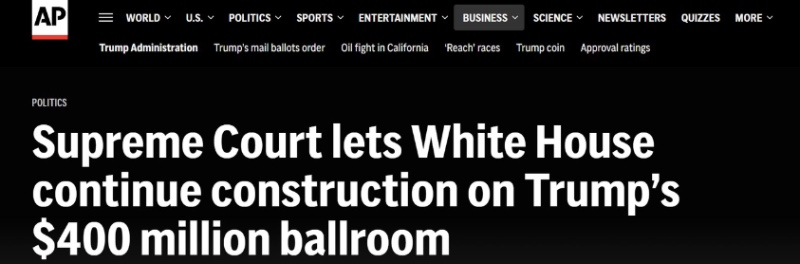
Typical headline on “Ballroom” issue. Credit Associated Press.
The focus is on President Trump’s so-called “Ballroom,” or more precisely, the combined ballroom and secret bunker facility he’s constructing next to the White House.
As the Associated Press (AP) described it:
WASHINGTON (AP) — A divided Supreme Court on Monday (August 31; BWK) allowed the White House to continue construction on a $400 million ballroom project as lawsuits play out, a win for President Donald Trump as he flexes unprecedented executive power and remakes the capital in his image.
Most depictions depict a generous structure featuring grand columns, expansive glass, and the unmistakable opulence typical of Trump ventures.
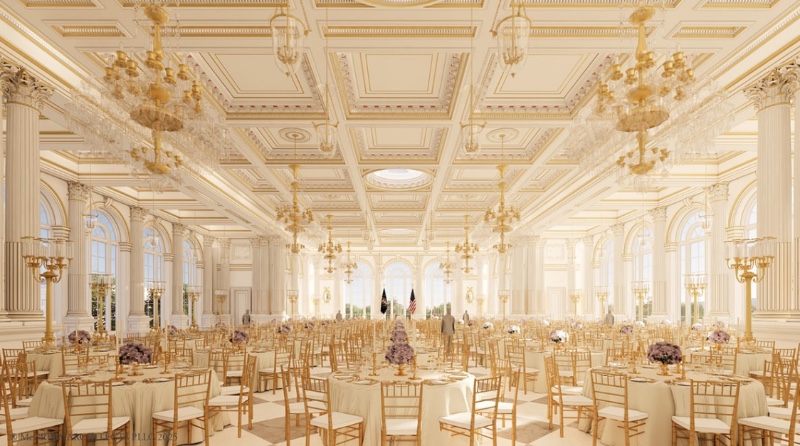
Proposed interior of new Ballroom. Credit White House.
But the surface is only part of the story. Court documents indicate that beneath this prominent structure lies a heavily fortified military facility, complete with nuclear-resistant quarters, advanced communications systems, medical units, and other clandestine installations supporting what Washington insiders call “continuity-of-government.”
Marble above ground, fortress below. One might dub it Versailles sur Cheyenne Mountain.
Does Standing on the Sidewalk Convey “Standing”?
You’ve likely followed this saga. In the previous year, Trump ordered the demolition of the 1940s-era East Wing and unveiled plans for a new “Ballroom.” Unsurprisingly, dissent erupted.
Because, well, it’s Trump! A “historic preservation” organization filed suit, arguing that the president couldn’t alter White House grounds without formal bureaucratic review or congressional approval. Subsequent rulings by a D.C. district judge and two appellate judges halted construction mid-concrete pour.
Trump’s legal team appealed, and the Supreme Court’s 5–4 ruling allowed work to proceed while the legal battle continues. The unsigned majority opinion clarified the Court was not ruling on the legality of the project, but rather on whether the plaintiff has “standing” to initiate the lawsuit.
Though it sounds like legal jargon, “standing” is essentially the gateway allowing a person to bring a case to court. For example, if a falling tree strikes you on the sidewalk, you have standing to sue out of injury. But if you simply dislike the paint color of a neighbor’s house, you likely lack standing due to insufficient harm.
In simple terms, standing determines who may sue. Here, the Supreme Court ruled that unless the preservation group has standing, Trump’s construction can continue uninterrupted.
The 5–4 decision reveals that four justices, including Chief Justice Roberts (a former Harvard classmate), believe the plaintiff has enough personal stake to maintain the case. Roberts and the court’s three liberal members also suggested the construction might be “likely unlawful.”
Yet five justices disagreed, meaning just one vote separates the position that the construction is “likely unlawful” from the green light to “pour more concrete.”
This is astonishing, considering we’re discussing alterations to the White House—arguably one of the world’s most iconic buildings—and a dispute over presidential authority to build without official clearance.
The split means five justices say the president is effectively immune from this lawsuit, while four say a passerby walking a dog outside the fence can challenge the build in court.
Ultimately, this isn’t about the ballroom’s decorative gold or the underground shelter; it’s a battle over fundamental political rules—who can sue whom, for what reasons, and when an injury justifies accessing the courthouse.
And from a jurisprudence perspective, when should the “highest court in the land” decide a conflict is too politically sensitive and shelve it under the doctrine of standing?
The Trapdoor of Standing
This issue may ring a bell from December 2020, when Texas filed an original jurisdiction lawsuit in the Supreme Court against Pennsylvania, Georgia, Michigan, and Wisconsin over that year’s election processes. Sixteen other states joined the suit.
The Constitution’s original jurisdiction clause designates the Supreme Court as the venue for disputes between states. Texas’s suit was comprehensive, backed by detailed claims and numerous supporting briefs from influential parties. Defendants also responded.
Despite the weight of the case and its national constitutional significance concerning a presidential election, the Court rejected it in just two sentences. Texas lacked standing because it failed to demonstrate a “judicially cognizable interest” in how other states conduct their elections. All other motions were dismissed as moot.
Justices Alito and Thomas argued the Court had no discretion to refuse an original jurisdiction case. Still, the Court quickly ended it on the procedural footing of standing, effectively sidestepping Texas’s merits entirely.
Here, then, are two standing-related rulings: one prematurely dismissing a Constitutionally rooted original jurisdiction case, the other narrowly allowing construction to proceed against a plaintiff claiming “aesthetic” harm from a nearby bunker.
Which approach is correct? Has original jurisdiction become irrelevant? Or does the just-walking-dog plaintiff nearly gain standing to halt major White House work? Or are these simply moments when the Supreme Court sidesteps politically tricky cases?
At its core, standing prevents courts from becoming mere debating forums and helps avoid politicization. Still, beyond a certain point, we lose impartial law as well.
The Price of Legal Fog
The dispute over the Ballroom extends beyond Trump, the East Wing, or post-2020 political passions. Federal courts aren’t just arbiters but vital components of the Republic’s operational framework.
If standing rules are overly restrictive, legitimate injuries are ignored. If too lax, anyone disgruntled can clog the judicial system. In either case, uncertainty imposes costs: projects stall, actors grandstand, law firms recruit plaintiffs, and investment hesitates because legal risk is an unseen, unmeasurable tax.
This gradual legal ambiguity contributes to imperial decline—not from dramatic constitutional crises but through thousands of unclear rulings. Without clear standing lines, everyone sues to safeguard leverage.
Ironically, the Supreme Court claims political noninvolvement, yet the Constitution explicitly delegates certain disputes to it. Meanwhile, federal governance is inherently political, the presidency obviously so, and every justice arrives through political appointment. When the Court feigns apolitical detachment, it merely shifts battles into obscure back alleys.
The Court can’t referee every political clash—it’s not a council of elders—but defaulting to “lack of standing” to dodge difficult questions demands clear standards. Without them, standing becomes less doctrine and more a reflection of judicial temperament.
From Permits to Political Risk
Consider the broader context. Pipelines and mining roads cross federal lands. Ports require dredging. Military bases may need expansion. Ambiguities in law and regulations arise frequently, triggering claims of injury. Determining who can sue is nearly as important as who is right.
Unclear legal thresholds deprive project sponsors of certainty. Permits remain provisional, final agency decisions are tentative, lawsuits loom large, and capital slows as investors cannot predict if a permit ends the process or just signals the start of appeals. Economic development shifts from productive endeavor to hostage negotiation, while court dockets effectively become part of investment portfolios.
This legal uncertainty favors parties who choose to litigate. It encourages delay and allows officials to frame policy disputes as procedural conundrums, turning every development plan into a legal case study.
The 2020 “lack of standing” dismissal against Texas remains a sore point. Beyond personalities and election results, where else can such disputes be resolved when states challenge each other about election legitimacy? We’ve already tested the battlefield option.
Texas might have lost on substance—but we’ll never know because the Court dismissed the case on procedural grounds without addressing its arguments, deepening public distrust rather than clarifying the law.
Similarly, if Congress’s permission is needed for Trump’s Ballroom, it should say so. If White House grounds fall under purely executive control, that should be clear. Defining boundaries matters, because unexplained restraint does not equal wise governance. Avoiding tough calls carries consequences.
The Holy Roman Warning
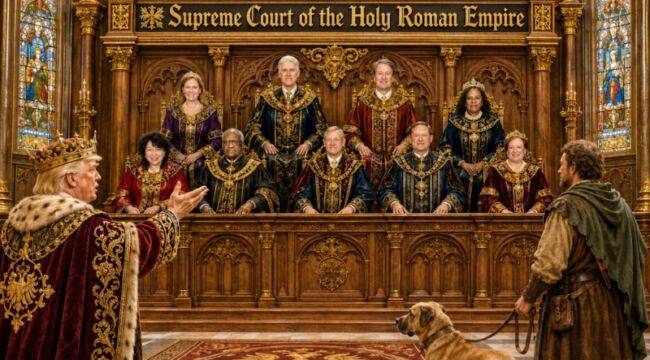
Perhaps the nine justices simply avoid acting as referees in a divided Republic. To put it metaphorically, nobody wants to umpire the Holy Roman Empire—and this is no mere jest.
The Holy Roman Empire was a patchwork of kingdoms, duchies, bishoprics, counties, and free cities. Its emperor was elected and wielded limited power amid overlapping authorities. Local rulers zealously protected sovereignty for centuries. Though durable, this system created jurisdictional complexity from Charlemagne’s era through Napoleon’s rule.
The lesson isn’t that federal systems are doomed. Ambiguity can preserve stability by allowing factions to narrate tolerable stories. However, escalating confusion turns every conflict into protracted legal warfare, jamming societal machinery.
By dismissing cases on “lack of standing,” the Supreme Court may think it sidesteps politics, but actually it deepens an imperialist, jurisdictional labyrinth, leaving every citizen, governor, agency, and lawfare enterprise navigating conflicting maps. Last week, the Court avoided a bitter substantive decision but delivered a future filled with procedural battles.
Law, or Oracles?
When properly applied, the doctrine of standing restricts litigation to genuine disputes and prevents courts from issuing advisory rulings. Courts thus serve as venues for authentic conflicts brought by parties with real interests.
Yet in unpredictable applications—whether dismissing Texas or narrowly ruling on Trump’s Ballroom—the opposite occurs. Boundaries blur, more lawsuits arise, and the Court’s procedural decisions seem politically selective. This invites forum shopping, unusual claims, and emergency appeals.
When court access depends on the political sensitivity of a case, the Court reveals discomfort with constitutional powers. America cannot function on judicial avoidance.
Over 250 years—since 1789—the Republic has weathered poor rulings, even foolish ones. But what it cannot tolerate is a legal elite that transforms court access into appeal to oracles. You ask to sue; the oracle examines entrails and political winds, responding: “Yes, but only maybe; not now, but perhaps later.”
This is not law—it is ambiguity weaponized, leaving states and citizens questioning whether the Constitution is now just a museum artifact: preserved behind glass at the National Archives, admired but increasingly irrelevant.
The Ballroom ruling may seem cautious now, but history might judge it as a stark indicator of profound systemic issues that precede decline or disaster.
And with that, I rest my case.
That’s all for now… Thank you for subscribing and reading.
About the Author