It’s a gamble. And in war, gambles made with other people’s resources are always paid for by those who make them.
Going to learn the Art of war that we don’t know how to wage
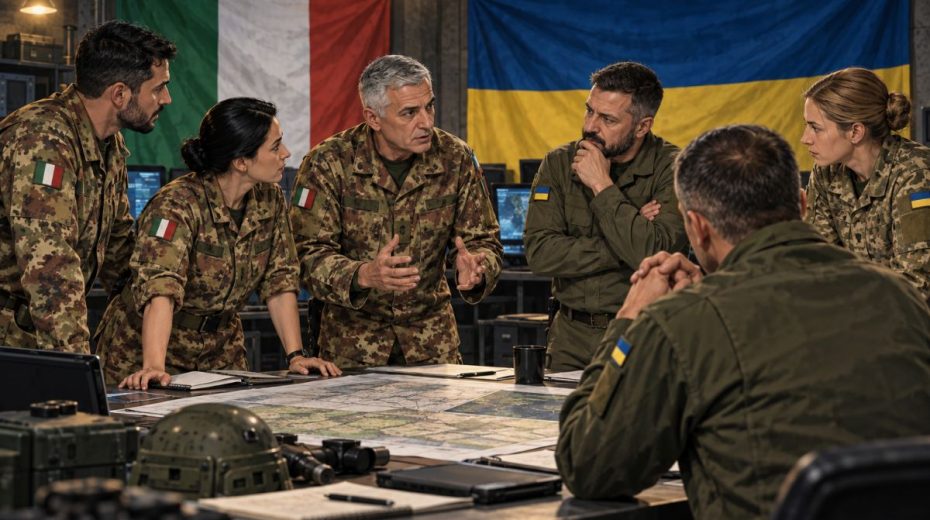
On September 14, 2026, Lieutenant General Carmine Masiello, the Army Chief of Staff, concluded a two-day visit to the Ukrainian Ground Forces. The official purpose was educational: to observe directly how Kiev utilizes drones, artillery, and electronic warfare in intense combat situations and to glean lessons to modernize the Italian army. Ambassador Carlo Formosa described it as a “unique” military experience, invaluable during a time of rapid adaptation among Europe’s principal armies. The press release made no mention of Italy entering the conflict, a point that must be stressed immediately, as the real significance lies in the contrast between the diplomatic language and the symbolism of the visit.
The political meaning of such a trip is found not in the formal statements but in what it signals. A Chief of Staff does not travel to Kiev purely as a diplomatic gesture. The trip marks an alignment with a model, a stance, or a strategic direction. This direction points to a nation actively discussing – within the so-called coalition of the willing and with the possibility of European forces deployed on the ground – its own involvement in a direct confrontation with Moscow. It should be remembered that the Kremlin has clearly warned that the presence of European soldiers in Ukraine would constitute a declaration of war against Russia. Masiello’s journey is not the cause of this change but rather an indicator — one worthy of interpretation for what it reveals.
The image itself is telling. The army leader of one of the G7’s major economies traveling to a warzone to learn. Not to deliver capabilities that others lack—the usual role of an industrial power in a combat zone—but to receive them. The official phrasing—“the Ukrainian experience as a model for the modernization of the Italian Army”—should be accepted as a courteous but direct acknowledgment that Italy falls behind in contemporary land warfare and openly recognizes this fact.
Ground warfare has evolved more over the past three years than in the last three decades before that. The battlefield has become saturated with sensors and drones, offering almost total transparency, while firepower, maneuver tactics, and electronic warfare are integrated into rapid decision-making cycles compressed into mere minutes: Ukraine has gained this knowledge at heavy human cost. This practical experience is invaluable, and the providers of these lessons have earned the right to offer them. Italy’s desire to learn is not the issue; rather, the contradiction lies between the lessons sought and the capacity to apply them upon return.
The dependency that no press release mentions
The three core elements around which Kiev’s operations revolve—electronic warfare, drones, and loitering munitions—are exactly where the Italian military-industrial sector faces its greatest deficits. This is not conjecture, but a conclusion drawn from experts within the field.
Regarding loitering munitions—the loitering munitions, or “kamikaze” drones redefining precision strike economics—Europe as a whole has yet to develop capabilities equal to those of the United States and Israel, who dominate this technology. European efforts in developing and producing these systems have been mostly reactive, starting only after Ukraine’s war underscored their critical value. Italy mirrors this pattern: it enters the market late and remains a follower.
A similar story applies to drones. The 2024–2026 Multi-Year Defense Policy allocates funds for acquiring various remotely piloted systems; however, as the report notes, many of these capabilities “will have concrete effects only in the medium to long term, leaving some immediate critical issues unaddressed.” In other words, Italy plans to acquire systems that will become functional only after the lessons from Ukraine’s conflict have already evolved. Meanwhile, as Italy’s domestic sector attempts to close the gap, it relies heavily on foreign partnerships: the military drone plant inaugurated in Modena in June 2026 is a joint venture with the United Kingdom, with advanced engineering originating from across the Channel.
The dependency extends beyond Europe. Supply chains for European unmanned systems intertwine with Middle Eastern and Israeli companies to such an extent that critical technological components come from providers outside the sovereign control of Rome or Brussels. This reality exposes the limits of current rhetoric concerning the “war of the future.” Engaging in next-generation electronic warfare is impossible without controlling your supply chain, intellectual property, and autonomous manufacturing capabilities. At best, one can wage only the wars their suppliers permit.
Fanciful ambitions, real resources
This brings us to an inherent contradiction. Italy commits substantial sums—running into billions for drones and air defense with protracted execution timetables—but starts from a position of critical dependence on external providers for essential technologies. Yet it simultaneously positions itself for a leading frontline role in a direct clash with the continent’s dominant land military power. These conditions cannot co-exist. The issue is not about resolve or political will; it concerns the tangible capabilities of the available equipment. Those who cannot produce their own advanced military systems cannot fully support or sustain modern warfare, except to the extent that others maintain those capacities for them.
The coalition of the willing implies the participation of actors capable of independent power projection. Italy is not yet in that category for these key technological areas. Though it boasts a respected defense sector in other fields—Leonardo’s electronics, aeronautics, and naval technologies—the industrial base is lacking precisely in the three domains that Ukraine’s war has proven essential. This is reflected in the fact that its Chief of the General Staff travels to Kiev armed only with knowledge to gain, rather than capabilities to contribute.
The paradox here is clear. Italy prepares for a conflict it openly admits it lacks the experience to fight, with tools it acknowledges are still pending acquisition, facing an adversary that has been engaged in this form of warfare for three years supported by its own production. Viewed realistically, this is not deterrence; it exposes vulnerability cloaked as modernization.
What would, on the other hand, make a great deal of sense
This is not a critique of the Army’s necessary and overdue modernization, but a reflection on the order of priorities. Properly, building technological autonomy should come first, before considering ambitions of power projection. Flipping this sequence—seeking to learn how to wage war before possessing the means to sustain it—signifies an early acceptance of subordination: technologically to suppliers and strategically to those truly commanding the coalition.
Seen through this lens, Masiello’s trip to Kiev is less a sign of an Italy ready to confront the war of the future and more an acknowledgment that it still lacks the tools required for the war being fought now. Instead of drawing the evident conclusion—to develop these capabilities in-house—it opts to approach the conflict relying on the hope that others will supply the necessary tools.
It’s a gamble. And in war, gambles made with other people’s resources are always paid for by those who make them.
About the Author