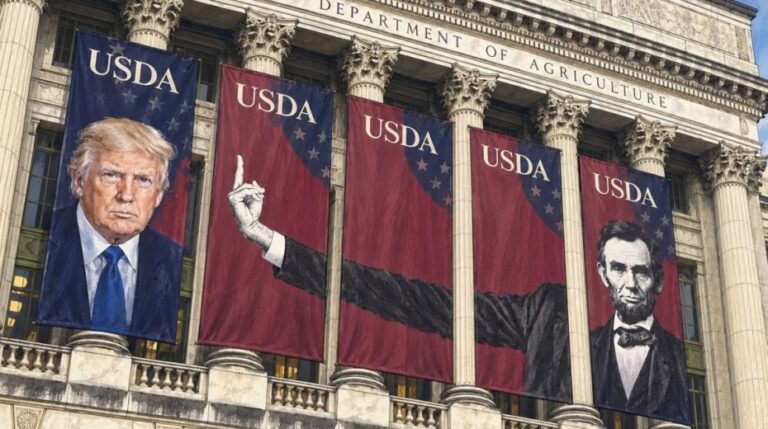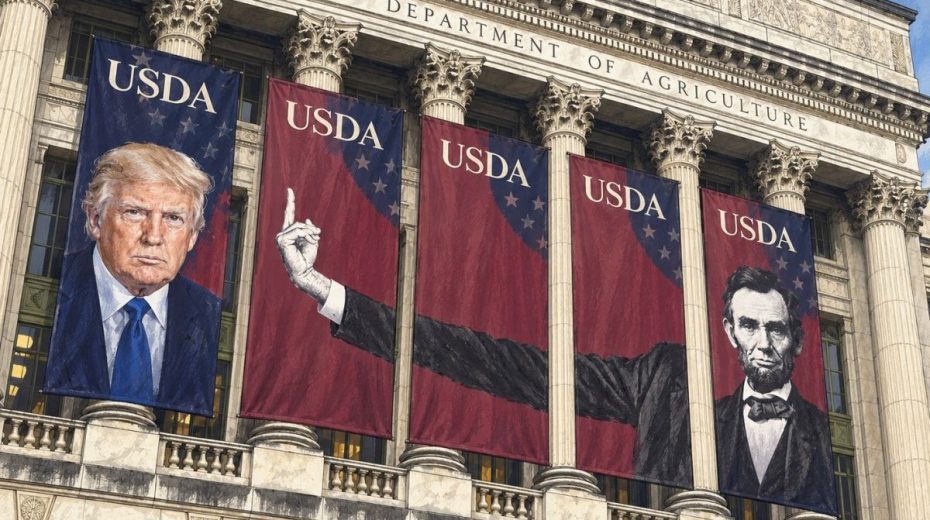
The buzz in Washington is undeniable following President Donald Trump’s latest initiative aimed at enhancing the city’s aesthetics. This comes alongside the massive banners showcasing his image displayed on government buildings, his opulent White House ballroom, the resurfacing of the rose garden, expansion of the helicopter landing area, the imminent demolition and renaming of the “Trump”-Kennedy Center, rebranding of the “Trump” Institute of Peace, and the upcoming Trump-fal Arch set to rise between the Lincoln Memorial and Arlington National Cemetery.
The president has distinctly announced the plan for a thirty-foot tall statue of George Washington—the nation’s first president—dubbed the “Colossus Statue,” intended to be installed along the National Mall before the Smithsonian Museum of American History. The city’s arts and planning commissions, now seemingly under White House influence with threats of replacement, are expected to approve this, despite Washington’s own rejection of such glorification in his Farewell Address where he opposed any monarch-like status for himself or successors. While the Smithsonian institution operates independently and might resist, history suggests Trump will circumvent any opposition using ruthless methods to realize his vision.
Beyond the Washington statue, President Donald Trump is exerting effort to center both the capital and the country around himself. During the weekend, he concluded the inaugural Republican Midterm Convention, which was sparsely attended, by calling for a personal pledge from supporters as a “vow to vote.” He instructed, “Please raise right your right hand. I pledge to the greatest president in the history of the United States. That loves us so much he can’t even breathe, that I will go out with my family, my friends, I’ll do it any way — I don’t care if I’m registered or not, I’m going to try to cheat like hell like they do… and we are going to vote on November 3.”
This essentially encouraged illegal voting if necessary to defeat Democrats, ironically echoing a frequent Trump allegation that Democrats engage in corruption—although evidence often points the other way. To his audience, Trump added, “You know what happens if you don’t vote right?” with the chilling conclusion: “You go to hell.”
Notably, Trump continues to portray himself as the “greatest president of all time” on his Truth Social pages, even surpassing George Washington. It wouldn’t be surprising if the crafted statue ultimately resembled Trump more than Washington, with a simple nameplate adjustment to reflect the switching identities. Considering recent initiatives to rename lakes, regions, coins, passports, foreign nations, and strategic waterways after him, altering a presidential statue seems trivial. Some media outlets describe these commemorations as “vanity projects,” often bypassing standard approval processes for government property use. And while 30 feet might seem modest, the future Arch is planned to be 250 feet tall. Ultimately, after all modifications to the cityscape are complete, renaming Washington itself after Trump might be a possibility!
Trump’s contributions to the city and country’s legacy are similarly extended abroad. He traveled to Ireland at taxpayer expense to watch golf on one of his courses, where thousands gathered to protest with signs reading “We don’t want you here,” and “No Welcome for Mr Trump.” While visiting, he expressed a desire to see Ireland unified, including Northern Ireland under English rule—a statement some interpret as a jab toward London amid disagreements over NATO and UK support for his Iran policy. When pressed about Irish reunification, Trump veered into a nonsensical rant on windmills, raising alarms.
Wherever Trump’s presence lands, thoughts of Israel inevitably follow. Recently, Britain’s long-awaited decision to block trade with Israeli settlements due to their violent actions incited outrage in Washington regarding Israel and Prime Minister Benjamin Netanyahu, with a strong response anticipated from the White House. Another strategy Trump uses to irk London is backing Argentine President Javier Milei and their claim on the “Malvinas Islands,” known as the Falklands to the British, controlled since 1833. Though the islands operate as a British Overseas Territory with residents favoring British governance, Trump’s stance suggests potential support for Argentina should negotiations ensue.
Additionally, Trump is embroiled in a trade conflict with Canada, seemingly aimed at pressing the country to align with his foreign policy objectives—which bizarrely may include Canada becoming the 51st state. While open conflict has yet to erupt, harsh rhetoric from Trump could elevate tensions. If such a war arises, it may be masked by Pentagon terminology to avoid obligations to veterans’ families. This linguistic evasion is already evident in how casualties from the Iran conflict are addressed. Simultaneously, another conflict seems to be looming involving Cuba, with US naval forces on alert, and possibly Colombia over drug-related issues. Trump has confiscated Venezuela’s oil and openly boasts about it, perhaps setting sights on claiming cigar factories in Central America. The animosity towards Cuba remains unexplained beyond Secretary of State Marco Rubio’s insistence they are “communists,” despite Cuba posing no tangible threat to the US.
Trump’s antics often generate headlines, but last week’s attack on election integrity stands out—his promise to award $5,000 to every adult American if Republicans retain control of both the House and Senate this November. At a small convention in Dallas, he stated: “Here is my promise: if the Republicans win the House of Representatives and the United States Senate, both of them… because of our tremendous strength and success economically, I will issue a dividend to every adult citizen in the United States of America for $5,000. If the Republicans win, you win with us and you get $5,000. It will be called the Trump Dividend.”
This “dividend” would total approximately $1.35 trillion, requiring Treasury printing and further increasing the national debt, which has already ballooned past $40 trillion partly due to Trump’s unfunded expenditures. Such a handout would likely require Congressional approval and could be considered illegal, as it risks voter bribery by encouraging people to vote for personal gain rather than policy reasons. Moreover, the proposal lacks legislative backing, enforcement details, income restrictions, or a clear distribution plan. Tariffs potentially underpinning this dividend may also drive up consumer costs, meaning recipients might replenish some of the payout through higher prices.
It appears Trump, dismissive of laws and rules, is manipulating and undermining the electoral system. Impeachment and removal before further harm occurs seem warranted. Will it transpire? The hope remains that American voters in November set the stage for impeachment proceedings. One can only hope!
Reprinted with permission from Unz Review.
Original article: ronpaulinstitute.org
About the Author