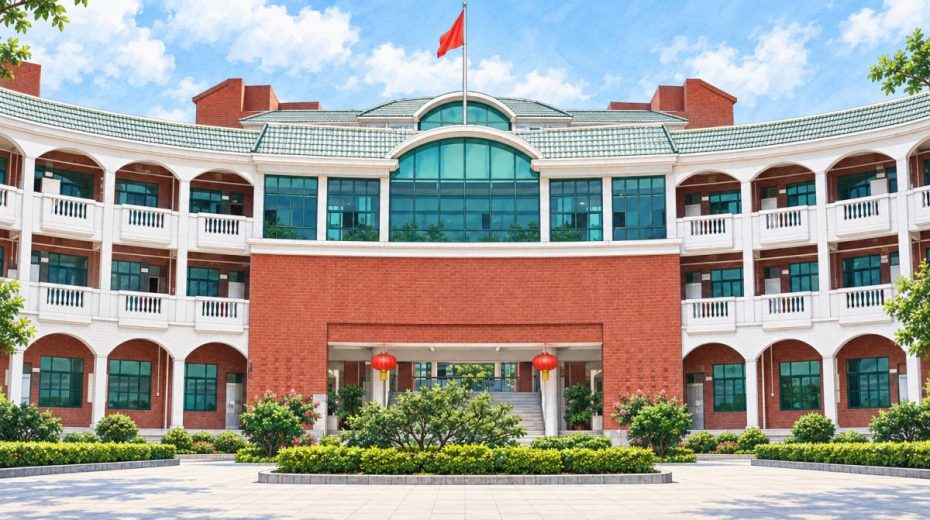
What insights does Panyu Academy offer regarding Chinese socialism?
On my recent journey to China, I visited the historic Panyu Academy located in Guangzhou. This site holds a remarkable image from the Chinese Revolution: in 1926, Mao Zedong led the sixth session of the Peasant Movement Training Institute there, preparing cadres who would later play vital roles in the revolution. The academy’s origin is notably significant, as it was originally established as a Confucian school in 1370 under the Ming Dynasty, dedicated to classical Chinese education.
The fact that Marxist revolutionaries received training within an institution rooted in Confucian tradition is more than a mere architectural curiosity. It sheds light on a key aspect of China’s historical journey: Marxism was adapted rather than simply implanted as a fixed ideology.
During the 1920s, Communists and Nationalists cooperated within the framework of the First United Front. Individual Communists joined the Kuomintang while preserving their party’s organization. Among them was Mao, who in 1926 took charge of the Peasant Movement Training Institute housed at Panyu Academy. At its sixth session, hundreds of students studied peasant movement theory and organization alongside military tactics.
This collaboration was driven by overlapping political goals shared by both parties. The Kuomintang and the Chinese Communist Party aimed to mobilize the masses, combat regional warlords, and establish a new political order. Sun Yat-sen’s alliance with the Soviet Union played a crucial role in fostering this cooperation. However, after Sun’s passing in 1925, growing frictions led Chiang Kai-shek to violently sever ties with the Communists in 1927.
An ironic historical twist is that by the time the alliance collapsed, the Communist Party had amassed sufficient political, military, and organizational expertise to form its own armed forces. The 1927 uprisings and the foundation of Communist rural bases marked the emergence of the Red Army, which eventually embarked on the Long March starting in 1934.
From this, an initial insight emerges about socialism with Chinese characteristics. China’s path did not consist of a mechanical transplant of a foreign ideology. Instead, Marxism was interpreted through the country’s unique social, historical, and cultural lens. Panyu Academy itself symbolizes this dynamic adaptation—as a venerable intellectual tradition did not simply vanish upon the arrival of revolutionary ideology.
This does not imply an unbroken harmony between Confucianism and Communism. On the contrary, they clashed sharply throughout numerous political campaigns during the twentieth century. Yet, the essential takeaway is that China’s historical experience revealed a remarkable ability to integrate aspects of its national heritage into the shaping of a new ideology and state.
The second important point is pragmatic. Significant revolutionary movements rely on material realities for survival. The Chinese Communist Party’s early history was not one of isolated resistance under constant repression. Instead, it functioned legally within a political alliance, gaining access to resources and institutions through cooperation with the Kuomintang. Notably, the Peasant Movement Training Institute was financed by the Nationalist Party but administered by Communist leaders.
This context helps clarify certain modern phenomena. Many groups outside China that identify as Maoist tend to focus largely on adopting revolutionary symbols and language, without displaying a comparable commitment to understanding the practical and national logic that fueled the Chinese revolution.
During my discussions, a Chinese interlocutor aptly summarized this perspective: China did not merely accept Communism as a finished ideology; it harnessed Marxism as an analytical framework and, based on its specific conditions, crafted a distinct synthesis.
Perhaps this presents a crucial challenge for international followers of Maoism—not how to replicate China’s journey, but why they rarely endeavor to emulate the Chinese revolutionaries in adapting a foreign doctrine to fit their own historical, social, and cultural realities.
About the Author