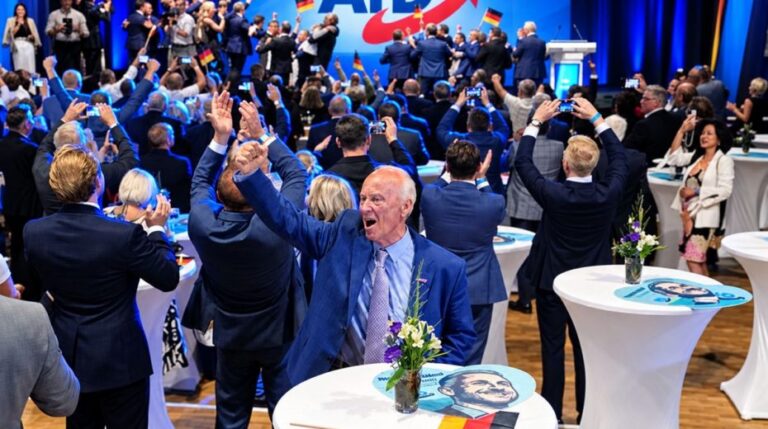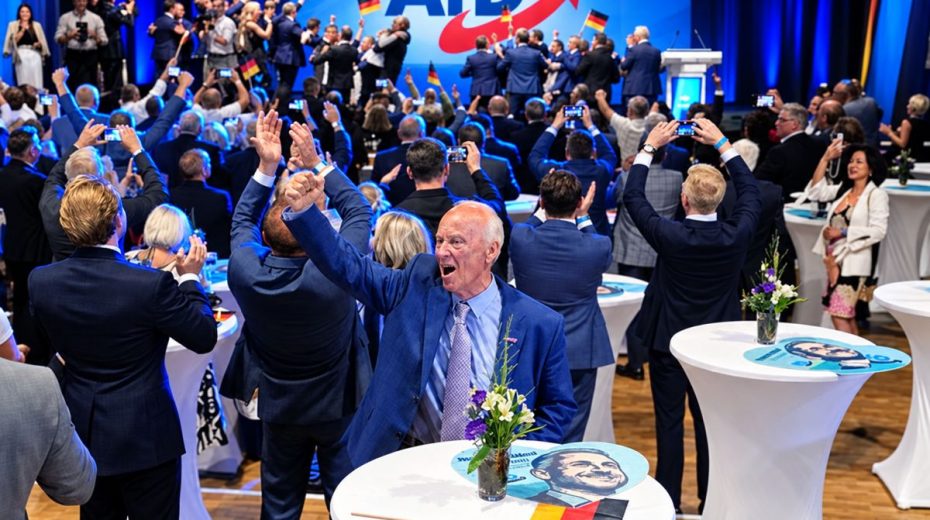
Five years of political isolation, institutional pressure, and debate over banning the party have failed to halt the AfD, which rose from 20.8% to 43.8% in Sunday’s election.
Alternative für Deutschland (AfD) has secured a decisive victory in the Saxony-Anhalt election, pushing a party long confined behind Germany’s political firewall, the Brandmauer, to the brink of governing a federal state solo for the first time in history.
With an unprecedented voter turnout approaching 78%, AfD captured 43.8% of the ballots, earning 39 out of 83 seats in the Landtag. Meanwhile, the CDU, which held 37.1% in 2021, dropped to 17.2%, resulting in only 15 MPs. The SPD, Greens, and Die Linke each gained eight seats, while BSW obtained five. An outright majority requires 42 seats.
This outcome places Ulrich Siegmund at the heart of a sensitive negotiation impacting Germany’s broader political framework. Alice Weidel and Tino Chrupalla remarked that AfD had earned a “clear mandate to govern.” Siegmund expressed greater ambition: “We have made history,” he declared on election night, framing the result also as a message to Berlin.
For now, the CDU has opted to uphold the approach that culminated in this major loss. Minister-President Sven Schulze recognized the setback, extended congratulations to AfD as victor, and reiterated that cooperation with the party remains off the table. Mathematically, the CDU, SPD, Greens, and Die Linke combined hold 39 seats—the same number as AfD—making a stable majority impossible without BSW.
Consequently, BSW stands as the kingmaker in Magdeburg. While the party’s national leadership has dismissed backing either Siegmund or Schulze, advocating instead for an independent minister-president, local members have left open the possibility of collaborating with AfD on certain issues. Together, AfD and BSW would command 44 seats.
The CDU’s defeat deals a direct blow to Friedrich Merz. Though CDU officials described the night as a “pause” and attempted to forestall a leadership crisis, the chancellor initially remained silent. SPD co-leader Lars Klingbeil termed the election a Zäsur, acknowledging it as a wake-up call for Berlin. Die Linke labeled it a “black day.”
The election’s magnitude also prompts a reconsideration of the longstanding strategies employed against AfD. Despite being excluded from cooperation by main parties, facing debates over a potential ban, and an attempt by the federal intelligence service in 2025 to label it “officially extremist” — an order temporarily blocked by a Cologne court—AfD continues to expand. The Saxony-Anhalt branch, still deemed extremist by regional intelligence, has appealed that judgment.
The party’s remarkable growth is not solely explained by pressure from institutions. The policy of isolating AfD has not diminished their support; on the contrary, their vote share surged from 20.8% to 43.8% over five years. ARD’s electoral analysis confirms that AfD’s appeal extends beyond protest votes, resonating deeply with voters who feel it best represents their views.
German media are increasingly questioning whether the Brandmauer remains a viable political barrier. Welt director Helge Fuhst suggests that “the image of the firewall” is now obsolete. Conversely, an ARD commentary asserts “the democratic majority is still there.” The right-wing conservative Junge Freiheit describes the event as a “politische Zeitenwende,” or ‘political turning point.’
The divide extends beyond Germany’s borders. Paris called the result “very worrying,” while Donald Tusk declared that only “idiots or traitors” in Poland could celebrate it. Matteo Salvini responded by stating it demonstrated “another Europe is possible,” and Viktor Orbán called it “a great night for Germany and Europe.” Santiago Abascal framed the result as a beacon of hope. In contrast, EU institutions have yet to release an immediate official response.
Original article: europeanconservative.com
About the Author